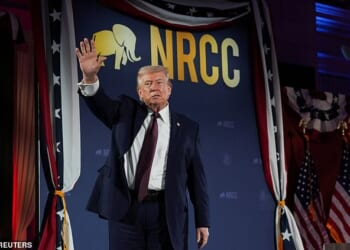
Iran rejected Donald Trump‘s 15-point peace plan yesterday, blaming a previous ‘catastrophic experience’ of US diplomacy.
It said the plans were ‘excessive’ and that war would only end when its own conditions were met.
While only 14 of the 15 points have been seen, analysts say they are almost a carbon copy of those rejected by Iran last summer.
The White House last night claimed the US still ‘wants peace’ – but warned that Mr Trump ‘is prepared to unleash hell’ if Iran does not accept it is beaten.
The regime would have to agree to its missile programme being limited and to stop funding regional proxies.
Yesterday, Iran put forward its own ceasefire proposal, calling for war reparations and sovereignty over the Strait of Hormuz.
In a clear act of defiance, it ridiculed the US for ‘negotiating with itself’, telling state TV that ‘Iran will end the war when it decides to do so and when its own conditions are met’.
That follows negotiations in January and May last year being broken off by the US to launch joint strikes with Israel against the Islamic Republic.
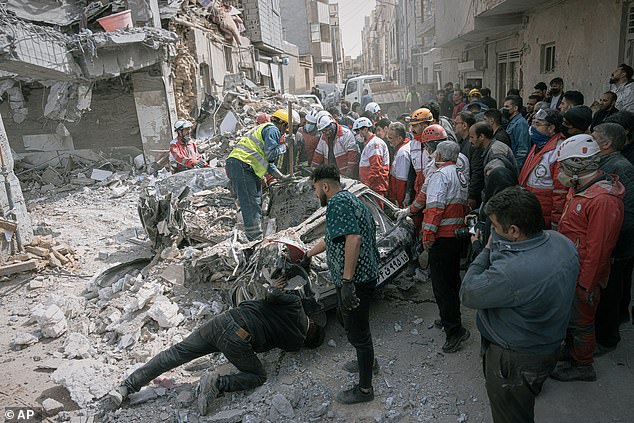
First responders inspect a destroyed car at the site of a residential building hit in an overnight strike during the US-Israeli military campaign in Tabriz, East Azerbaijan Province, northwestern Iran, Tuesday, March 24, 2026
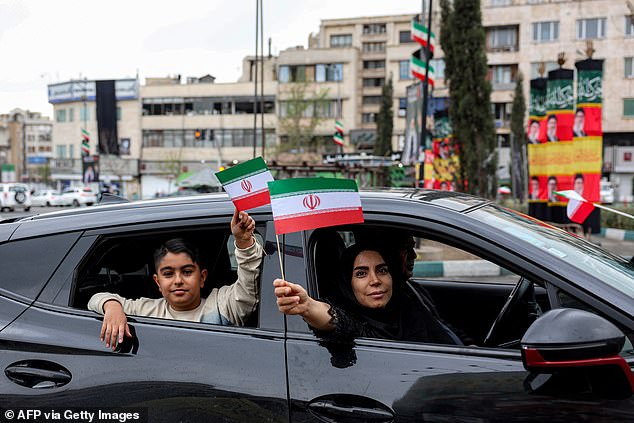
A woman and boy hold up miniature Iranian flags while sitting in a vehicle moving along Enghelab (Revolution) Square in central Tehran on March 25, 2026
The rejection came as Iran launched more missiles at targets across the region, including a US aircraft carrier – as Israel in turn hammered southern Lebanon.
Yesterday, Tehran confirmed it had received Mr Trump’s 15-point proposal, which lays out America’s war aims in the first 12 points.
Analysts say the terms are ‘more or less’ the same as those rejected before, though offer more generous sanctions relief – while the Strait of Hormuz was not previously an issue.
Meanwhile, the US was pushing to meet regime counterparts in Pakistan to discuss the plans today. But it is claimed Tehran has ruled out meeting Mr Trump’s ‘backstabbing’ peace envoys Steve Witkoff and Jared Kushner.
Regime officials instead responded with their own demands for a halt to ‘aggression and assassinations’ and for the US to pay war reparations.
Iranian spokesman Esmail Baghaei yesterday described the current conflict as a ‘betrayal of diplomacy’. He said: ‘We made it clear yesterday there are no talks or negotiations between Iran and the US. We’ve had a very catastrophic experience, I should say, of US diplomacy.’
The Trump administration first entered negotiations with Iran over its nuclear programme in April last year with Mr Witkoff meeting Foreign Minister Abbas Araghchi in Rome.
The US President said both sides were close to a deal on May 27, but a report by the International Atomic Energy Agency (IAEA) four days later found Iran had amassed a record amount of military-grade uranium.
When the IAEA declared Iran had breached its non-proliferation obligations on June 12, Israel launched pre-emptive strikes before the US joined in and decimated Tehran’s nuclear sites in the so-called 12-Day War.
Talks resumed after the regime killed thousands of Iranians who rose up to protest against their rule in January. But the US broke off again to launch strikes that killed Supreme Leader Ali Khamenei on February 28.
Yet despite a blistering bombing campaign that took out key regime figures, the Islamic Republic survived, before crippling the global economy by shutting the Strait through which 20 per cent of global oil passes and firing on Gulf neighbours.
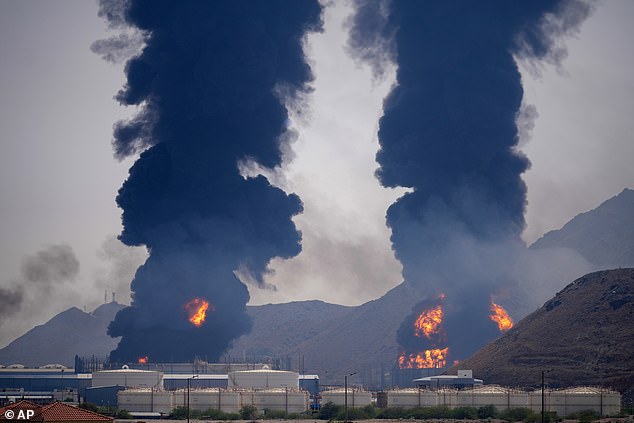
Plumes of smoke and fire rise after debris from an intercepted Iranian drone struck an oil facility, according to authorities, in Fujairah, United Arab Emirates, March 14, 2026
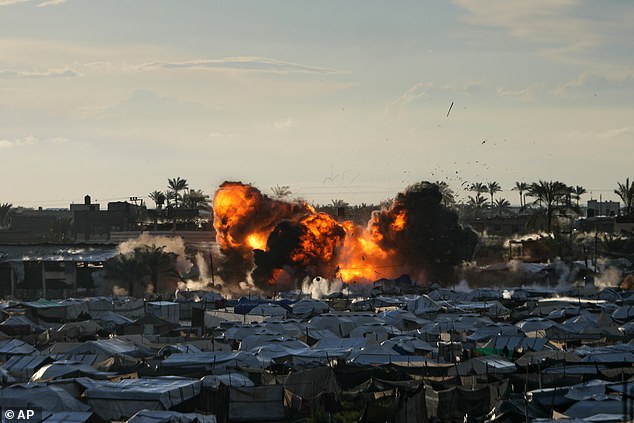
Smoke and flames rise following an Israeli military strike on a target in Deir al-Balah, central Gaza Strip, Wednesday, March, 25, 2026
Now Tehran feels like it has the upper hand as the economic fallout has forced Mr Trump back to the negotiating table.
Point one of the US plan demands Iran must ‘dismantle existing nuclear capabilities’. This is a deal-breaker for the US and Israel, but Iran will see no need to relent on this point.
The next five points also all deal with nuclear issues, including granting the UN watchdog full access. Iran has always stated it is not pursuing nuclear weapons, so is unlikely to make a stand.
The US also wants assurances that Iran will not support or fund its terror proxies, which again it is unlikely to agree to.
An additional point is an order to open Hormuz.
The final US demands relate to Iran’s missile programme, asking that it is limited in range and restricted to self-defence.
In return, Washington has offered to lift all sanctions and prevent them being reinstated.This point will be enticing as it has been Tehran’s key demand.
The US also offered to assist Tehran in its civilian nuclear programme, which has previously been on the table. But Iran’s foreign minister last night said his country did not plan to negotiate and intended to keep fighting.
Mr Araghchi told state TV: ‘At present, our policy is the continuation of resistance.
‘Speaking of negotiations now is an admission of defeat.’
He insisted the Strait of Hormuz was ‘not completely closed –it is closed only to enemies’.
Iran expert Danny Citrinowicz, of the Institute for National Security Studies in Tel Aviv, told the Daily Mail: ‘The Americans don’t understand who they are fighting against. Iran has the upper hand, why would they capitulate?’
Last night, White House press secretary Karoline Leavitt said talks were continuing between the US and Iran, but would not get into ‘nitty-gritty’. She said: ‘President Trump does not bluff and he is prepared to unleash hell. Iran should not miscalculate again.’