Artificial intelligence is perverting the logic of our economic and political systems
Imagine waking up one morning to discover your job still exists, but your services are no longer required. The work is being done, just not by you, not by anybody. Somewhere, a machine is doing it faster, cheaper and without complaint. Your employer has not gone bust. The economy has not collapsed. In fact, everything is more efficient than ever. You are simply no longer needed, and a machine wrote the email to tell you so.
Capitalism has always rested on a simple bargain: I work, I get paid, I live. Break that bargain, and the system does not bend; it starts to unravel. For two and a half centuries, that exchange has survived steam, electricity and the microchip. Each time, prophets declared the end of work; each time, work returned wearing a different collar. But the approaching wave of artificial minds is not another gadget. It is the first technology that can do what we do, only better, faster and relentlessly. When the marginal cost of an hour of intelligence falls towards the price of a few watts of electricity, the wage contract that underwrites every market from Aberdeen to Auckland begins to look antiquated as the horse drawn cart, except you can still find a practical use for one of those.
I confess I feel a tremor of heresy writing this. I have spent my adult life believing in the miracle of prices, the efficiency of profit motives and the dignity of earning one’s keep. Yet the arithmetic is indifferent to belief. In 2023, Anthropic’s chief executive Dario Amodei warned that AI could eliminate half of all entry-level white-collar jobs within five years. This is not distant speculation. It is close to the stated ambition of the companies building these systems: to create artificial general intelligence that outperforms humans at most economically valuable work.
Consider the ledger of economic activity a decade from now. Every task that once required human hands or minds — growing food, writing code, diagnosing illness, even greeting guests with a trained smile — can be performed by machines at a fraction of the cost. The price of human effort remains tied to mortgages and grocery bills, while the price of digital labour falls towards the cost of electricity. In that contest, flesh and blood cannot compete with code and actuators.
It is tempting to dismiss all of this as far-fetched — to see AI as little more than Google on steroids. That would be a mistake. Even in its current, early form, it is already beginning to replace real work. In my own business, an administrative role has been replaced by an AI agent, and a bookkeeping role will follow when the next vacancy arises. This is not a distant prospect. It is happening now, while the technology is still in its infancy.
Unlike previous technological revolutions, AI is not merely automating muscle or routine clerical work. It is beginning to rival human intelligence across the whole spectrum of economically valuable activity. Modern models can already pass professional exams, write code, generate art and drive vehicles. Give them embodied form and the factory, the office, the call centre and the lecture hall begin to empty at once.
This presents capitalism with an existential paradox. AI promises to deliver what capitalism has always pursued: maximum efficiency, lower costs, higher productivity. But it does so by removing the very thing the system depends on — human wages.
If a large share of jobs disappears, so too does the income that sustains demand. Who, then, buys the products? Who keeps the system turning? The engines of capitalism will stall precisely when they should be accelerating. A system built on mass consumption cannot survive if the masses no longer have wages.
The same technology that destroys existing jobs also competes directly with any new ones
The usual reassurance is that new forms of work will appear, as they always have. Perhaps we will all become artisan cheesemakers, therapists, or therapists for artisan cheesemakers. But this time the pattern breaks. The same technology that destroys existing jobs also competes directly with any new ones. Therapy itself can be delivered by an avatar that remembers every sigh since nursery school. There is no obvious new frontier of human labour left untouched.
Only then does the full economic consequence become clear. If machines perform most work, and labour and energy both trend towards near-zero cost, then prices begin to collapse. A nuclear reactor built by robots, maintained by drones and optimised by algorithms could deliver electricity for next to nothing. Vertical farms tended by machines that work 18 hours a day, 7 days a week could outproduce today’s best land with a fraction of the inputs. When a refrigerator can be printed, delivered and installed for little more than raw materials and energy, the cash register starts to look like a museum piece.
What comes after may, in theory, be better. This is the part many people struggle to imagine, because all our political languages were built for a world in which human labour remained central. Capitalism assumes scarcity, wages and mass consumption. Socialism assumes human production and political conflict over how its proceeds should be divided. AI unsettles both assumptions at once. If machines can produce abundance with minimal human input, then neither the free market nor the planned state, in their inherited forms, fully explains the world ahead.
There may be some future system beyond both, a post-labour settlement for which we do not yet have a name. It may borrow from markets, public ownership, common governance, citizen dividends and new forms of distributed control. It may look, in places, familiar. But in the end, it will belong to a category we have not yet learned to describe. From inside a wage-based civilisation, it is hard to see clearly what a post wage one would look like.
In its more optimistic form, such a system could be genuinely liberating. If machines produce most goods and services, human beings could be freed from drudgery rather than merely displaced by it. Work would no longer be the condition of survival. The great economic question would cease to be how to force everyone into productivity and become instead how to distribute abundance without destroying freedom, dignity or social order. That is at least a conceivable future. But even if it is possible, it is not around the corner.
Between the age of wages and any age of abundance lies a very dangerous transition. Whole sectors will shrink or disappear long before a new settlement emerges. Regions built around old forms of work will hollow out. Millions may find themselves economically redundant before they are politically protected, socially valued or materially secure. Populists will promise to ban the machines. Utopians will promise that the machines will solve everything. Both will be wrong. The immediate challenge is not to design the final paradise. It is to get through the transition without social collapse.
If ownership of productive AI concentrates in a handful of mega-companies, we do not simply get inequality
And that is where the darker possibility enters. When old systems weaken before new ones are understood, power tends to concentrate in the simplest available form: ownership. If no coherent successor emerges, the vacuum will not remain empty. It will be filled by those who own the infrastructure of intelligence.
This is the real nightmare. If ownership of productive AI concentrates in a handful of mega-companies, we do not simply get inequality. We get something closer to digital feudalism: a world in which access to the means of existence depends on your relationship to those who own the machines. Not the smokestacks of Manchester, but the server farms of Nevada; not land, but code. A society in which most people are economically unnecessary is not a market order in any meaningful sense. It is dependency administered by software.
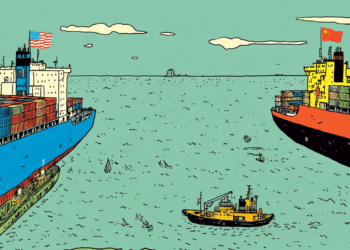
But the concentration may not stop at companies. It is also concentrating geographically thanks to Europe’s high electricity prices. If the most powerful AI systems — and the infrastructure that runs them — are built and controlled primarily in the United States and China, then those two economies begin to do a disproportionate share of the world’s productive work. Intelligence becomes an export, but not in the traditional sense. It does not create jobs abroad; it replaces them. What, then, happens to everyone else?
Countries that once relied on manufacturing, services or even high-skill professional work may find those sectors hollowed out, not by domestic failure but by remote competition from machines they do not own. The global division of labour begins to collapse into a global concentration of production. Instead of trade between nations, we become vassal states dependent on those who control the systems that produce everything.
And here is the part that ought to worry us most: our leaders are barely speaking about it, let alone preparing for it. The public conversation remains trapped in older arguments — productivity, growth, inflation, training, industrial strategy — as though the challenge were simply one more technological disruption to be absorbed by existing institutions. It’s highly unlikely that will be the case. If AI is capable of making large parts of human labour permanently uneconomic, then the task is not merely to retrain workers or subsidise innovation. It is to rethink the foundations of the social contract before events do it for us.
Very little of that is happening. We are not seriously debating how the gains from machine productivity will be distributed. We are not building institutions capable of preventing extreme concentration of technological power. We are not preparing portable systems of security for a world in which stable employment may no longer be the norm. We are not even speaking honestly about the scale of what may be coming. Our leaders oscillate between boosterism and complacency while focussing on the latest issue in the headlines this week. We are sleepwalking into oblivion. The AI apocalypse will not come from a rise of the machines, but from a complacency to prepare.
None of this is comfortable reading for a free market disciple. It offers neither the reassurance that markets will automatically adapt nor the consolation of a neat socialist inheritance. But the alternative to facing the problem is not the defence of capitalism. It is its slow suicide. If we cling to a model of labour and reward that no longer matches economic reality, we will not preserve the old order. We will merely drift into a harsher one.
The real question, then, is not whether capitalism survives in its current form. It is whether what follows preserves anything we would recognise as a free society. Perhaps there is a better post-labour settlement ahead, one capable of combining abundance with liberty. Perhaps. But if we do nothing, the more likely outcome is a world in which machine power accumulates faster than political wisdom, and ownership hardens into destiny.
The machines are not merely changing what we do. They are changing what the system is.