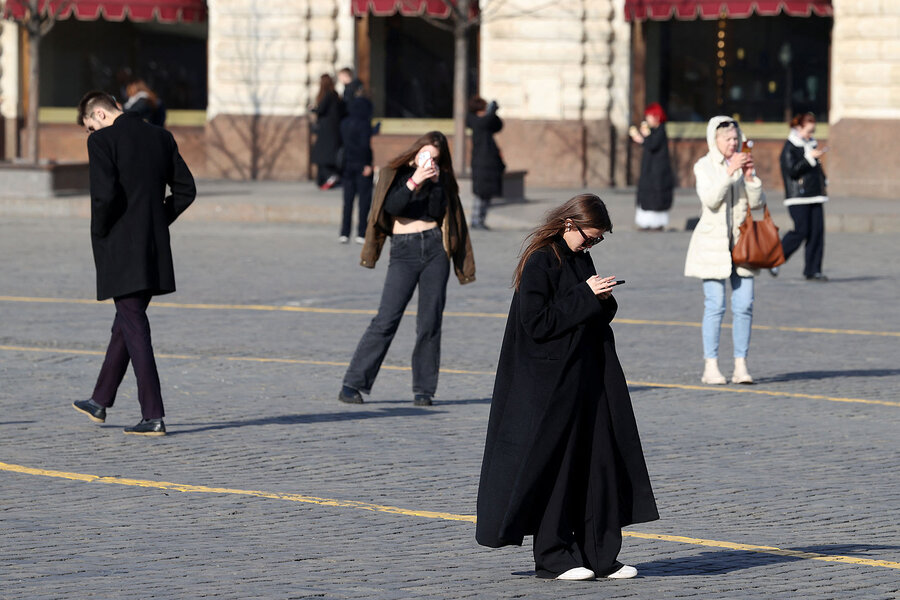
Residents of Moscow have long been familiar with war-related GPS spoofing, particularly downtown, where it forces drivers to reach for paper maps when their mobile phone navigator goes haywire.
The spoofing is engineered by security forces to prevent attacking Ukrainian drones from utilizing local signals to aid their targeting, and many Muscovites seem to accept it with a shrug.
But in recent weeks, they have been hit by a wave of orchestrated internet and mobile phone disruptions, creating digital mayhem in some quarters. In addition, the government seems to be “throttling” – or deliberately slowing down – WhatsApp and Telegram, Russia’s most widely used messaging apps, which the government wants to replace with a Russian-developed super-app called Max.
Why We Wrote This
The Kremlin has had a testy relationship with online messaging services in recent years. Now, it seems to be moving to shut them out of Russia completely in favor of one approved super-app – potentially upending the online lives of many Russians.
“It’s very irritating, but what can we do?” says Natalya, a Moscow office worker who asked that her last name not be used for privacy reasons. “I once thought of getting rid of my landline, and I’m so glad I didn’t. Maybe we’re going to have to fall back on those phones.”
Officials hint that it is part of a shadowy electronic war with Ukrainian enemies. But some analysts worry it’s a dress rehearsal for a plan to corral the country’s formerly open digital space and expel foreign influences.
Internet interference
Russia has long planned to establish a “sovereign internet” that can stand alone, relying on only Russian resources, says Sarkis Darbinyan, a cyberlawyer with RKS Global, a Russia-focused digital rights group. “The idea is that if the global West splits off Russia from the internet, then Russian authorities have the complete infrastructure and methods in place to keep a self-sufficient Russian internet working,” he says.
Authorities have made little effort to explain the current flurry of disruptive measures, which are apparently countrywide. In Moscow, they have affected many local businesses and have sometimes left people unable to book a taxi, pay with a bank card, or even make a phone call. The outages are so far localized and temporary, but unpredictable. In a report about the situation, the daily newspaper Izvestia quoted one Muscovite as saying, “The internet doesn’t work on one street, but it does on the next one.”
Asked about the problems, Kremlin spokesperson Dmitry Peskov said something might be done to compensate businesses that experience losses due to internet disruptions, but otherwise, “Citizens should have no doubt that the main goal is to ensure security.” He added that the Ukrainians are using increasingly sophisticated means of electronic warfare against Russia, requiring the use of “technological retaliatory measures.”

Some analysts suggest that authorities might be preparing for a near-complete shutdown of the internet, perhaps to be implemented in a time of emergency, that would keep about 900 core Russian websites working normally. A “whitelist” of these sites was published this month, and it includes most basic services and approved media and social media platforms, as well as government operations.
This is the first time most Russians, especially people in Moscow, have been seriously hit by an internet crackdown, which authorities suggest is related to the war in Ukraine. Lev Gudkov, a director at the Levada Center, Russia’s only independent public opinion agency, says that large numbers of urban people, and many key businesses, have come to depend on the internet as part of daily life.
“Young people, up to 50 years old, are heavily connected to social nets, engage in information search, online shopping, even such a simple thing as ordering a taxi. Of course, this internet interference is affecting them.”
Russia’s media regulator, Roskomnadzor, has been pruning the internet for years in an effort to make social media obey increasingly strict national security laws. Foreign-based platforms like Facebook, LinkedIn, and X were blocked for refusing to house their data for Russian users on servers in Russia. Now, the agency is throttling Telegram, WhatsApp, and other foreign-based messaging apps, making them largely unusable for the more than half of Russian internet users who don’t engage a virtual private network (VPN). There are also rumors that Telegram will be completely shut down on April 1.
“There is a bureaucratic battle over this. Many state agencies, and lots of officials, use Telegram in their work. Soldiers in the [war in Ukraine] depend on it for communication,” says Anton Merkurov, an independent media expert. “But the security services say these apps are used by terrorists, fraudsters, and other enemies. The Kremlin sees them as organizing tools for protesters, and conduits for dissent.”
So far, he adds, “those who want to block Telegram are winning.”
“Max is not doing well”
About half of Russians currently use a VPN, says Mr. Darbinyan, and the effect of these measures will probably be to increase the use of VPNs. So far, a working VPN enables a user to bypass most of the internet interference and access foreign websites and apps with ease.
“People are not ready to go into the streets,” he says. “But use of VPNs is an act of protest in itself. At least it shows that people are still hungry for information.”
Though VPNs are not strictly illegal in Russia, the government has been trying to restrict their use by removing them from app stores and using new technology to detect and block common VPN protocols.
There seems little enthusiasm for Max, despite the fact that it performs all the functions of the other platforms that are under attack, integrates with government services and leading Russian banks, and comes preinstalled on all new digital devices sold in Russia.
Statistics suggest that as of early 2026, Telegram was the most popular messaging app in Russia, with almost 100 million users. WhatsApp was second, with about 90 million users, while Max trailed with fewer than 75 million. But the strong state-backed promotion of Max, combined with the throttling of its competitors, makes it likely that this picture will change.
“Max is not doing well. It has a lot of bugs,” says Mr. Merkurov. “People don’t want to use it. They know that what comes from the government is never good.”
Roskomnadzor tried to take down Telegram once before, in 2018. But its efforts to block the app created massive collateral damage for Russian businesses and internet users, and the government was forced to back off. This time, it is employing even more disruptive methods, but seems likely to succeed.
A major difference is the ongoing war, which enables the government to cite national security to justify harsh measures, says Alexander Verkhovsky, director of the Sova Center in Moscow, which monitors trends in political speech.
“Most things we call repressive these days are related to the war, directly or indirectly,” he says. “It doesn’t mean that when the war ends, things will return to what they were. So many new laws and regulations have been passed, so many new facts created, and we will probably be living in this new reality for a long time.”