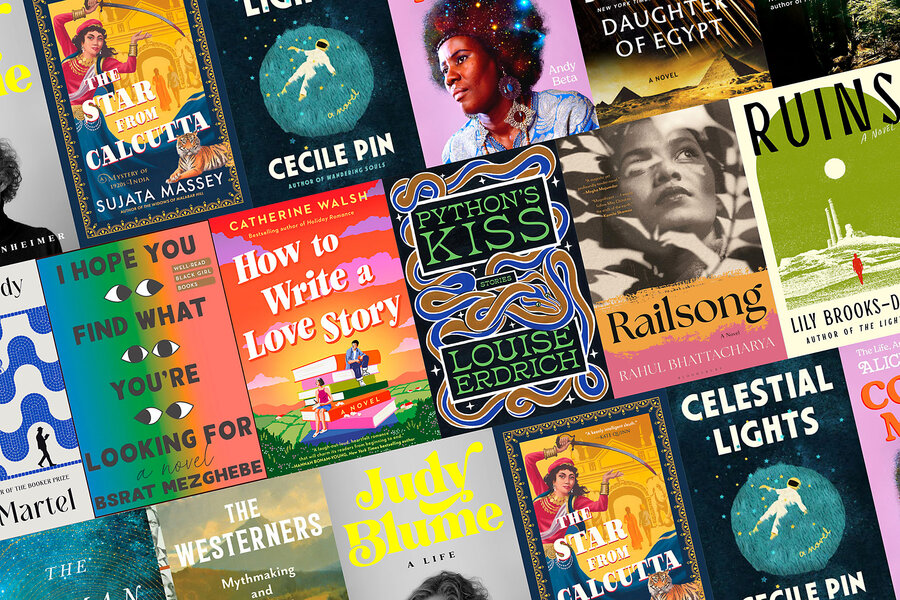
These are the fiction titles our reviewers liked best this month.
Son of Nobody, by Yann Martel
“Life of Pi” author Yann Martel again flexes his extraordinary imagination in this latest novel. A Canadian classicist, stalled on his dissertation about Homer’s “Iliad,” leaves his wife and young daughter (named Helen, of course) for a yearlong fellowship at Oxford. The scholar, Harlow Donne, becomes obsessed by fragments of Greek text on scraps of shredded parchment, which he patches together to create an inventive account of the Trojan War from the perspective not of gods or nobility but of commoners, including a “son of nobody” named Psoas. The pages of Martel’s novel are split horizontally. There’s the so-called lost epic, which Harlow dubs “The Psoad,” on the upper half, and his highly personal commentary below, which links the horror and insensibility of war with the tragic loss of his marriage and young daughter. “Son of Nobody” joins other brilliant novels involving deranged scholars, including Vladimir Nabokov’s “Pale Fire.” – Heller McAlpin
Why We Wrote This
Our reviewers’ March picks travel the globe and beyond, from stories about women in India blazing new trails and Eritrean immigrants following their dreams to an astronaut winging his way to Europa.
Python’s Kiss, by Louise Erdrich
Award-winning author Louise Erdrich follows up “The Mighty Red” with a new collection of short stories teeming with snakes and cats, travelers and troubadours, survivors and secrets. While the speculative fiction wobbles, most of the stories grab and hold. “The Hollow Children,” a haunting chronicle of a bus driver piloting his morning pickup of schoolchildren through a blizzard, and “Amelia,” about the friendship between an antsy teenage girl and the stylish customer who frequents the local KFC during her shifts, are standouts. – Erin Douglass
I Hope You Find What You’re Looking For, by Bsrat Mezghebe
In her winning debut novel, Bsrat Mezghebe aims a compassionate eye and skilled pen on the tight-knit Eritrean community in Washington, D.C. Central to the tale are 12-year-old bookworm Lydia; her former freedom fighter mom, Elsa; their generous injera-making neighbor Zewdi; and a newly arrived cousin with big thoughts of his own. As the storytelling shifts between Washington in 1991 and Elsa’s rebel days in Eritrea 15 years earlier, each character grapples with family, purpose, and the pursuit of ideals. – Erin Douglass
The Woman and Her Stars, by Penny Haw
In Georgian-era England, Caroline Herschel is rescued from a life of servitude by her devoted brother, William, and ushered into London’s music scene. Her heavenly voice gives her a sense of purpose. When William becomes the king’s astronomer, Caroline assists him, and then determinedly becomes the first woman to discover a comet. This charming historical novel, based on Herschel’s true story, shines brightly with memorable characters, and an inspiring leading lady realizing her worth. – Stefanie Milligan
How To Write a Love Story, by Catherine Walsh
As Ciara Sheridan struggles to write the final volume of her late father’s bestselling fantasy series, Sam, her dad’s New York-based editor, travels to Ireland to lend support. So much rides on this volume. The two clash, but soon discover they share more than a love of her father’s work. Catherine Walsh writes a delightful, believable rom-com tailor-made for book lovers. – Joan Gaylord
The Shock of the Light, by Lori Inglis Hall
This World War II novel centers on close-knit British twins, Tessa and Theo. Recruited by the Royal Air Force, Theo returns home after the war realizing his sister, one of 39 Special Operations Executive women spies, is still missing. Theo devotes himself to finding her. Lori Inglis Hall’s thoroughly researched, well-plotted book channels the heartbreak and humanity of wartime, its aftermath, and love’s redeeming power. – Stefanie Milligan
The Star From Calcutta, by Sujata Massey
Bombay’s sole female solicitor, Perveen Mistry, faces a new case in Sujata Massey’s latest 1920s whodunit. As monsoon season drags on, ever-curious Perveen must investigate the death of a British film censor in the wee hours of a glitzy party stuffed with stars, investors, and suspicious hangers-on. There are twists, turns, and jolts of action; still, the unrushed storytelling gives the city’s vivid landmarks – from Chowpatty Beach to Malabar Hill – time to glow. – Erin Douglass
Daughter of Egypt, by Marie Benedict
This gorgeous, suspenseful novel celebrates two captivating women. In 1920s Egypt, Lady Evelyn Herbert; her father, Lord Carnarvon; and archaeologist Howard Carter search for boy Pharaoh Tutankhamun’s treasure-filled tomb. Three thousand years ago, Egypt’s most successful woman pharaoh, Hatshepsut, disappeared, and signs of her reign were mysteriously erased. The 20th-century tomb-seeking trio add Hatshepsut to their dangerous excavating adventures. – Stefanie Milligan
Ruins, by Lily Brooks-Dalton
Ember lives 3,000 years in the future, post “Crisis” era, working as an academic in archaeology. When the opportunity finally comes to pursue her foundering research’s central questions about pre-Crisis peoples, she jumps, dropping everything to lead the expedition into uncharted waters. Thought-provoking, exciting, and sometimes ugh-inducing (Ember is one selfish protagonist), the story captivates. – Erin Douglass
Celestial Lights, by Cecile Pin
Cecile Pin’s beautiful and profound novel tells the story of a boy born on the day the Challenger space shuttle exploded and fell into the sea. He grows up to become a legendary astronaut sent by a visionary billionaire on a 10-year mission to the distant moon Europa. As he leaves his cherished wife and son, Ollie examines his life choices in poignant flashbacks. – Stefanie Milligan
Railsong, by Rahul Bhattacharya
Rahul Bhattacharya’s generous storytelling captures the coming-of-age of Charu Chitol, a railwayman’s daughter in newly independent India. Charu dreams of escaping poverty, domesticity, and patriarchal society for modern life in Bombay, and hopes to marry for love. Amid a country undergoing change, Charu forges her future with optimism. – Stefanie Milligan
These are the nonfiction titles our reviewers liked best this month.
Judy Blume: A Life, by Mark Oppenheimer
Mark Oppenheimer’s affectionate biography traces the beloved author’s life and work in exhaustive and illuminating detail. Written with its subject’s cooperation, the book offers insight into how Judy Blume’s background and experiences provided raw material for her classic young-adult novels, including “Are You There God? It’s Me, Margaret” and “Starring Sally J. Freedman as Herself.” – Barbara Spindel
Cosmic Music, by Andy Beta
The life of jazz virtuoso Alice Coltrane has often been overlooked in favor of her husband, the late John Coltrane, one of the most influential figures in jazz. But in Andy Beta’s comprehensive biography, readers get to know the groundbreaking musician as she finds both musical and spiritual transformation. – Mackenzie Farkus
The Westerners, by Megan Kate Nelson
Historian Megan Kate Nelson’s compelling narrative offers an expansive and eye-opening view of the 19th-century American West. Through the stories of fascinating but little-known people in the region, she demonstrates that white women and Indigenous, Black, Mexican, and Asian women and men were as vital to the frontier experience as the white male pioneers of national myth. – Barbara Spindel
When the Forest Breathes, by Suzanne Simard
Suzanne Simard is a paradigm-shifting researcher in forest ecology. Her first book, “Finding the Mother Tree,” argued that trees communicate with one another, share carbon and other resources through mycorrhizal networks underground, and forge cooperative relationships with their own kind as well as with other species in their immediate environment. “When the Forest Breathes” combines personal memoir with descriptions of her scientific investigations. It serves as an impassioned plea for preserving forests and helping them regenerate. – Richard Schiffman