NASA has revealed plans to build a $20billion (£14.9billion) permanent base on the moon.
New chief Jared Isaacman, who joined the agency in December, has announced a ‘focus shift’, prioritising a lunar habitat that allows for ‘long–duration human presence’.
He said NASA will spend the next seven years constructing the station at the moon’s south pole over dozens of missions.
Artist impressions of the base feature futuristic rovers, communication devices, solar panels, habitat modules and launch pads on the moon’s surface.
The station will represent the next step towards ‘achieving the near–impossible’, he said, and will ‘ensure American leadership in space’.
‘There will be an evolutionary path to building humanity’s first permanent surface outpost beyond Earth, and we will take the world along with us,’ Mr Isaacman told a conference at NASA headquarters in Washington.
‘This time the goal is not flags and footprints,’ he added.
‘This time the goal is to stay.’
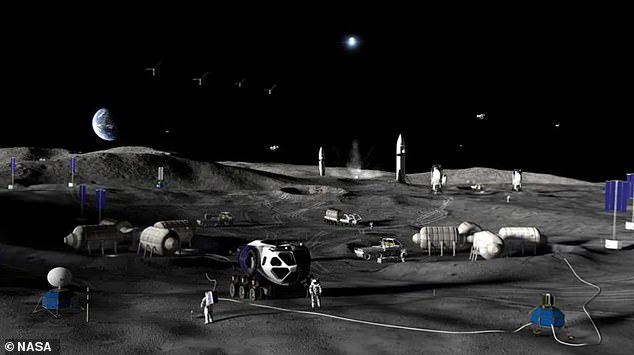
Artist impressions of the moon base feature futuristic rovers, communication devices, solar panels, habitat modules and launch pads on the lunar surface
Building the moon base will take place over three phases, NASA said.
The first involves a shift from infrequent missions to a ‘repeatable’ approach that increases the tempo of lunar activity.
Phase two will see a move towards semi–habitable infrastructure involving rovers and other forms of transportation.
Finally, for phase three, NASA ‘will deliver heavier infrastructure needed for a continuous human foothold on the moon’.
This will include multi–purpose habitats created by the Italian Space Agency and lunar utility vehicles from the Canadian Space Agency.
The ‘habitation module’ will be three metres wide and six metres long (10 feet by 20 feet) with a mass of around 15 tonnes.
It will have wheels, allowing it to be easily moved across the moon’s surface. It is also completely self–sufficient, providing power and heat for inhabitants.
The module has currently been designed to be able to support two astronauts for between seven and 30 days – or a larger crew for short periods in case of an emergency.
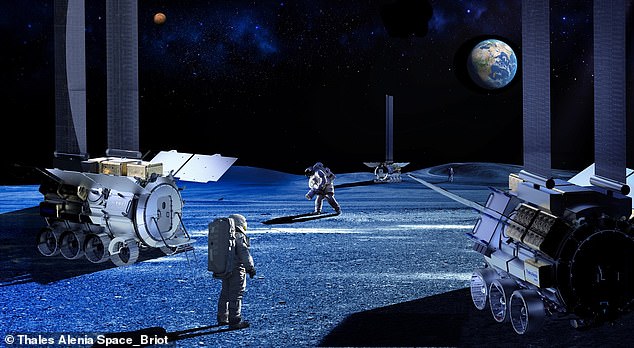
The Italian Space Agency’s habitation module will safely host astronauts during their missions, support surface operations, enable scientific research experiments both with and without the presence of a human crew, and have the capability to move on the surface (artist’s impression)
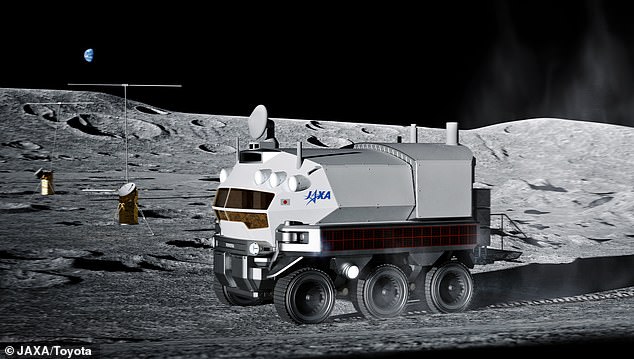
A concept image of a pressurised rover on the surface of the Moon. The rover will boast robotics, cameras, sensors and scientific instruments, acting as a ‘mobile laboratory’ for exploration activities
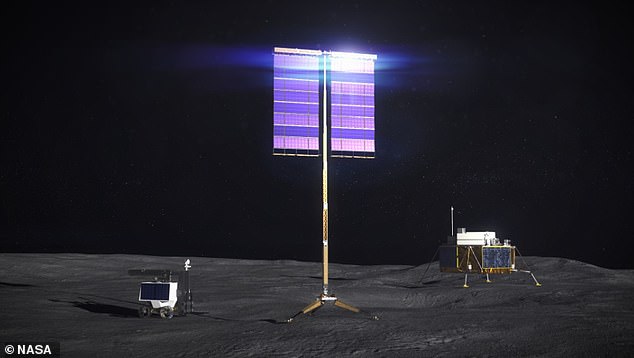
Solar array systems will help power exploration of the Moon. Pictured: An illustration of the device, which can deploy up to 32 feet high
NASA said its moon base plans also include a pressurised rover, which has been designed by the Japan Aerospace Exploration Agency (JAXA).
This is a mobile habitat that can allow astronauts to explore much further than current moonwalks allow, supporting two crew members as it traverses across the lunar surface.
The rover will boast robotics, cameras, sensors and scientific instruments, acting as a ‘mobile laboratory’ for exploration activities.
‘The objective is clear: build the foundation for an enduring lunar base and take the next step towards Mars,’ Mr Isaacman wrote on X.
In a nod to the race against China to build a permanent base on the moon, Mr Isaacman said: ‘The clock is running in this great‑power competition, and success or failure will be measured in months, not years.’
He added that ‘building a base will seem pale in comparison to what we will be capable of accomplishing in the years ahead’.
NASA has also announced that in order to focus on the moon base project, it would be suspending plans to create Lunar Gateway – its lunar orbital space station.
‘The agency intends to pause Gateway in its current form and shift focus to infrastructure that enables sustained surface operations,’ Mr Isaacman said.
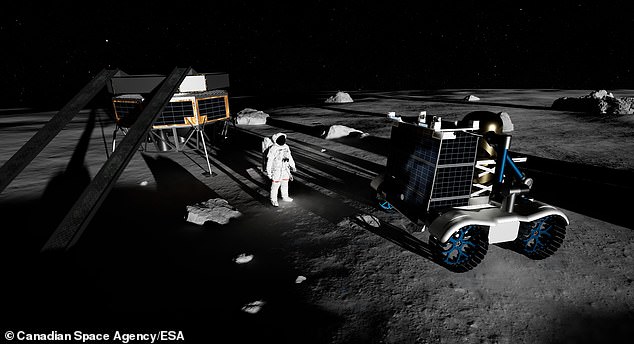
NASA said lunar utility vehicles from the Canadian Space Agency (pictured) will also be needed
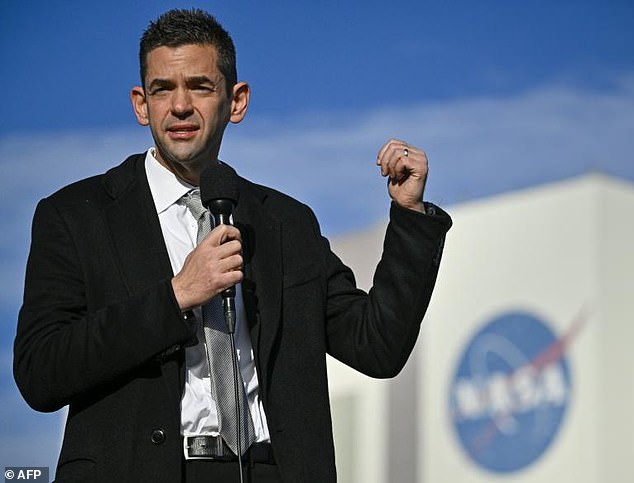
NASA Administrator Jared Isaacman, who joined the agency last year, said focus needs to ‘shift’ towards establishing a permanent base on the moon
The Gateway orbital lunar station was meant to serve both as a point of transfer for astronauts headed to the Moon as well as a platform for research.
The suspension of the initiative isn’t entirely surprising – some had criticised it as financially wasteful or a distraction from other lunar ambitions.
Putting it on hold will allow for the redirection of efforts and resources towards the construction of the base near the strategic south lunar pole, Mr Isaacman explained, which was already a goal.
Last month, NASA said it was reshuffling its Artemis programme that has suffered multiple delays in recent years, as it aims to ensure Americans can return to the Moon’s surface by 2028.
That goal remains unchanged, but the US space agency is shifting its flight lineup to include a test mission before an eventual lunar landing to improve launch ‘muscle memory’.
That strategic revision came amid repeated delays to the Artemis 2 mission, which was originally due to take off as early as February, but is now targeting early April. It is meant to see the first flyby of the Moon in more than half a century.