More famous for its wines, festivals and cricket ground, South Australian electoral contests are rarely of interest to outsiders. Last Saturday’s state election, however, was different: it provided the first concrete evidence that the global populist surge has firmly arrived down under.
With its proud tradition of social reform — among other things, it was the first Australian state to enfranchise women and legalise homosexuality — South Australia is not a traditional One Nation heartland. While smaller right-wing parties have come and gone, such as the socially conservative Family First Party, they never received more than a few per cent of the vote.
Despite this, South Australia just became the first state to give Pauline Hanson’s populist One Nation any lower house seats outside of her stronghold of Queensland. While the final seat count is yet to be determined — the State’s complex preferential voting system and delays in receiving postal votes mean that close results take some time — it has secured at least two and possibly up to five seats in the 47-member lower house.
Vote shares told an even more dramatic story. For the first time anywhere, One Nation has outpolled the mainstream centre-right, with 22.2 per cent of the vote according to the most recent figures. By contrast, the opposition Liberal Party collapsed from 35.7 per cent to just 19.1 per cent, although it remains ahead in terms of seats.
Local factors only partly explain what happened. The shambolic state of the Liberal Party clearly didn’t help. In December last year, just over 100 days before the election, the Party chose its third leader since the March 2022 election, the 35-year-old Ashton Hurd. Their first leader, David Speirs, resigned after losing a key by-election, and was subsequently convicted for supplying cocaine. His successor, Vincent Tarzia, quit after polls suggested he was leading the Party to oblivion.
The relative popularity of the State’s moderate Premier, Peter Malinauskas, also clearly helps to explain how the governing centre-left Labor Party secured a record 33 lower-house seats, despite its vote share falling by 2.4 percentage points.
More importantly, the State results mirror nationwide trends.
Over the past several months, One Nation has overtaken the mainstream centre-right Coalition in national polls — at the federal level, the Liberal Party is typically in coalition with the more rural-based National Party. According to the most recent Newspoll — generally considered the most reliable Australian pollster — One Nation leads the Coalition by 27 per cent to 20 per cent on the primary vote.
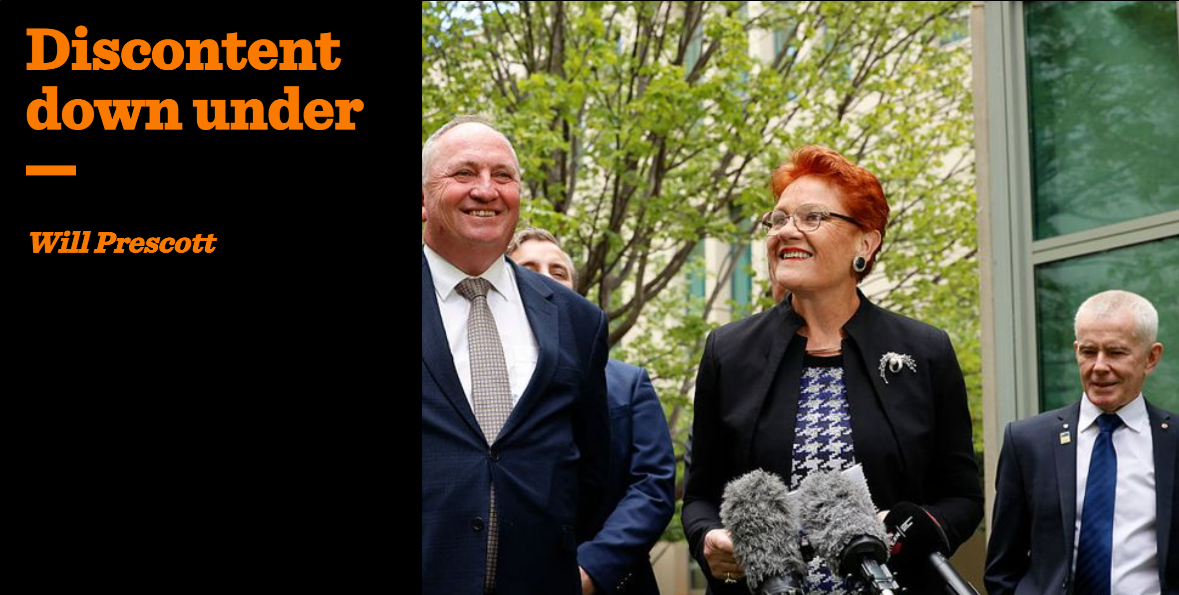
Hanson’s Party first surged to prominence in the late 1990s. She then faded from view before staging a comeback in 2016, when she returned to federal Parliament after an 18-year political exile. While her political fortunes have waxed and waned, her core message has remained consistent: like populists elsewhere, her central focus has always been opposition to multiculturalism and immigration. In recent years, that has primarily centred around Muslim immigration.
Like the South Australian Liberals, the federal Coalition has struggled badly since last year’s disastrous election loss. Trapped between the need to win back more socially liberal inner-city seats, lost to Labor and centrist independents, and the need to protect more conservative rural seats against a resurgent One Nation, the Coalition has pleased no one. Weak leadership and bitter public rows between the Liberals and Nationals have only made their problems worse.
Combined with the growing salience of One Nation’s signature issue — immigration — this has created the perfect environment for a populist surge.
For now, Labor has been the main beneficiary of the One Nation surge. However, Saturday’s South Australian election also highlights worrying trends for the centre-left. While the Liberals lost the most seats, some of the biggest swings against Labor towards One Nation were in its heartland outer suburban seats. Indeed, one of the likely new One Nation MPs, Jason Virgo, was Labor-aligned when I knew him as a student. As the ABC’s former chief election analyst, Antony Green, has noted, this could mark the early stages of a political realignment away from Labor.
Of course, one should be wary of reading too much into a single state election, and Australian voters often vote differently at the state and federal levels. However, the extraordinary nature of Saturday’s result and its overlap with federal trends suggest this time really is different. Until the mainstream gets its house in order, One Nation looks here to stay.