TRAVELLING around Britain during the Iron Age may have been more sophisticated than previously believed.
A hoard of exquisite metalwork has been uncovered in North Yorkshire and experts believe it’s one of the biggest from that time ever discovered.
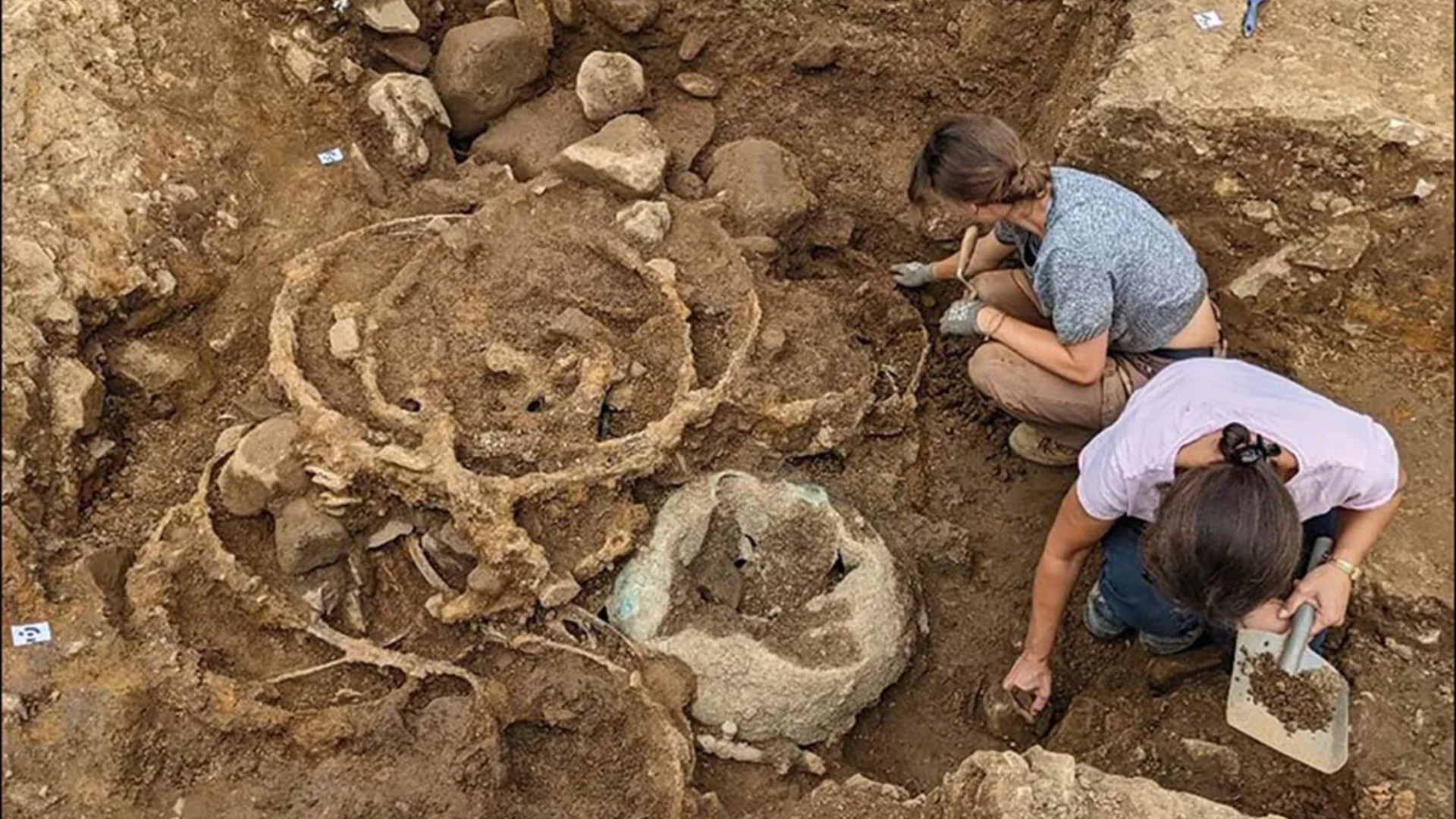
Almost 950 pieces from at least 300 whole objects were dug up on farmland near the village of Melsonby.
The most remarkable of them could overturn everything we thought we knew about transport some 2,000 years ago.
Until now, everything pointed towards the most elite using two-wheeled chariots to get around.
But experts have unearthed evidence of what looks like the first ever four-wheeled wagon in Britain.
Read more on British history
These sorts of vehicles were a feature in continental Europe at the time but not over here.
An excavation team found everything from an elaborately decorated horse harness to wagon parts and 28 iron tyres.
Other objects unearthed include swords, cauldrons and ceremonial spears.
They were first spotted by metal detectorist Peter Heads in 2021.
He reported it to the Portable Antiquities Scheme, leading to a major excavation project in 2022 by a team of archaeologists from Durham University, with support from the British Museum and Historic England.
Three distinct deposits found across two sites were identified for further investigation.
Sign up for The Sun Tech newsletter for gadgets, games & more

Hello! I’m Sean Keach, The Sun’s Head of Technology and Science
I’ve been writing about gadgets, games and the future of technology for more than a decade.
During that time I’ve penned thousands of articles, filmed hundreds of videos, talked tech on TV and radio, and travelled around the world to bring you the latest on Apple, Meta, Google, Amazon, Netflix and more.
And I’ve got a weekly newsletter called The Sun Tech that you can read for free every Thursday.
I bring you the latest from the world of tech, including behind-the-scenes action, exclusive content, expert analysis, and plenty of help advice – so please follow along!
A more in-depth new study reveals the presence of the steering mechanism and 50 pieces of U-shaped brackets needed on four-wheeled wagons of this era.
But the findings also create more questions than answers.
Scientists uncovered clues that suggest the wagons were deliberately burnt and bent before being buried – and they’re not entirely sure why.
“The presence of four-wheeled wagons at Melsonby, with similarities to continental vehicles, would transform our understanding of the forms of wheeled transport and the role of such vehicles in the British Iron Age,” scientists explain in their research, published in the Antiquity journal.
“At the same time, the scale of the Melsonby deposits emphasises that communities in northern Britain had levels of material wealth comparable to their counterparts elsewhere in Europe.”
What was Iron Age Britain like?

Here’s what you need to know…
- The Iron Age was a violent period in British history lasting from 800 BC to the Roman invasion of 43 AD.
- It followed the Bronze Age, and marked a time in which ancient Brits began to make tools and weapons out of iron.
- Little is known about the Iron Age, as Brits left no written history of the period.
- We know that iron tools made farming much easier than before and settlements grew in size.
- Brits lived in clans that belonged to tribes led by warrior kings.
- Tribes frequently fought bloody battles using deadly iron weapons.
- People lived in hill forts to protect themselves from attack.
- The remains of several hill forts survive in Britain today, including at Danebury in Hampshire, Maiden Castle in Dorset, Old Oswestry in Shropshire and Traprain Law in Scotland.