2026 has been a good year for conspiracy theorists so far. The release of the Epstein files, for example, has revealed many formerly questionable hypotheses about the conduct of the world’s elites to be entirely plausible. The past months have also been demonstrably fruitful for conspiracists; think of the intrigue that must have been involved in the US Government’s abduction of Venezuela’s leader Nicolás Maduro.
These events are part of a watershed in the status of conspiracy. By definition, any conspiracy theory referring to motives that have been confirmed and to operation has been publicly documented is merely a fact. The conspiratorial now plays out in the open and in real time.
Yet the appeal of conspiracy as a mode for assembly and explanation has far from diminished. Two contemporary art exhibitions with radically different politics suggest that it is both too early to debunk conspiracy as an organising principle and too late to distinguish conspiracy theory from narrations of truth.
Conspiracies at London’s Warburg Institute looks like a sober affair. The exhibition’s introductory text duly cautions visitors that mainstream conspiratorial plots “promote racism and hatred” and “contest the authority of mainstream media”. It invokes conspiracists’ dislike of “expertise and knowledge” and denounces their “exclusionary authoritarianism”.
Yet this sparse hang of works by only four artists, curated by Slade art historian Larne Abse Gogarty, addresses none of these topics, as though they were too contentious for the setting. Instead, it claims the conspiratorial initiative for the institution, placing it back in the hands of the “good” guys.
Caspar Heinemann’s 2023 ink drawings of Theodora and Her Cabin exemplify this protocol. The images project an alternative life story of Ted Kaczynski in which the Unabomber had acted on a moment of doubt in his gender identity. His 1998 trial revealed aborted sex change desires; the fragmentary disclosures have been the fodder of culture wars ever since.
Heinemann, who identifies as trans, poses Theodora in harmony with nature, smiling and affirmed by a reflection in the mirror. Yet the shelves in this Unabomber’s cabin are full of chemical containers. Are they oestrogen vials, or does this conspiracy too end in mass killings? Heinemann’s work takes a moral outcome for granted yet hints at no reason. Nor does it attend to the theory, pertinent here, that Kaczynski’s gender dysphoria was induced by an MKUltra-adjacent research programme.
Conspiring against conspiracy theory is a means of evasion. In her 2023 book, What We Do Is Secret, Abse Gogarty argues against art that overtly debunks or corrects undesirable narratives — suggesting that such work is politically ineffective — and proposes conspiracy as a mode of covert aesthetic.
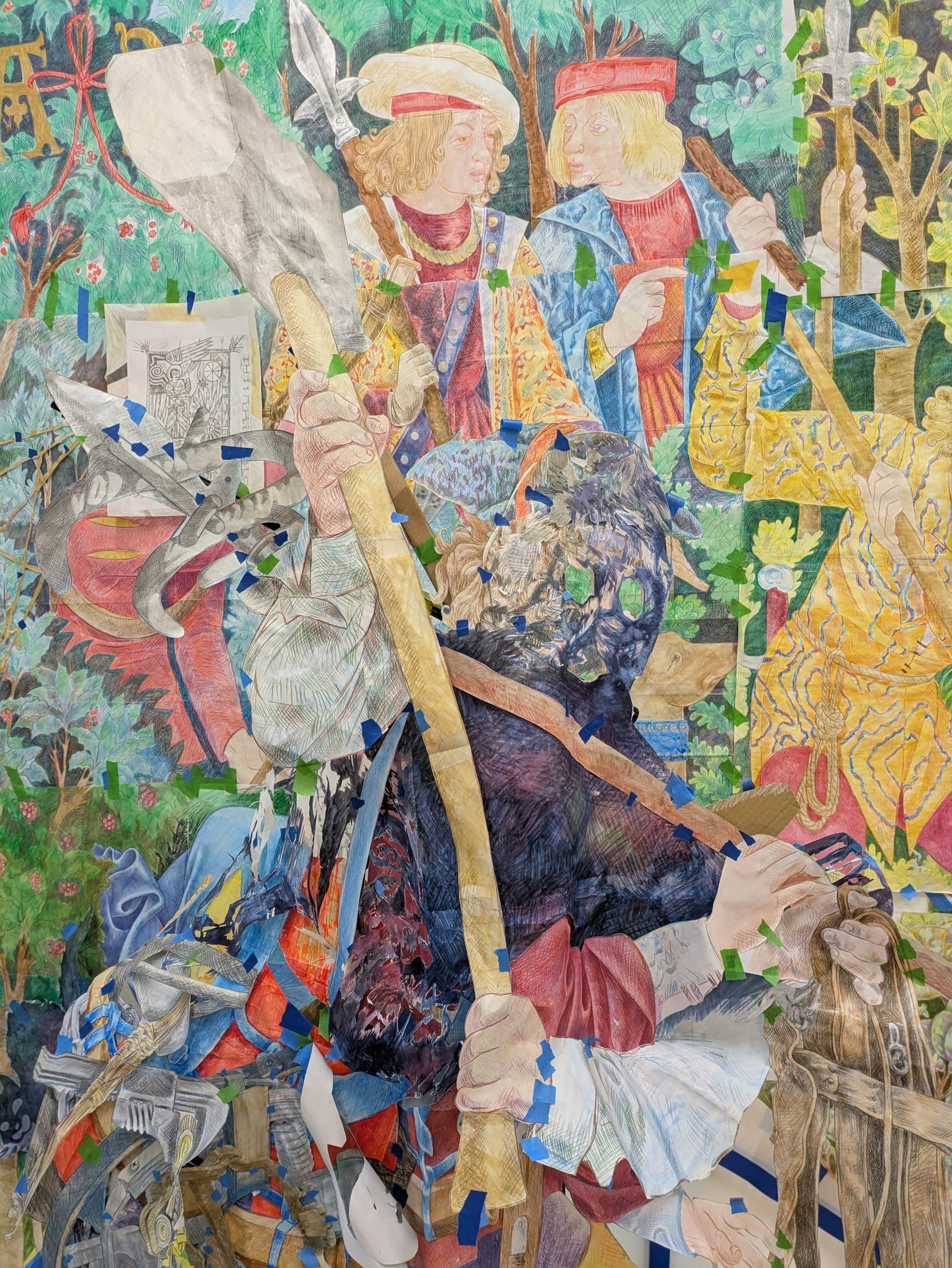
The politics at play notwithstanding, this proposal is attractive in principle: who isn’t tired of artists acting as scolds? Sam Keogh’s 2026 watercolour and pencil rendering of the sixteenth-century Flemish Unicorn tapestries, complete with CCTV surveillance towers and self-referential art-historical puzzles (facsimile of Abi Warburg’s everything-is-connected Mnemosyne Atlas hang nearby), gloriously nods at the indecipherability of motives. What is the action it conceals?
Yet when Abse Gogarty proclaims conspiracy a knowledge practice — which would, surely, concede that even flat Earthers strive towards some internally consistent worldview — she explicitly excludes epistemic paradigms outside her political preference. Conspiracies reinforces a logic of total prohibition, which recognises and endorses only one set of secrets. But even by Abse Gogarty’s admission, many conspiracy theories have arisen to rebel against such deployment of conspiracy.
This control paradigm is a vacuum, suffocating all non-conforming perspectives with the might of that hierarchical “expertise and knowledge”. The curator has form here: Abse Gogarty and the exhibiting artist Hannah Black were heavily involved in the art world’s ideological witch hunts and cancel culture circa 2016.
Now they declare the overt part of their mission accomplished. Is it part of the transition to the covert, then, that Wheel of Fortune, Black’s 2021 contribution to this show, is a disorienting light installation? This assembly, consisting of rotating disks and consumer electronics whose function is indiscernible, is vaguely akin to the double slit experiment from quantum physics. Its mixed aesthetics predictably coalesce to zero. The conspiracy of Conspiracies demands that viewers take its outcome on trust.
By contrast, Man-made Horrors Beyond Comprehension, on show at Pharmakon Gallery in Bucharest, states its intent on the tin. It then restates it, only to rephrase it and reframe it a moment later, as if to submerge the viewer in a vat of conspiratorial soup. Narrated by the gonzo anthropologist and curator Aaron Moulton, this exhibition elevates conspiracy as the apex explanatory formation, one which emerges alongside, although not despite, reason and logic.
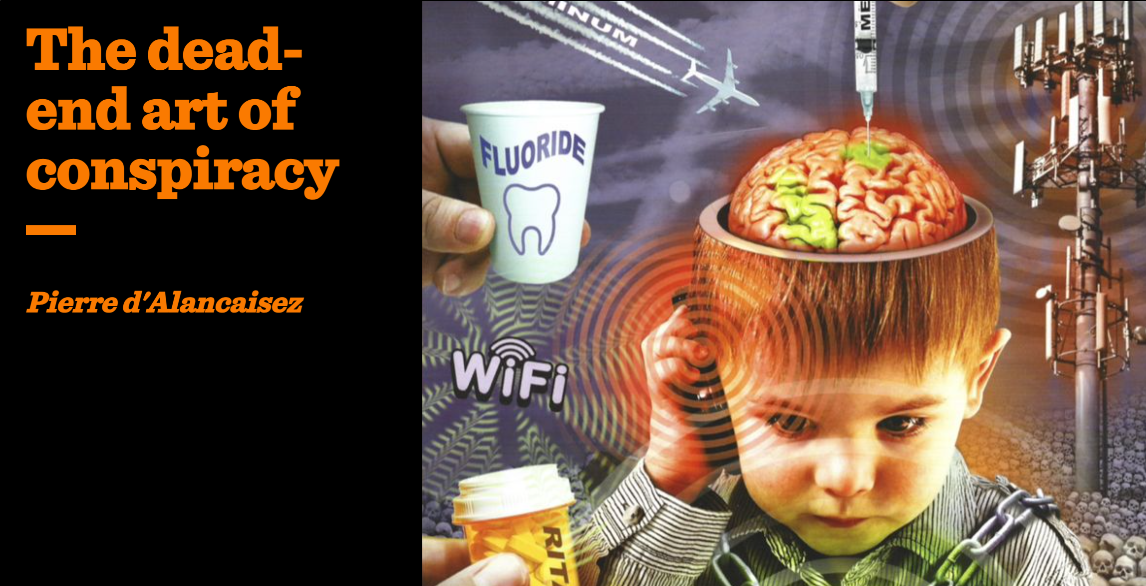
If Conspiracies looks like a public information display in an underfunded library, Moulton’s show is a corner in a comic bookstore basement. The pillar of the exhibition is a collection of the covers of Sheeple magazine, a creation of the late American commercial artist David Dees. Sheeple airs a raft of conspiracy theories, from the Bilderberg Group, via GMO foods, to the Protocols of the Elders of Zion (Moulton previously faced accusations of antisemitism when he included Dees’s work in an exhibition on the influence of George Soros in Eastern European art).
Conspiracy theory, according to Moulton, is inescapable … It has replaced religious belief as the fundamental element of mythmaking
What is remarkable about this oeuvre is that it builds an aesthetic link between benign illustration — Dees worked on Sesame Street Magazine, for example — and today’s ubiquitous conspiratorial imagery. An AI image generator, prompted to examine the effects of 5G towers, Fluoride-enriched water, and mass ADHD medication — like that which produced Mainstream Media, a series of videos by the Canadian artist Jon Rafman, included in the exhibition — would return content that looks eerily like Dees’s.
Conspiracy theory, according to Moulton, is inescapable. As the stuff of slop, our gentle nightmares, it has replaced religious belief as the fundamental element of mythmaking. The Dutch artist Tibor Dieters, whose contribution to the exhibition is a collection of Extremely Online Delft Blue tiles with imagery updated for the twenty-first century, tracks the changing payload of the myth. His ceramics, some of them already cracked, depict innocuous objects, like motorcycles, but also police violence, sexualised anime figures, and Bill Clinton in a sexy cocktail dress.
Dieters is one of a generation of artists whose conspiratorial consciousness arose as the internet meme reached its peak status. He and Moulton met during the Covid pandemic on the Do Not Research forum which was then a hotbed of soft Leftist trolling and obsessive image production. The cultural influence of the internet of this period, which saw millions of posters transmit new messages under the auspices of established memes, firing them off as if at random, terrified established power structures. Even the Left was censoriously suspicious; Abse Gogarty bemoaned the inescapability of the nihilistic “poasting” loops.
Abse Gogarty and Moulton conceived of their projects before the latest conspiratorial paradigm shift unfolded. And it has been significant. The old comforts offered to both rationalists and truthers by the regime of fact-checking, which dominated the arena until less than a year ago, have revealed themselves to be empty promises. Designations like “disinformation”, which were only ever accidentally antonyms for truth, no longer act as protective magic spells. Nobody knows what happened to BBC Verify’s Marianna Spring, hands-down the last decade’s greatest conspiracy theory artist.
If Conspiracies resists theorising (not least by the impenetrability of Abse Gogarty’s writing), thus proposing that art is action, Man-made Horrors Beyond Comprehension is aesthetic theory without a conspiracy. The two theorists’ models are antagonistic to each other without once occupying common ground. Their clash, instead, is with the limits of fantasy. Ted Kaczynski’s cabin may be as real to Heinemann as Epstein Island is to the graphic artist Jak Ritger in Moulton’s show. Yet both experience them primarily as information hyperlinks. As a new form of apparently less speculative conspiracies takes over, the artists’ challenge will be to capture their true, terrifying presence.
Conspiracies continues at Warburg Institute until 2 May. Man-made Horrors Beyond Comprehension is on at Pharmakon Gallery until 26 April.