Yesterday’s post on Truth Social declaring in bold capital letters that Donald Trump had engaged in ‘very good and productive talks’ with Iran was not so much a surprise as a shock to friend and foe alike.
It meant the US President was suspending his dire threat to destroy Iran’s energy infrastructure at least until Friday, even though the vital Strait of Hormuz remains blocked by Tehran’s Revolutionary Guard.
The reasons for Trump’s change of heart, including tumbling stock markets and pressure from US allies in the Gulf, are not so hard to see.
Hopes that the destructive war of tit-for-tat sabotage between America, Israel and Iran might be suspended were a particular relief in East Asia.
Cratering markets in Japan, South Korea and Singapore were threatening a world-wide recession that would engulf America, too.
At home, big donors to the Republican party are pressuring the President to find a way out of the conflict.
Republican candidates for November’s mid-term elections are desperate for Trump to ‘declare peace’ and restore some measure of normality before the voters savage them.
While Trump’s initial response to Iran’s blockade of energy exports from the region were upbeat – the US is self-sufficient in oil, why worry? – it turns out that America’s farmers rely on imports of fertiliser (which is made with hydrocarbons) from the Gulf.
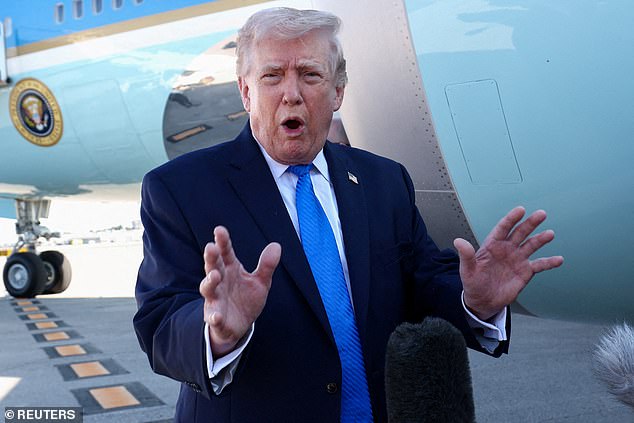
President Trump wants the Iranians to give up their missiles, to renounce their nuclear enrichment programme and reopen the Strait of Hormuz to energy exports
American businesses and banks, meanwhile, are alarmed to see their international trading partners threatened with recession.
It was Trump himself who let the cat out of the bag. Discussing his secret Iran ‘talks’ with reporters, he said: ‘I just want as much oil as possible. I want to have the system lubricated.’
Affordable energy is the key vulnerability for America and its allies. Without it, there is no Western economy – there is no West. And the Iranians know that now for sure.
Any hopes of lasting peace, then, should be tempered. For a start, it’s hard to see how Trump’s demands could possibly be accepted in Tehran. The President wants the Iranians to give up their missiles, to renounce their nuclear enrichment programme and reopen the Strait of Hormuz to energy exports.
Indifferent to the vast suffering of their own civilians, Iran’s hardliners scent weakness. They know all too well that it’s Iran’s ability to strangle exports of oil, gas and fertiliser from the region – supplies making up around 20 per cent of the world’s daily needs – that forced the US President’s change of heart.
Iranian media outlets are crowing that Trump has blinked first – and with some justification.
Iran’s hardliners hope soaring fuel prices will split America from key allies such as Japan, South Korea and the Europeans, and their strategy is succeeding. The mullahs have few incentives to throttle back now.
Besides, as Trump himself admits, it’s no longer clear who in Iran – a vast territory the size of Western Europe – is in charge.
‘It’s a bit tough, we have wiped out everyone,’ he said yesterday. ‘We haven’t heard from the Supreme Leader. We don’t know if he’s living.’ How do you make a deal with an unknown, invisible negotiating partner? Who exactly has Trump been talking to?
The Iranians say no one – because the ‘talks’ are a figment of his imagination.
Even if the President did reach agreement with, say, Tehran’s foreign minister or the speaker of parliament, it is unlikely that either man could stop militant Revolutionary Guard commanders from continuing to fire missiles and drones, so decentralised is the command structure.
Regime change, meanwhile, seems completely off the agenda.
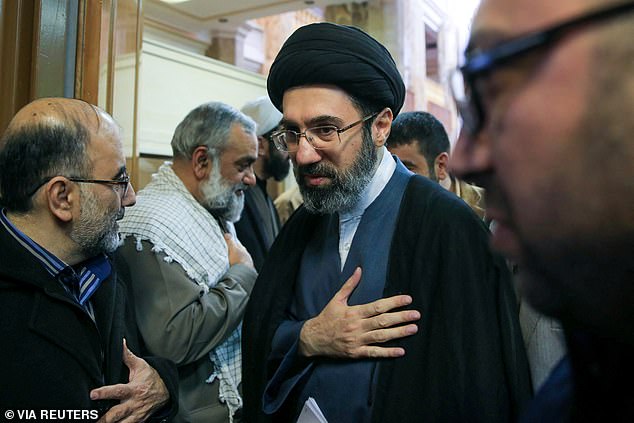
Iran’s hardliners, like the new Supreme Leader (centre), hope soaring fuel prices will split America from key allies such as Japan, South Korea and the Europeans
It is less than four weeks since Israel and America saw deposing the Islamic Republic and installing a pro-Western regime – maybe even a democratic one – as key to long-term peace. Yet today, Trump is offering to run the Strait of Hormuz jointly with an ayatollah, so anxious is he to stop the economic carnage.
Could Trump’s very personal approach to diplomacy pull off a dramatic summit meeting with the new Supreme Leader?
The President met North Korea’s Kim Jong Un three times, breaking a diplomatic taboo in the process. Trump said during his last election campaign – when he was the ‘peace candidate’ – that he could even imagine shaking hands on a deal in Tehran. But while his meetings in North Korea lowered the temperature between Washington and Pyongyang, they produced no halt to Kim’s nuclear build-up.
Besides, the surviving members of an Iranian regime are unlikely to welcome the man who authorised the death of the new Ayatollah Khamenei’s father, mother, wife and other relatives. Iran’s wounds will be fresh for a while.
Remember, too, that America and Iran are not the only states participating in this war.
While both Tehran and Washington would welcome an end to this horrific exchange of fire, Benjamin Netanyahu – the prime minister of Israel, whose air force has played such a key role in the attacks – will be harder to persuade.
The Jewish state feels it is in mortal danger from the Islamic Republic and its chants of ‘Death to Israel’. Netanyahu has no intention of stopping the raids until the mullahs are crushed or, at the very least, have lost all ability to exploit nuclear technology. Neither outcome seems likely in the short term.
Israel is also at war in Lebanon to its north, where Iran’s proxy Hezbollah is fighting a battle of survival. Even if Netanyahu is forced to swallow a ceasefire with Iran, he remains determined to destroy the Shia insurgents once and for all, and is pouring troops into southern Lebanon.
The two conflicts – Iran and Lebanon – are so inextricably linked, they are effectively the same. Hezbollah and the Revolutionary Guard are so closely intertwined – many have fought side by side – that the continuing assault on southern Lebanon is seen by the mullahs as an attack on Iran itself.
Yes, a shaky ceasefire in the region would be better than all-out war – while it lasts. No sooner had Trump raised the prospect of a break in hostilities, than oil prices plunged.
Yet a few missile-free days will be no more than a pause for breath. Even if Trump pulls off a miraculous deal – and miracles are in short supply – an arms race, not disarmament, is likely to follow.
Iran’s Islamist hardliners are bound to replenish their arsenals and start locating the enriched uranium currently thought to lie beneath the rubble of America’s earlier ‘bunker-busting’ attacks.
The Gulf states will remain within easy reach of Iran’s missiles and will stock up with missiles of their own.
I fear that Trump and Netanyahu have started something they cannot stop. And that any ‘peace’ will merely be a ceasefire before the bloodshed – and paralysing economic crises – break out anew.
- Mark Almond is director of the Crisis Research Institute, Oxford.