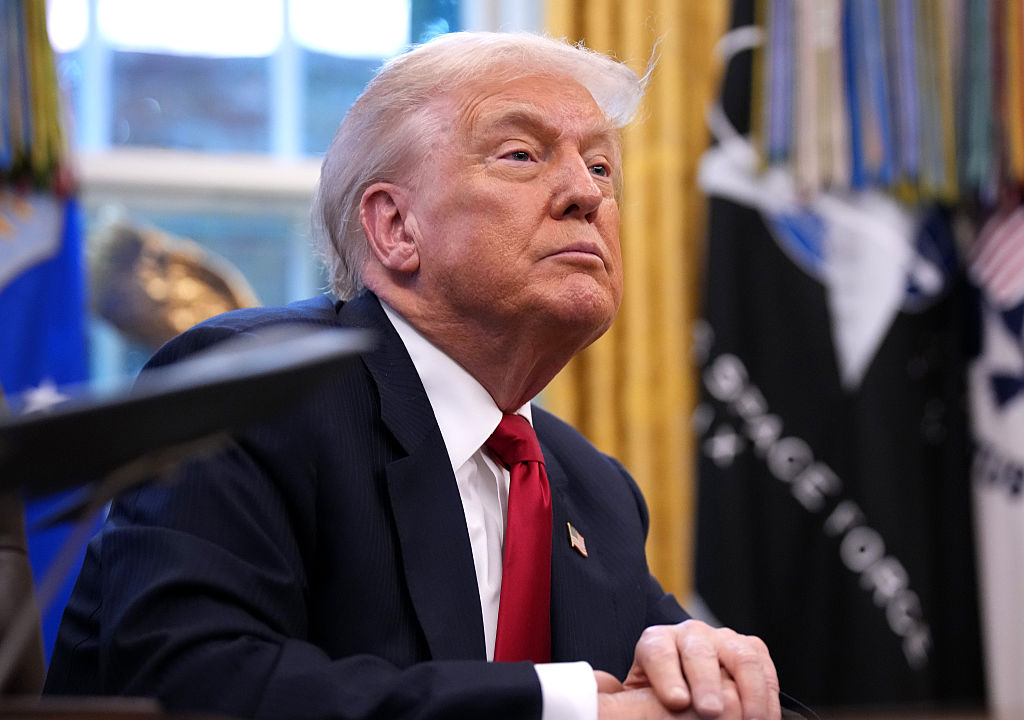
After Cuba suffered a complete blackout Monday, President Donald Trump announced that he believed he would be the president who has “the honor of taking Cuba” and resolving the United States’ longstanding conflict with its communist Caribbean neighbor.
“I do believe I’ll be… having the honor of taking Cuba,” the president said. “Whether I free it, take it—I think I could do anything I want with it. You want to know the truth. They’re a very weakened nation right now.”
Indeed, Cuba finds itself in a precarious position. Economically, the country is in perhaps the worst straits since the Special Period, the economic crisis that followed the collapse of the Soviet Union, Cuba’s principal benefactor. Following the raid on Venezuela that captured the former President Nicolás Maduro, the Trump administration has been strangling the Cuban economy, cutting it off from any external aid or assistance. Venezuela, which until recently supplied Cuba with a significant amount of its imported oil, is now under American domination. The U.S. has also threatened to place heavy tariffs on any country that “directly or indirectly sells or otherwise provides any oil to Cuba,” a measure that has induced Mexico, Cuba’s largest oil supplier, to halt its shipments as well.
The results of that pressure continue to unfold. Cuba’s fragile electric grid is close to complete collapse, with the country suffering from nationwide blackouts. Even when the power is on, it is strictly rationed; Cubans live more hours without electricity than with it. Transportation has become incredibly costly, as fuel prices have skyrocketed (where there is any to be found). The island no longer has any stockpile of jet fuel, incoming flights must carry enough fuel to leave the island without refueling.
The U.S. has also been quietly working to convince countries to kick out their contingents of Cuban doctors and healthcare workers, a program that has long been used by the Cuban government to secure additional funding, promote friendly relations with regional neighbors, and even as a front for espionage.
The deteriorating economic situation has galvanized some domestic opposition: Protesters in the city of Moron attacked and burned a Cuban Communist Party building last week. But civil society in Cuba is extremely weak, even compared to that of Venezuela under Maduro, and the probability of a major popular uprising that somehow leads to a change of regime is essentially a fantasy. Economic pressure can weaken, but almost never topples authoritarian regimes, which are as natural to poverty as they are to wealth, if not more so. As long as the security forces and the Communist Party remain intact, no change of government is forthcoming.
The Trump administration is well aware of this by now. American economic pressure did not topple Venezuela or Iran, it did not cripple Russia in its war with Ukraine, and it has yet to end the Castros’ power in Cuba. It has repeatedly signaled both publicly and privately that it is willing to use force to change the balance of power if the Cuban government makes such an aggressive move necessary.
For now, however, the administration is working on more pacific solutions to the Cuba Problem. Trump officials have been engaged in a series of talks with the Cuban government on potential steps to open up the relationship between the two countries diplomatically. The negotiations, apparently being carried on at least in part with Raúl “Raulito” Guillermo Rodríguez Castro, the grandson of Fidel Castro’s brother, Raúl, could pave the way for a completely different kind of U.S.–Cuban relationship, if the Cubans decide they would prefer to bend the knee to the U.S. rather than risk getting the Maduro or Ayatollah Khamenei experience.
The Trump administration doesn’t seem to be pitching the Cubans many softballs. According to a recent New York Times report, the U.S. is pushing the country to ditch President Miguel Díaz-Canel and install a new leader that is more likely to comply with “suggestions” from Washington. Díaz-Canel is seen as a stalwart of the old regime and a communist hardliner, although he may have less power than 94-year old Raúl Castro, who remains a larger-than-life hero of the Cuban Revolution and is capable of exerting significant influence within the regime.
Subscribe Today
Get daily emails in your inbox
Any new president that Cuba installs in place of Díaz-Canel, however, is likely to be nothing more than a figurehead. The Cuban Communist Party is a much stronger and cohesive institution than the institutional scaffolding Maduro inherited from Hugo Chávez in Venezuela, and a new president will not materially change the structure of power within the country. Instead, it would be a signal that the Cuban elite in the army, intelligence services and communist party leadership have decided that cooperating with the U.S.—however grudgingly—is better for their health than continued hostility.
If a satisfactory deal is struck, it would have the strange effect of making communist Cuba—a thorn in America’s side since the early Cold War—an uneasy partner of the U.S., at least in foreign policy. The principal concerns of the Trump administration in the Caribbean are ending illegal migration and drug-trafficking and reducing the influence of Russia and especially China in the Western Hemisphere. Opening up the U.S. economy to Cuba would cut down on the flow of Cuban refugees to the U.S. by stabilizing the country’s economy and bringing significant investment and tourism; the Cubans are well cut out to be competent allies in fighting the drug trade—unlike Venezuela, the Cuban government is not linked with cartels, and Cuban territory is not a major transit point for drug trafficking. But the U.S. would also require Cuba to sever their links with China and Russia in return, leaving Americans as the government’s principal source of income.
Leaving the Communist Party in power is unlikely to be satisfactory to the Cuban lobby in Florida, which has engendered the most prominent advocates of regime change in Cuba for decades. It may also not sit well with Marco Rubio, himself of Cuban extraction, who is currently running talks with the Cuban government. But with the U.S. increasingly entangled in an unpopular war in the Middle East, it may be the only chance the administration has of pulling off a major coup in its ostensibly Western Hemisphere–oriented national security policy.