As federal immigration agents spread across Portland, Maine, during Operation Catch of the Day, which began Jan. 20, Nina, like many other immigrants here, stayed home. Her daughter didn’t go to school, and Nina didn’t go to work, even though she knew she’d lose pay. But the risk of being detained by Immigration and Customs Enforcement (ICE) or another agency seemed too high.
Nina entered the United States from the Republic of Congo on a tourist visa before applying for asylum. In the eight years since, she’s worked to support herself and build a life for her daughter. Yet the surge shook her confidence in whether she truly had a home in Maine.
“I thought I finally had a place to, like, put my suitcases,” she says, “where I could at least sleep well, and then see my daughter going to school and having her life.
Why We Wrote This
Over decades, immigrants in and near Portland, Maine, have become part of the community – but many wondered what could happen when federal agents began enforcement action. They discovered an unexpected level of support.
“I didn’t expect [it] to be like this,” she adds.
Nina, who asked that her full name be withheld because she worries about being targeted by immigration enforcement, was among tens of thousands of “New Mainers” who moved to the state in the last 30 years. Thousands of refugees from Somalia have settled here since the early 2000s, according to news reports. They relocated from larger, warmer, and more diverse locales such as Atlanta, where refugee agencies had placed them, and largely settled in Lewiston, about 30 miles from Portland. Both communities have prided themselves on embracing immigrants.

As word spread that Maine offered safety and strong social services, the immigrant population grew, especially in Portland. Today, about 34,300 immigrants – roughly half of Maine’s foreign-born population, according to census data – call Greater Portland home. Maine’s immigrants have enmeshed themselves in the community by many metrics: About 50% have lived in the U.S. for 20 years or more, and three-quarters speak English, a report from the Migration Policy Institute (MPI) found.
As January’s enforcement operation intensified, Nina and others in Portland discovered – in themselves and in their neighbors – that decades of coexistence had built a deep commitment to immigrants.
Portlanders pieced together networks to monitor enforcement activities, shuttle immigrant children to and from school, and deliver food to those unwilling to leave their homes. After a winter storm dumped a foot of snow on the state Jan. 25 and 26, neighbors shoveled cars out for immigrants who feared federal agents would detain them if they stepped outside. Protesters flooded the streets, braving biting temperatures even by Maine standards, and called for the surge to end.
“I have seen a community show up in ways that I didn’t think would happen,” Moon Machar says. Ms. Machar’s family arrived in Maine as refugees from Ethiopia when she was a child. She has lived here most of her life.
The surge, she and others interviewed say, built new bonds between immigrants and U.S.-born residents.
“If ICE wasn’t here, I don’t think some of the people would have come out of their house and made it a point to connect with individuals from our community,” she adds. (Listen to an excerpt of an interview with Moon Machar as she talks about her “African Mainer” identity.)

Yet tension between immigrants and their new home has surfaced, as some have questioned America’s commitment to welcoming people from other shores. Similar feelings have ricocheted across the U.S., as President Donald Trump deploys immigration agents to fulfill his vow to deport people living in the U.S. unlawfully – about 14 million people. That number surged by some 3 million under President Joe Biden, who had relaxed some of Mr. Trump’s immigration policies. Despite repatriating more immigrants than any president since George H.W. Bush, Mr. Biden’s administration could not keep up with migrants attempting to enter the country. U.S. Border Patrol recorded some 7 million encounters at the southern border, compared with about 2 million during Mr. Trump’s first term. Such encounters are often used as a proxy for illegal crossings. Although Portland’s immigrants saw a flood of support during nine days in January, some now grapple with the realization that many in the country – and in Maine – support Mr. Trump’s immigration actions.
“It’s become very, very evident that I am ‘from away,’” says Ms. Machar, an Army National Guard veteran, using a common term in Maine. “There are individuals who do not want me here, regardless of my military contributions, regardless of all the good I try to do in the community, regardless of how proud I am to represent the state of Maine.”
Enforcement surge makes its mark
Two weeks after the height of enforcement actions in Portland, Nina still feels a well of anxiety when she leaves her home. If she’s arrested, she thinks, she could be sent to a detention facility thousands of miles away, as has been the case in other incidents. What, she wonders, would happen to her daughter?
“I feel like all of us are getting put into the same basket, and they’re calling us ‘illegal’ even though we’re not,” she says.
Traditionally, asylum-seekers like Nina have been shielded from deportation and allowed to work while their cases move through the system. That process can take years. They can be detained by ICE for a variety of reasons, such as if the agency deems them a public safety threat or a flight risk. The Trump administration has in some cases deported asylum-seekers and, last year, issued a memo pausing asylum applications “pending a comprehensive review.”
The number of immigrants in the state swelled from just over 45,600 in 2010 to about 65,800 in 2024, according to census data. Only 4.7% of Maine’s 1.4 million residents were born outside the U.S. Since 2022, some 1,748 refugees and asylum-seekers have settled here, according to Catholic Charities’ Office of Maine Refugee Services.

Although Maine has drawn national attention for its population of immigrants from countries in Africa, nearly half of the state’s immigrants are from Asia or Europe. One-fifth are from Canada. Immigrants from African nations, largely in East Africa, make up roughly 20% of the foreign-born population.
About 8 in 10 of Maine’s immigrants reside here legally. Half have obtained citizenship, according to a report from MPI, and another 32% hold either a green card or temporary visa. Though some estimates say about 10% of Maine’s immigrants entered the country unlawfully, MPI puts the figure at 18%.
The U.S. government has broad authority to deport people who enter the country unlawfully. But those people can apply for protections like asylum as a defense against removal. Donny Ardell, a Republican state representative, says it’s the law, not the public, that decides whom immigration agents can target under U.S. law.
“A permanent resident who has committed a series of violent felonies is just as removable, you know, deportable, as someone who’s merely an illegal alien,” he says.
As the surge in Portland got underway, federal officials reportedly said they were targeting 1,400 of “the worst of the worst criminal illegal aliens” across the state. That came seven weeks after the start of what became a 3,000-agent operation in Minneapolis – a campaign marked by immigration law enforcement fatally shooting Renee Good and Alex Pretti, two U.S. citizens who were opposing federal actions there.

On Jan. 29, Maine Sen. Susan Collins announced that the Department of Homeland Security would end “enhanced operations” in the state. The agency, which oversees ICE, has not confirmed that statement, and uncertainty still lingers in Portland’s brick and cobblestone streets. In a statement to the Monitor, DHS said it would “continue to enforce the law across the country.”
The Trump administration has maintained for over a year that its enforcement efforts mainly target people with criminal records. Yet Portland residents say the arrests here often appeared indiscriminate, sowing distrust. Even some native-born residents stayed home, believing that they might encounter immigration agents who would detain them first and ask questions later. School absences spiked. Businesses threatened to close for lack of workers.
It’s not that immigration enforcement itself is a problem, says Ruben Torres, advocacy and policy manager at the Maine Immigrants’ Rights Coalition. Immigration agents have sought to enforce laws in Portland and Maine many times, under both Republican and Democratic administrations.
“There is enforcement that should happen. There is enforcement that will happen,” he says. “But at the same time, there should be respect for the process, and the people in that process.”
Born in California, Mr. Torres says even he worries about being detained by ICE, echoing fears expressed by Nina and others.
Portlanders have particularly criticized the arrest of a corrections officer recruit, whom DHS officials reportedly called “an illegal alien from Angola,” in early January. Local officials said that the recruit had cleared a criminal background check and was authorized to work in the U.S. until 2029.
That incident has rankled even those who are sympathetic to immigration enforcement. Kevin Joyce, sheriff for Cumberland County, where Portland is located, questions whether immigration enforcement in Maine targeted those who have broken the law. Cumberland County jails, which the sheriff’s department operates, have historically cooperated with immigration officials.
“I’ve been pretty vocal about the fact that ICE does have a job to do, and that is to get the criminals off the street,” he said at a news conference. “I was all set with that. But … this is an individual who had permission to be working in the state of Maine. We vetted him.”
Such arrests have undermined trust not only in the federal immigration system, but also in local police, residents and local officials say.
“I’m watching my kids – [a] fifth grader and an eighth grader – and they’re afraid,” says the Rev. Peter Swarr, priest at Trinity Episcopal Church in Portland. “They see a police car, and they don’t trust that police car anymore.”
Mayor: time to look forward
Mayor Mark Dion hopes those feelings are temporary. As Portland emerges from the surge, he says the task is to build something new – something stronger.

“We’ll get through it, and we’ll talk about it,” he says, sitting behind a regal wooden desk at City Hall. “It was a hard two weeks. And now, the real work begins.”
Throughout the city, much of that work is already underway, as native-born residents seek to strengthen bonds with their immigrant neighbors and rebuild trust. Sheltered from the February cold at The Cathedral Church of St. Luke are the Rev. Swarr and Sarah Borgeson, who co-lead the newly launched Neighborhood Support Network. The goal is to deliver food to some 70 families who remain too afraid to leave their homes.
Packages will include household essentials like toilet paper and also foodstuffs like palm oil, tilapia, and cassava leaves – staples in many East African countries, where many of Portland’s immigrants are from.
The emergence of such efforts underscores the spirit of neighborliness that has driven Portlanders to paper telephone poles, buildings, and windows on their snow-lined streets with missives proclaiming love for immigrants in Spanish, English, French, and Portuguese. As people rushed to help one another, new bonds of kinship between immigrants and U.S.-born residents blossomed.
“We are engaging all kinds of networks of support, some of it underground, some of it very explicit in public, so that our neighbors know that we love them and consider them to be part of the community,” says the Rt. Rev. Thomas Brown, Episcopal bishop of Maine. “When one of us is harmed, at some level, all of us are.”

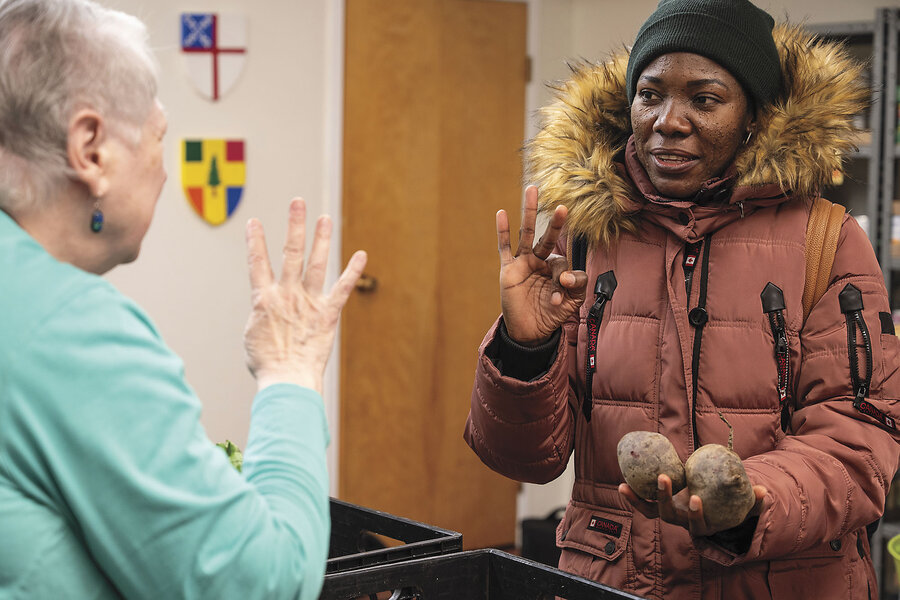
Such initiatives have been built on an extensive web of support services that already existed for immigrants. Deeper in a building attached to the cathedral sits a small room infused with the smell of potatoes. Here, every Thursday, Mary Brighthaupt and a small group of volunteers shepherd largely immigrant visitors through a small but mighty food pantry.
Some 75% of the neighbors, as Ms. Brighthaupt calls those who get food from the pantry, are New Mainers. Most do not speak English. Volunteers communicate largely through gestures, holding up fingers to convey how many items each neighbor can take. The visitors smile, gratefully, and fill plastic shopping bags with as much as they can. Interest in community aid projects such as this one has ballooned since the surge, Ms. Brighthaupt says.
One such project is Maine Needs, a nonprofit that provides basic goods to Mainers who can’t afford them. When they heard about the immigration enforcement push, staff members posted on social media asking for donations of diapers for parents staying at home with their children. The community obliged: In a conference room, stacks of diaper boxes rise from floor to ceiling.
“We watched a community show up. I have chills just thinking about it,” says Angela Stone, founder and executive director of Maine Needs. “They might look like boxes of diapers, but that’s a community that’s like, ‘Absolutely not – we’re gonna look after our neighbors.’”

State legislator: a right to enforce the law
Pious Ali wasn’t surprised by Portland’s response. An immigrant from Ghana, Mr. Ali has lived in the U.S. since 2000 and in Maine since 2002. He’s spent years as an elected official, rising from the school board to be a city councilor at large. He was the first African-born Muslim elected to public office in the state.
Mr. Ali sees his political career as proof that immigrants can become part of the community. “You need to feel comfortable, you need to feel welcome, you need to feel being part of the society you live in to even think of running for office, right?”
“The support that came out is Portland being Portland, and Maine being what mostly Maine is,” he adds.
Mostly.
Many in Maine support President Trump’s immigration crackdown. Although Kamala Harris won the state in the 2024 presidential election, most of her votes came from Greater Portland. More rural parts of the state, to the west and north, voted for Mr. Trump.
A poll from the University of New Hampshire in April 2025 found that 45% of Maine residents approved of Mr. Trump’s handling of immigration. That’s higher than the national 38% approval he received in a February 2026 Reuters poll, which was down from 55% the year before. Although a majority in the UNH poll disapproved of the president’s immigration policies, that was starkly divided along partisan lines, with 98% of Democrats disapproving and 96% of Republicans approving.

Mr. Ardell, the state representative, says that the government has a right to enforce immigration law, and he sees Mr. Trump’s efforts as routine enforcement, not federal overreach.
“I think the opposition is that President Trump is the chief executive who’s directing it,” he says.
For decades, both Democratic and Republican presidents have funneled tens of billions of dollars into immigration enforcement. Last year, Mr. Trump’s tax and spending bill gave ICE a windfall that made it the most well-funded law enforcement agency in the country: about $75 billion spread over four years, on top of an $8 billion annual budget.
This year, Maine enacted a bill to limit cooperation with federal immigration officials. Supporters of such bills argue that they boost trust between local officials and immigrants, who might otherwise fear that accessing social services or reporting crimes will result in deportation.
Mr. Ardell, who worked in immigration enforcement for 20 years, says those policies make enforcement more dangerous – especially as civilians stage protests. Federal immigration agents lack local policing power, he says.
“The only tool they have is lawful commands, and if those aren’t complied with, you have potentially increasing levels of force to ensure compliance,” he says.
Leaning on her community
As she begins to relax after the surge, Nina wishes Washington would reconsider its position on immigration. She doesn’t want criminals on the street, either, and she says that the government has the right to punish those who break the law. But she sees immigrants as a boon for communities around the country, not just in Portland.
“Being [an] immigrant – I don’t think it’s a crime,” she says. “If we’re here, it’s also maybe because [Americans] need us.”
When she read social media comments cheering ICE’s arrival in the state, Nina began to think that most of her fellow Mainers thought differently. “So that means they don’t like us?” she wondered, as she scrolled through her feeds on Facebook and TikTok. “They just pretend to like us, but they don’t really like us?”
But in recent weeks, the community’s effort to come together and support her – from her boss who gave her rides to work to the churchgoers who delivered food – cemented her feeling that she belongs here. Her neighbors, she realized, want her to stay. She’s sure, now, that she picked the right place for her family.
“If something happens to me,” she says, “maybe my daughter will be protected.”