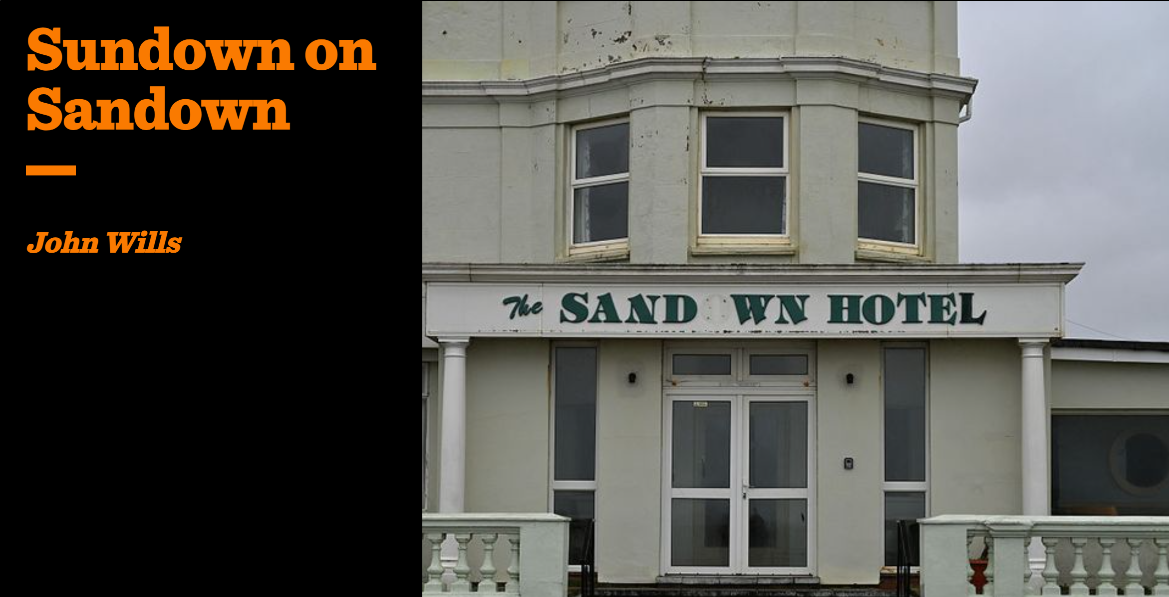
The Isle of Wight’s south-eastern edge is home to Sandown, squatting forlornly at the edge of the English Channel. I spent my teenage years there, and left at the first opportunity.
I carry many memories of the Island, and several of them are good, although growing up there meant experiencing culture at a distance. My sister and I followed Britpop and grunge through Melody Maker and the NME, reading about events far removed from our lives. We felt like those expats reading month-old copies of The Times in the veldt. We were informed about events in the real world, certainly, but we were not involved.
Times have changed, though. Sandown is no longer provincial: there is barely enough left of Sandown for it to be much of anything at all.
The town of my teenage years has given way to systematic ruin
The town of my teenage years has given way to systematic ruin. Successive governments have pursued policies that effectively accelerated collapse through disinvestment and closure. The scale of this became clear in a recent article about Sandown’s Town of Culture funding bid. The photograph accompanying it — intended to showcase the town in its best light—featured a burned-out hotel, its collapsed roof dominating the frame. This was apparently the most flattering image available.
The scale of Sandown’s disintegration has became impossible to ignore. In June 2025, Sandown Town Council launched a formal dereliction survey to measure the impact of the town’s vacant and abandoned buildings. The findings were stark: 82% of Sandown residents live within 500 metres of a derelict site. To put this in perspective, the Scottish government considers it a crisis when a third of the population lives within that distance of dereliction; in some inner-city Scottish neighbourhoods, that figure rises to 55%. Sandown’s 82% dereliction rate is not an outlier in an otherwise healthy town. It is the town. The survey reached 1,000 responses in just eleven days, with respondents describing how the decay makes them feel unsafe, how visitors from the mainland are shocked by the sight of it, and how it creates “an air of depression” for those trying to live there. The council acknowledged having “limited legal and policy tools” to tackle the problem individually — a politely bureaucratic way of saying they are powerless to stop the decline.
The underlying mechanics of the Island’s problems are straightforward. Low wages drive out young people. Out-migration accelerates ageing. Ageing increases service demand on a narrowing revenue base. Underinvestment follows. Jobs become scarcer and pay less. The loop closes. Understanding this cycle is essential to understanding why Sandown cannot save itself.
The jobs that remain are overwhelmingly seasonal, and poorly paid even when they exist. The pattern I’ve watched is one of precarity. The few better-paid jobs — like a network engineer I know who was made redundant when his firm lost government rural broadband funding — exist at the mercy of policy decisions and grant cycles. One local firm, Vestas, brought genuinely good jobs in composite materials engineering to the Isle of Wight. Those careers ended (for locals, at least; the jobs went to Holland) when grants associated with wind turbine blade manufacturing ran out. It says something about the Island’s luck that even government-supported green jobs didn’t provide a payout. In some respects, this has not changed since the 1990s: seasonal work remains the baseline. I remember grown men preparing to sign on the dole as the season driving Sandown’s Dotto Train came to an end. I was naively astonished at how calmly the arrival of (what I assume were) the bad times was accepted.
I remember grown men preparing to sign on the dole as the season driving Sandown’s Dotto Train came to an end
The Island is further damned by being an island. Any factors that might have limited economic stress to something resembling the merely normal deprivation of other coastal areas are instead amplified by the narrow strip of water separating it from the mainland. Transport costs and delays, a thin employer base, and poor labour mobility combine to push prices up while holding incomes down.
These structural constraints mean that everyday necessities such as fuel, food, utilities and housing are all more expensive than they need to be. Wages cluster in sectors driven by an ageing population: care, retail, public services and what remains of a hospitality industry that labour has not yet fully destroyed. The island’s costs — both economic and social — are experienced year-round, but its revenues are strictly seasonal.
Schooling is also poor. My own alma mater drifted in and out of special measures before being rebranded as an academy and partially demolished. The demolition appears to have improved academic outcomes at GCSE a little, although I cannot fully prove the causality. Generally speaking, Island schools underperform mainland equivalents by a wide margin — just 18% of A levels from Isle of Wight students were graded A* or A, compared to a national average of 28.3%. This is the worst result in the country. It is not a mystery as to why. When there is no local reward for academic success, schools cannot build the infrastructure that creates it.
Of my six closest school friends, three fled to Australasia. Three remain, none in conventional work. Those who leave do fine, but the Island exerts a gravitational pull—stay a few weeks after graduation and you’re trapped. The Island cannot save itself.
Local government does absorb some of the local talent. Local government labours under the same constraints as the wider Island economy: high per-capita demand for services, limited revenue-raising capacity, and a restricted ability to invest long-term except via central grants.
When these realities are raised, the standard response from Islanders is that there is “loads of crime on the mainland” — as if that exonerates the Island’s non-crime related failings. There is more mainland crime, certainly, but not necessarily more per capita. Crime in Sandown and Shanklin is comparable to that in other struggling coastal towns — Hastings, Ramsgate — places that islanders might consider considerably less safe. The difference lies in what sort of crime. On the island it is overwhelmingly low-level: acquisitive theft, alcohol and drug-related offences. All are the visible symptoms of economic stress rather than metropolitan lawlessness. These are not signs of organised criminality, but instead are indicators of pressure.
Broadly speaking, Island crime is more likely to be half-inched meringues, not twelve-inch machetes
The government’s response to this sort of generalised regional decline has been to throw short-term grants at individual companies and hope for multiplier effects. Vestas is a good example of this approach: subsidies generate jobs (not necessarily efficiently), which lead to good wages for a few years, then sudden withdrawal when the funding stream dried up. The cycle repeats endlessly — a new initiative is announced, local authorities compete for it, companies arrive temporarily, and then the money vanishes. What distinguishes this from genuine economic development is that it treats symptoms rather than causes. The real constraint on the Isle of Wight is not the absence of manufacturing subsidies. It is the cost and friction of connection to the mainland. Every supply chain transaction costs more.
A fixed link — a bridge or tunnel — would be a different kind of intervention altogether. It would be permanent infrastructure, not a grant programme dependent on annual government discretion. Its cost would be substantial, perhaps £10 to £15 billion upfront. But compare this to the cumulative waste of decades of regional development schemes that have failed to reverse the island’s decline. More importantly, a fixed link would work indirectly, addressing the structural constraint rather than trying to create jobs artificially. Transport costs would fall for businesses and residents alike. Labour mobility would improve—a care worker or tradesperson could access mainland wages without relocating entirely. Life on the Island for mainland-employed workers employed at mainland salaries would become more practical. These are second-order effects, not direct job creation, but they operate through genuine economic logic rather than subsidy dependency.
The counterargument is obvious: a bridge might simply accelerate gentrification, pushing up property prices and replacing struggling locals with wealthy commuters from the mainland. That is a real risk. But it is also an argument for pairing infrastructure investment with other policies directed at addressing housing need, educational underachievement and effective interventions with people committing crimes. This sort of infrastructure investment creates the conditions within which long term solutions become possible. A grant-dependent economy creates conditions in which nothing changes over the longer term. What matters is not whether the Isle of Wight deserves investment — it does — but whether that investment takes the form of permanent structural change or yet another cycle of temporary subsidies followed by abandonment.