This article is taken from the March 2026 issue of The Critic. To get the full magazine why not subscribe? Get five issues for just £25.
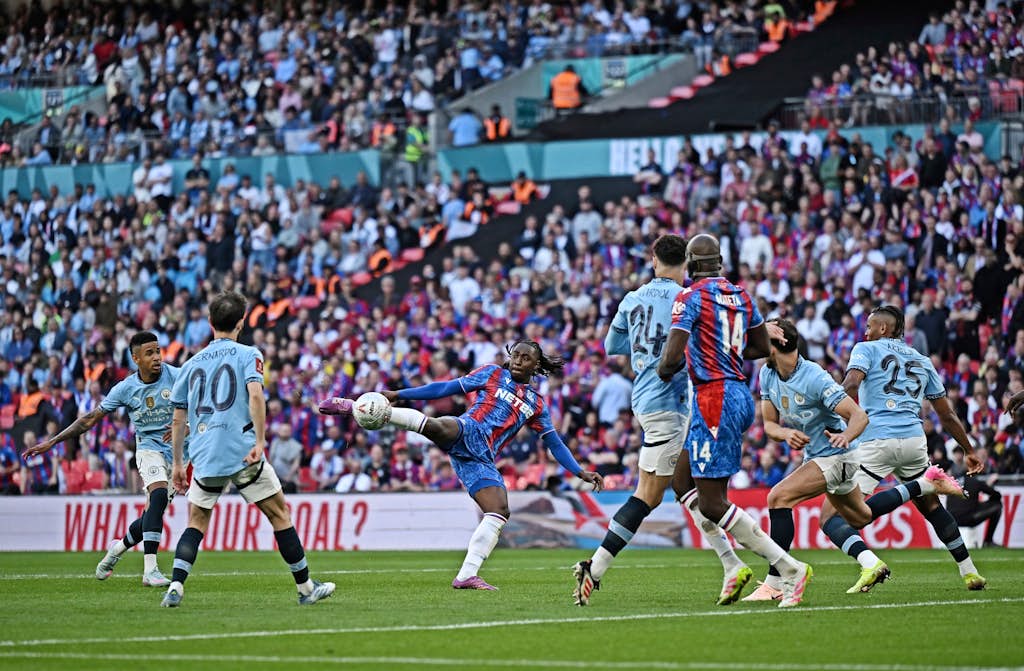
Crystal Palace fans seeing adverts for the movie Highest 2 Lowest could be forgiven for thinking it was a documentary about their club rather than a Spike Lee crime thriller. Nine months ago, they won their first trophy, the FA Cup, on a day of supercharged emotion at Wembley: swathes of fans weeping uncontrollably after their boys had beaten the fearsome Manchester City 1-0.
Now their captain, Marc Guéhi, is with City; their scorer that day, Eberechi Eze, has gone to Arsenal; their star striker Jean-Philippe Mateta wants out; their talismanic manager, Oliver Glasner, will be off at season’s end; and they’re in the bottom third of the league. Where did it all go wrong? The answer should discomfit all fans, not just Palace’s. It’s gone wrong not through catastrophic mismanagement or unforeseen bad luck, but because that’s the way the game is these days.
In the past three seasons alone, the Big Six (Arsenal, Chelsea, Liverpool, Manchester City, Manchester United and Tottenham Hotspur) have bought 17 players from what might be termed a Middle Six (Bournemouth, Brentford, Brighton & Hove Albion, Palace, West Ham and Wolves — and yes, at least one of the last two won’t be in the Premier League next season).
This is not to blame the players in question, who’ve every right to maximise their earnings and chances of success whilst they can. Both Guéhi and Eze left Palace with grace and dignity, as did Antoine Semenyo with Bournemouth recently. They’ll always be welcome back at the clubs which helped make them.
But these are 17 of those smaller teams’ best players gone not to direct rivals but to clubs whose financial clout allows them to perpetuate their superiority. The lowest-valued of the Big Six, Chelsea (£509m) is worth more than twice the highest of the Middle Six (West Ham, £240m).
There’s always been inequality in football but it’s becoming more egregious, not just financially but culturally, too. In his 1956 autobiography, Sunderland’s Len Shackleton famously had a chapter called “The Average Director’s Knowledge of Football” which consisted of a single blank page, but those directors were at least men of their communities.
The Moores family, who owned a majority stake in Liverpool for more than 50 years, made their money partly from the football pools. When Peter Hill-Wood became Arsenal chairman in 1982, he was the third generation of his family to do so. There were no Russian oligarchs seeking footholds against Vladimir Putin, no American hedge fund billionaires leveraging the debt on undervalued clubs, no Middle Eastern sovereign wealth funds promoting their nations abroad.
The clubs these people have now bought have been helped disproportionately by Champions League money and the strictures around profit and sustainability rules, as well as by their own heft. Ask fans of Everton or Nottingham Forest, both of which have been deducted league points for financial infractions in recent seasons, what they think of the 115 charges against Manchester City still being unresolved after three years, and the answers will be short, Anglo-Saxon and unprintable.
The loudest voices in the punditry and podcast spheres belong almost exclusively to former Big Six players, who in turn discuss those very clubs ad nauseam. The European Super League might have been nixed at birth a few years ago, but the mindset behind it is alive and kicking harder than ever.
This is not a reflexive harking back to a non-existent golden age. The influx of money into the Premier League over the past three decades has brought countless improvements — better players, better stadiums, better coverage, vastly safer match-day experiences. But much has also been lost.
It’s less clear what the solution is. The American model of salary caps and reverse-order annual drafts help ensure a much broader range of competition. Only ten of the 51 clubs (19 per cent) to have played in the Premier League since its foundation in 1992 have finished first or second: in the same period, 25 of the NFL’s 32 teams (78 per cent) have reached the Super Bowl.
But the NFL can afford to work like that because both ingress and egress are tightly controlled. There’s no promotion or relegation, the draft accounts for the vast majority of new players, and there are no vaguely credible alternative leagues.
In contrast, football’s global talent sweep allows multiple pathways in and numerous international options, which in turn make unilateral legal strictures difficult to impose: no league will want to be hamstrung by conditions that don’t apply to its immediate competitors.
Whatever the answer is, there has to be one. Palace’s cup win was a victory not merely for the club and its fans, but for everyone who loves the game: a rebel alliance taking down the Death Star, heroes just for one day, a joyous dialling up of emotions to 11. City fans had once wept and lost themselves in a moment like that, back in 2012 with Sergio Agüero and 93 minutes gone on the last day of the season, when titles were all new and shiny. Now they hardly even bother to come to domestic cup semi-finals, so familiar are they with serial triumph.
“Football,” said Palace chairman Steve Parish, “it gets you in your soul.” It’s a precious thing, and we lose it at our peril.