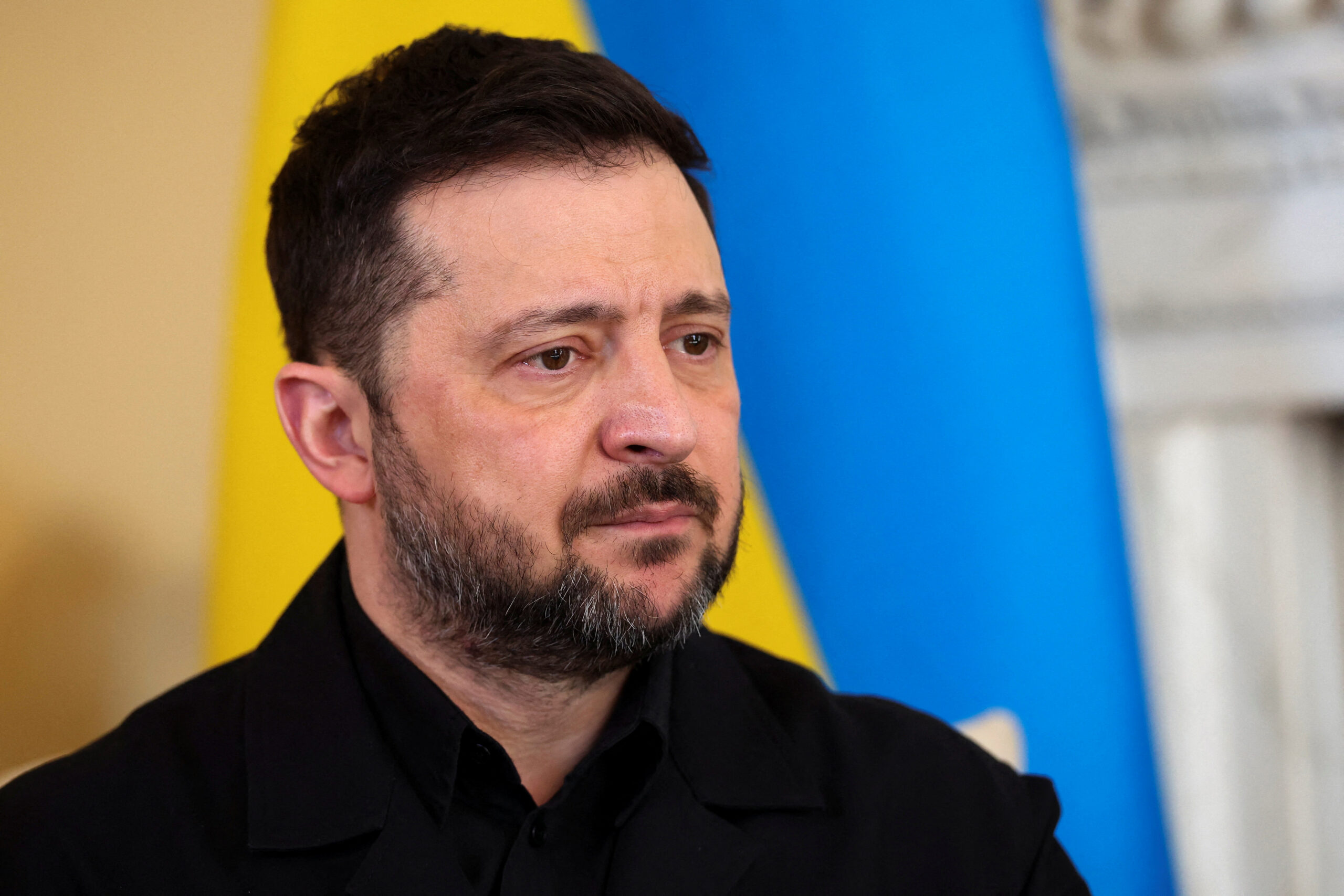
Volodymyr Zelensky has been president of Ukraine for seven years. He has been at war with Russia for four. He is now facing intense new challenges.
The pressure is mounting on Zelensky to hold presidential elections. Yaroslav Yurchyshyn, a member of Ukraine’s Parliament, says the Ukrainians have been told that the U.S. could pull out of the diplomatic process “if Ukraine was not prepared to compromise, including by holding elections.” They have reportedly also been told that security guarantees are contingent on elections being held. Legislation for holding elections is being prepared.
But the pressure on Zelensky comes, not just from the Americans to hold an election, but from the polls. The public perceives corruption, scandals and increasing authoritarianism, and has through four years of devastation seen all of the assurances of victory, NATO membership, accelerated accession to the European Union, and reacquisition of lost territory vanish. Hence trust in Zelensky is eroding.
According to the sociologist Volodymyr Ishchenko of Freie Universität Berlin, there is a trend whereby Zelensky is seen as a capable wartime leader but not the right man for Ukraine after the war. Polling suggests that Zelensky could lose an election, not only to the former top general Valerii Zaluzhny, who has long been seen as a threat, but also to the former intelligence chief and current chief of staff Kyrylo Budanov. Recent polling by the Kiev International Institute of Sociology in January indicates that 72 percent of Ukrainians trust Zaluzhny and 70 percent trust Budanov, while only 62 percent now trust Zelensky.
Political pressure on Zelensky comes not only from the electorate but from within his own party. The unquestioned loyalty that Zelensky has had from his Servant of the People party is over. Nicolai Petro, professor of political science at University of Rhode Island, told me that about 40 MPs from his own party “are boycotting sessions and refusing to vote on legislation being pushed by the EU.” Some, he says, “are worried that they are being targeted by the National Anticorruption Bureau. Others say that they are sick and tired of being taken for granted by Zelensky.” The recently exposed cash-for-votes system is also collapsing, and some say they are rebelling because “the amount they are being paid under the table has fallen.”
Public opinion is making it harder for Zelensky to maintain his position and not compromise on his redline of territorial concessions. New polling by the Kiev International Institute of Sociology shows a major shift: In a simulated referendum, a majority of Ukrainians say they would support “territorial compromises” if peace came with security guarantees and accelerated EU membership. Sixty-one percent say they would vote yes to that proposal, and only 10 percent say they would vote no. Including only those who say they would vote brings the yes vote up to 86 percent. The polling question did not specify ceding all of Donbas, but even among those who say they are categorically against exchanging Donbas for security guarantees, 54 percent would vote yes to this proposal. Only 14 percent say they would vote no.
But the question of accelerated EU membership is also squeezing Zelensky. The path to the EU is not as smooth as it was made to sound. The revised 20-point peace plan proposes accelerated accession to the EU with a defined target of 2027 or 2028. But when EU President Ursula von der Leyen proposed fast-tracking Ukrainian membership, with benefits accruing as Ukraine increasingly met EU regulations, Germany and France, apparently speaking for many members, balked. Germany’s Chancellor Friedrich Merz rejected the 2027 target date as “not possible” and pushed it back nearly a decade, suggesting a more realistic target of no earlier than 2035.
The wider global picture is also growing unkind to Zelensky. The war on Iran has diverted attention, and especially weapons and air defenses, from Ukraine. Interceptors that would have been sent to Ukraine are being burned up in the skies over the Middle East. The war on Iran is resulting in easing sanctions on Russian oil, pumping the Russian economy full of cash to finance the missiles being launched on Ukraine. It also uses up the interceptors that would have been sent to Ukraine to shoot them down. The coming pressure on Ukraine’s ability to defend itself is threatening. “The risk is very high, in my view,” Zelensky says.
And, finally, Zelensky is facing renewed pressure from President Donald Trump. When asked about Zelensky’s offer to help the U.S. defend against Iranian drones that were the prototype for a class of Russian drone that Ukraine has so much experience facing, a dismissive Trump answered, “No, we don’t need [Ukraine’s] help in drone defense.” In an interview with NBC, Trump repeated that rejection and then added contemptuously that the “last person we need help from is Zelensky.”
Subscribe Today
Get daily emails in your inbox
In Trump’s ever shifting mood about the war in Ukraine, he seems, once again, to be turning on Zelensky. “I’m surprised that Zelensky doesn’t want to make a deal,” Trump said. “Tell Zelensky to make a deal because Putin’s willing to make a deal.”
“Zelensky is far more difficult to make a deal with,” he added.
Since he became president, Zelensky has known little other than pressure—but is it becoming unsustainable?