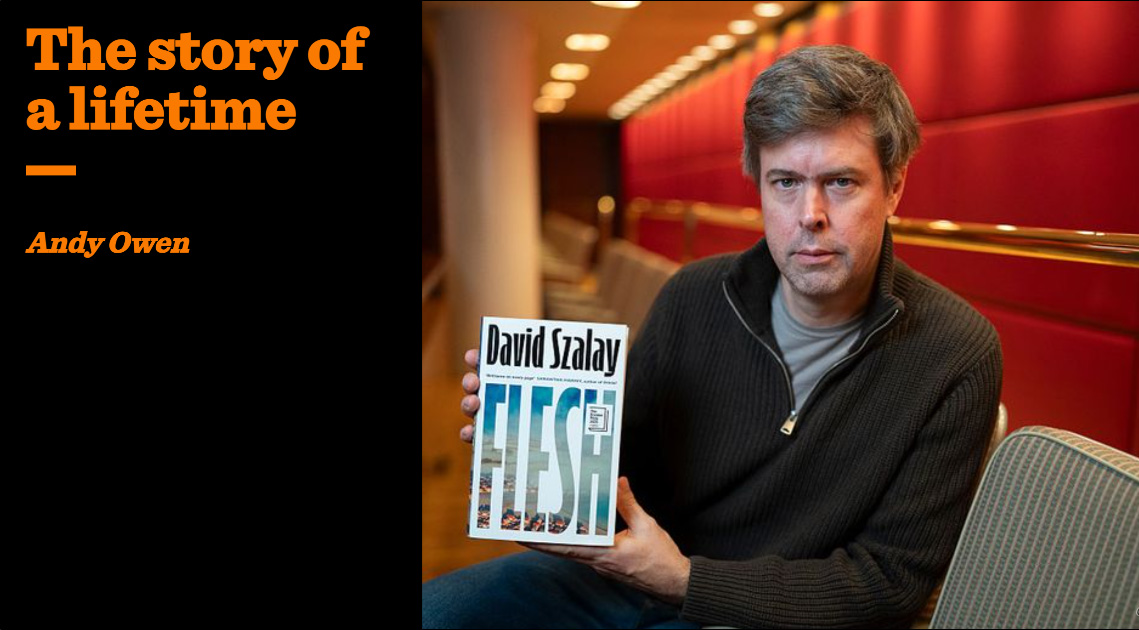
British-Hungarian author David Szalay’s Flesh, a moving account of one man’s life, was released in paperback on 19th March. Szalay tells the story of István, from modest beginnings in Hungary, through war in the Middle East, to migration to the UK and a journey through the social strata of contemporary London. Flesh is about forces that make and break our lives – chance, choice, the weight of our own pasts, the interactions of our physical desires and mental ambitions and the invisible boundaries of a supposedly meritocratic, multicultural, society. It is also a unique entry into the small genre of novels known as “whole life novels.” Author William Boyd, who has written a few such novels, tells me that, “There’s no doubt that readers’ responses to my whole life novels are different from those to an orthodox novel.” The judges of the Booker prize had a different response to Flesh than the other books they considered awarding it the 2025 prize.
Flesh is set apart from others in the genre, as, whilst we follow István across the vast majority of his life, we are not exposed to his inner thoughts and his dialogue is mostly limited to one word replies. But the overall effect that Szalay creates with his propulsive plot, sparse text and what he leaves unsaid, ends up having the same effect as the best novels in the genre: we feel like we know the central character intimately. As author Roddy Doyle, chair of the Booker judges said: “At the end of the novel, we don’t know what the protagonist, István, looks like but this never feels like a lack; quite the opposite. Somehow, it’s the absence of words — or the absence of István’s words — that allow us to know István. Doyle provides the example of “we know he grieves because, for several pages, there are no words at all.”
Boyd, whose whole life novels (WLNs) include the wonderful Any Human Heart, which follows Logan Mountstuart from youth to old age and through some of the key events of the twentieth century via his fictitious journals, tells me “I think this is because the reader has all the information about the central character from cradle to grave. Consequently, the relationship between reader and protagonist is different — readers feel they actually know John James Todd, Logan Mountstuart, Amory Clay and Cashel Ross [characters from his WLNs] and that enhances the response to the fiction.”
Some of Boyd’s fictional whole life characters have been so convincing they have persuaded readers they are real. After getting to know David Bowie when they both joined the editorial-board for the art magazine Modern Painters, they conspired to create a fictional dead American artist called Nat Tate. Bowie thought the concept would work more effectively as a book, so published Boyd’s fake biography, Nat Tate: an American Artist 1928-1960 via his own publishing company. Bowie wrote the jacket blurb, organised the launch party (on April Fool’s Day, 1998) in artist Jeff Koons’s studio in Manhattan, and read out extracts of the book, completely deadpan, to the assembled New York glitterati.
Experiencing all that shapes the central character allows us a level of understanding of them we rarely achieve with the real people we meet. As the author Rita Felski wrote: “[T]he weight of what has gone before bears down ineluctably on what is yet to come.” We are all shaped by our own pasts, our childhoods, our parents’ experiences, and collective group experiences. In WLN we see the main character develop out of their interactions with others, and situated in a complex history of relationships. In our perpetual present these experiences and relationships remain out of view, like neolithic burial tumuli under the accumulative mossy growth of millennia that when wandering through at ground level appear to be random, natural, unconnected mounds. WLNs allow us a drone’s eye view that reveals the ancient patterns and human intention from the apparent aimlessness of nature. WLNs let us see Felski’s weight and, when we trace the central character’s journey and show us how helpless we are when we try to disavow the past. In Flesh we see that because of his past, István’s rise is fighting against the gravity of what came before. We see how his past propels him forward and influences how others perceive and ultimately punish him, dragging him back to where he began.
WLNs allow us the privilege of experiencing another’s full life, a privilege rare in our real lives. According to Herodotus, Athenian statesman Solon, told the wealthy King Croesus, who wanted to know who he thought was the happiest man alive, “Count no man happy until his end is known.” Solon believed that a person’s true happiness cannot be determined until their life has concluded, hopefully peacefully. WLNs allow us to do Solon’s full count. For many of those that are most important to us we do not get to witness their whole life; we do not know the early lives of our parents and if we are lucky we will not know the final years of our children. We will not know the end of all the stories we care so much about, nor should we wish to, as if we do know all their ends it would bring us untold heartache and leave us alone. WLNs allow us to appreciate the scope of a whole life without heartache.
The best WLN, like Flesh and Any Human Heart, also feel truer to us than other stories
Boyd goes further and states that “one of the greatest appeals of the whole-life novel is that we can see in a fictional alter ego’s journey from the cradle to the grave a paradigm or model of our own journey in all its aleatory and fascinating nature. As we read we can construct, if you like, the parallel novel of our own complete existence or, if we’re young, at least postulate and prefigure how such a story might unspool and be recorded. It gives the total life novel a powerful extra-literary frisson.” Boyd has noticed that some of his younger readers, in reading about the longer lives of these characters, can see what it’s like to age, to achieve success or live with failure, to lose a loved one, to suffer bad luck or good luck. He shares with me that he thinks “readers then find themselves imagining their own futures. It’s a funny feeling – projecting forward, wondering what the life ahead of you will be like. One of the first letters I received about Any Human Heart was from an 18-year old Dutch girl who said: “Now I know what it’s like to be old.””
The best WLN, like Flesh and Any Human Heart, also feel truer to us than other stories, I believe, in part, because they do not follow the orthodox structure we are used to of beginning, middle and end. In The Sense of an Ending, literary critic Frank Kermode investigates our need to make sense of our lifespan with fictional stories that have an origin, a middle and an end. “What puts our mind at rest,” he writes, “is the simple sequence.” Stories have always helped make sense of our world. Writer Jonathan Gottschall argues that stories have a universal grammar. He writes: “No matter how far we travel back into literary history, and no matter how deep we plunge into the jungles and Badlands of world folklore, we always find the same astonishing thing: their stories are just like ours. There is a universal grammar in world fiction, a deep pattern of heroes confronting trouble and struggling to overcome.” WLNs deviate from this universal grammar; there is no orderly progression, no symmetry, it is just one thing after another. As Boyd states, “It’s the haphazard rollercoaster of a life that is key in the whole-life novel rather than a particular plot, theme or central relationship.” There is also the irony that by extending our understanding of the main character further subverts the grammar, as we see them not as a singular hero of the story but as one strand in the complex weave of humanity.
Whilst being the main character István avoids “main character syndrome” (MCS). To suffer from MCS is to locate yourself at the centre of your story in the starring role. You treat everyone else as an extra, there to help tell your story. Only your (the hero’s) perspectives, actions and words matter. István’s story, however, is simultaneously both uniquely his and composed of moments so many others from his time and place will have experienced. We understand the interactions with others that make him who he is and determine his future. It is as much their story as his.
Another irony is that to achieve Boyd’s haphazardness takes a lot of precision and planning. He shared that “The technical difficulty of writing a whole life novel — or at least this is the case with mine — is that there is a definite narrative, a clear story that you want to tell, but that has to be presented as aleatory, of one thing randomly happening after another as in any human life. My whole life novels are elaborately planned so that the themes I’m exploring can emerge. As my key theme is to establish that life is all about the good luck and the bad luck that you have, I arrange circumstances so that the luck-factor seems as arbitrary as it is in life.” When this planning is done as successfully as Boyd has done it, WLNs reveal the truth to us that our life is not a story, with the universal grammar that Gottschall identifies.
The deliberate attempt to avoid the expected grammar of story telling that Boyd describes can contrast with the desire of a biographer of a real whole life to shape a life into a story, resulting in fictional WLNs feeling more real than real life stories. Recognising this is the case, biographer of Charles de Gaulle, Julian Jackson, claimed that “all biographers must guard against the temptation to impose excessive coherence on their subject.” Additionally, when we enter the world of the fictional narrator of a WLN, even when explaining to the readers their own motivations and limitations, we take their word for it, assuming objectivity, as there are no others sources to challenge their version of events other than those provided by the author in any metanarration, that then itself becomes the objective truth of the character. Biographies compete with multiple sources and often have to infer from second or third order sources when recounting their version of events. Jackson, discussing the challenge of getting to the truth of Charles de Gaulle’s life, claimed that, “half truths and slurs cling to his memory like barnacles.” In WLN, we are often, Flesh aside, provided direct access to the thoughts of the central character. Even when we get this in autobiographies we are aware of the author’s motivations to conceal and embellish, and a moment’s consideration of our own memories tell us the autobiographical narrator is as unreliable as the inferring biographer. To bastardise Albert Camus, whole life fiction is the lie through which we tell the truth about a life. But there is a limit to this truth.
Whilst we feel we know István intimately, Flesh also shows us the limits of our knowledge about others. It shows how much we must use our imagination to get to “know” the inner lives of those we meet. Our views of the inner lives of others may become more accurate the more we understand of their past and their present, but they are ultimately fictions we create. The central, titular quote in Any Human Heart is borrowed from Henry James: “Never say you know the last word about any human heart.” Even if we have direct access to that heart, we may not have the words. At times Flesh is about what’s unsayable — it plays with the limits of the medium and by doing so shows us the limits of our own language and ability to explain our experience. There are still parts of the human experience that are beyond our ability to describe with language (music can often go further but even then there are limits). Both words on a page and the words we say to each other can seem lacking. With Flesh, Szalay states that he “wanted to write about life as a physical experience, about what it’s like to be a living body in the world.” Sometimes we just have to live through, there is nothing more to say or do than physically survive, be that living body in the world and be there as a physical presence for others.
Some of the most beautiful passages in WLN describe the experience of the passing of time when we do manage to survive. In Robert Seethaler’s A Whole Life by, which tells the story of Andreas Egger’s life in a remote alpine valley, the narrator states towards the end of the book, “He remembered his own childhood, his few years of school, which at the time had stretched out endlessly before him and now seemed as brief and fleeting as the blink of an eye. All in all, time bewildered him. The past seemed to curve in all directions, and in memory the sequence of events became confused, or would constantly reform and re-evaluate itself in peculiar ways.” In Charles Dickens’ David Copperfield the central character reflects,“My school days! The silent gliding on of my existence – the unseen, unfelt progress of my life – from childhood up to youth! Let me think, as I look back upon that flowing water, now a dry channel overgrown with leaves, whether there are any marks along its course, by which I can remember how it ran,” and later concludes, “Feel the truth, that trifles make the sum of life.” Both highlight the strangeness of the peculiar relationship of memory and the furtive, even surreptitious, passing of time. WLNs, often through the necessity of story telling, jump periods of time, before lingering in vivid detail on single moments or periods before further jumps, replicating the experience of our incomplete, perforated, memories.
Our lives are flashes of light in an eternally dark universe, whose timescale is so vast as to be meaningless to us. Whilst our calendars may mark the movements of the planets, we consider the passing of human time within the only timescale we can understand from the inside. This makes the temporal unit of “one life”, which becomes “a generation” when scaled up, uniquely profound to us. Regardless of the historical events a life witnesses, it is the same unit for all of us; this momentary pause between the tick and the tock. WLN can show how much we can fit into one life, whilst at the same time reminding us that we all only have our single lifetime to accumulate these experiences. Throughout our history we have used the stories we tell each other to pass on subjective moral and ethical lessons from generation to generation, but we seem to have a lot less success than we have passing on objective scientific knowledge. While scientific knowledge and the technologies at our disposal increase over time, the lessons that lead to progress in our collective morality or culture have to be re-learnt across single lifetimes in endlessly changing social conditions.
Hesse tells us that life is not a riddle to be solved and there is no secret spell
Hermann Hesse’s Narcissus and Goldmund, tells the story of Goldmund’s search for meaning across his life. As his search nears its end he reflects: “…it was all incomprehensible and really quite sad, though also beautiful. One knew nothing. One lived and walked about on the earth or rode through the forests, and so many things looked at one with such challenge and promise, rousing such longing: an evening star, a bluebell, a lake green with reeds, the eye of a human being or of a cow, and at times it seemed as if the very next moment something never seen but long yearned for must happen, as if a veil must drop from everything. But then it passed, and nothing happened, and the riddle was not solved, nor was the secret spell lifted, and finally one became old … and perhaps one still knew nothing, would still be waiting and listening.”
Hesse tells us that life is not a riddle to be solved and there is no secret spell. Forcing the moments of our lives into a narrative structure may give us the illusion of sense, but life is not a story with a recognisable plot which we can self-author. It is a chaotic, messy, succession of events more unplanned than planned, more down to luck than agency, some we learn from, some we don’t, driven by our relationships and reactions to others as much as driven by our own intentions, until that journey ends, not at some ultimate goal or reckoning of cosmic justice, but just when our time is up.
We should resist the temptation to try and write our own stories to the end. If we do, we risk missing the beauty in the trifles that make the sum of life, we narrow our path of future experiences down from the wide plain of the unwritten story and risk relegating others to extras in your self-centered tale. We should instead appreciate our interdependencies with others, recognise the shared strangeness of our experience of living in our temporary flesh, and embrace the uncertainty, the sadness and the beauty of the haphazard rollercoaster.