Iran‘s barbaric regime has long used sexual violence as a sickening tool to crush dissent.
Known for their brutality, the Islamic Revolutionary Guard Corps (IRGC) slaughtered thousands of protesters who dared to take to the streets in anti-government protests in January.
But despite their fearsome reputation, the sadistic sexual punishments meted out by the ayatollah’s violent henchmen in recent months have still shocked observers.
Last month a report from Amnesty International found that thousands of Iranians are at risk of sexual violence, with children as young as 14 being sexually assaulted by IRGC gangs in January.
In the same month, two Iranian nurses were gang-raped and relentlessly tortured by the Islamic Republic’s security agents because they treated wounded protesters during anti-regime demonstrations.
The nurses, from Tehran’s Rajaei Cardiovascular, Medical and Research Centre, have had their uteruses removed, so violent were the assaults.
One victim, 33, is so traumatised she begged surgeons to let her die and she is currently tied to the hospital bed to stop her from harming herself as she remains under the supervision of IRGC security forces.
It follows a long pattern of sexual intimidation used by IRGC enforcers to strike fear into protesters.
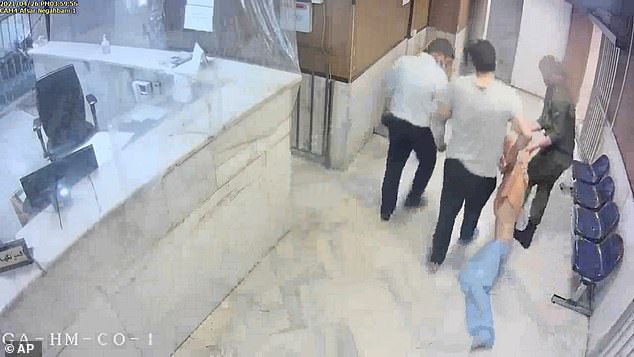
One nurse, 33, was held in detention and repeatedly gang-raped by three IRGC agents at a time for three days, according to Iran International. (Pictured: IRGC guards drag an emaciated prisoner, at Evin prison in Tehran)
Girls as young as 12 have been raped in attempts to ‘inflict lasting physical and psychological damage on protesters’, according to an Amnesty.
UN human rights investigators found Iran uses ‘sexual violence’ alongside torture, arbitrary killings, arrests and forced confessions.
In one shocking case, IRGC agents stormed the house of Amirhossein Ghaderzadeh, a 19-year-old protester who took to the streets in January.
They stripped him and his two sisters, one who was aged just 14, to inspect them for metal pellets to ‘prove’ their participation in demonstrations before subjecting them to sexual violence and sentencing Amirhossein to death.
Authorities have since refused to disclose his fate or whereabouts.
IRGC forces used sexual violence to crush anti-government protests in 2022, sparked by the killing of 22-year-old Mahsa Amini after she was arrested by Iran’s morality police for not wearing a hijab in Tehran.
At least 45 survivors, including 26 men, 12 women and seven children told Amnesty they were subjected to rape, gang rape and other forms of sexual violence during those protests.
The organisation reported that ‘Iran’s intelligence and security forces have been committing horrific acts of torture, including beatings, flogging, electric shocks, rape and other sexual violence against child protestors as young as 12 to quell their involvement in nationwide protests.’
One victim, Farzad, said he was gang-raped in a van belonging to the Special Forces of the police.
He said: ‘Plainclothes agents made us face the walls of the vehicle and gave electric shocks to our legs. They tortured me through beatings… resulting in my nose and teeth being broken.
‘They pulled down my trousers and raped me. I was really being ripped apart. I was throwing up a lot and bleeding from my rectum.”
Maryam, who was gang-raped in a Revolutionary Guard detention centre, recounted that her rapists told her: ‘You are all addicted to penis, so we showed you a good time. Isn’t this what you seek from liberation?’
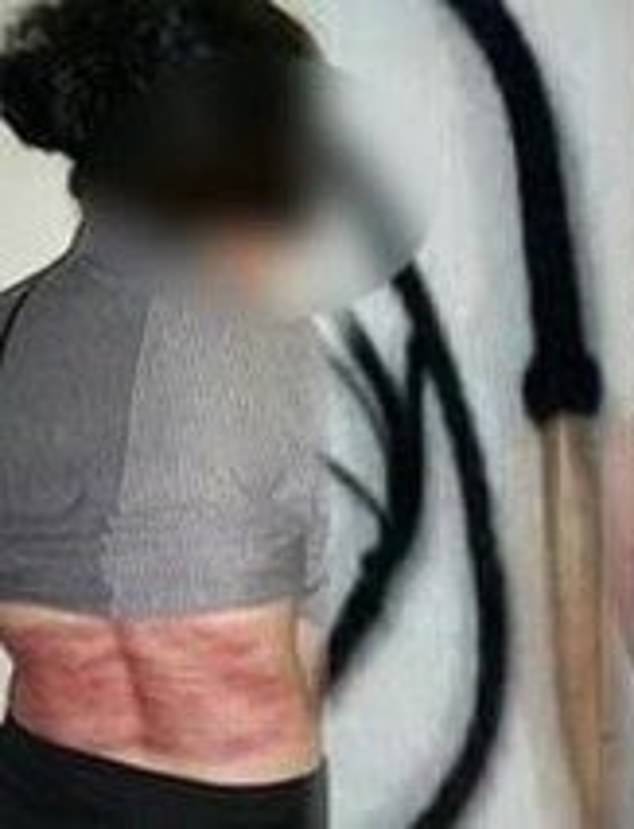
In 2024, Iranian authorities whipped a woman 74 times for ‘violating public morals’ and fined her for refusing to wear a hijab while walking through the streets of Tehran
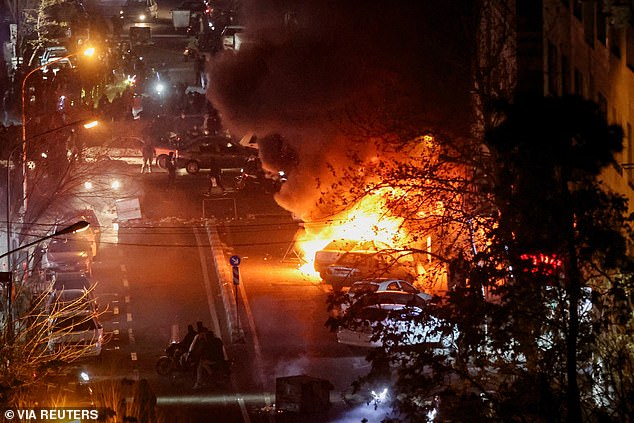
Iran was gripped by nationwide protests against the government in January, which broke out over the collapse of the currency’s value and resulted in the deaths of thousands of protesters
Other victims were so traumatised they said they were considering suicide.
Speaking in 2023, Diana Eltahawy, Amnesty International’s Middle East and North Africa Deputy Director, said Iran’s ‘violence against children exposes deliberate strategy to crush the vibrant spirit of the country’s youth and stop them from demanding freedom and human rights’.
She claimed that Amnesty had obtained testimonies from the victims and their families detailing the extent of the horrific torture endured against scores of children.
A report published by the organisation read: ‘A former detainee told Amnesty that, in one province, Basij agents forced several boys to stand with their legs apart in a line alongside adult detainees and administered electric shocks to their genital area with stun guns.’
The organisation also reported that state agents had used rape and other sexual violence as a weapon against child detainees to break their spirit, humiliate and punish them, and to extract confessions.
A mother told of how state agents raped her son with a hosepipe when he was detained.
Other torture methods included floggings, shocks and holding children’s heads under water, it was reported.
One boy said: ‘They gave us electric shocks, hit me in my face with the back of a gun, gave electric shocks to my back and beat me on my feet, back and hands with batons.
‘They threatened that if we told anyone, they would [detain us again], do even worse and deliver our corpses to our families.’
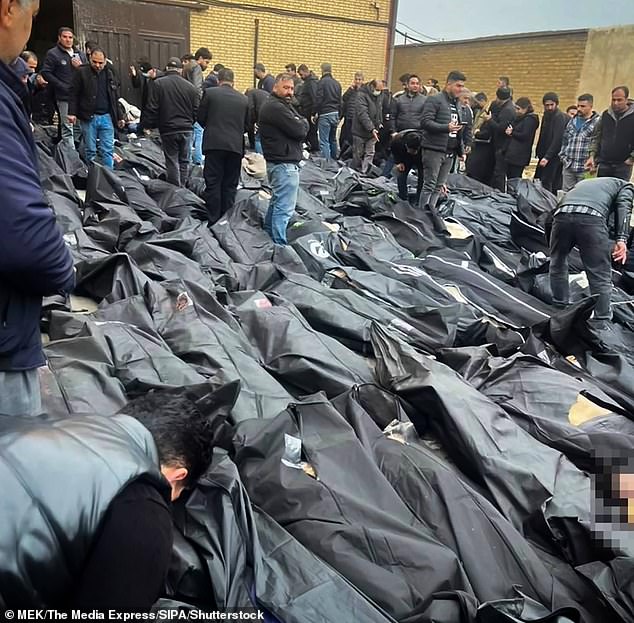
Families and residents gather at the Kahrizak Coroner’s Office confronting rows of body bags as they search for relatives killed during the regime’s violent crackdown on protests in January
In the latest grim example of retribution inflicted on their citizens, IRGC officers massacred thousands of protesters before killing and sexually abusing medics who helped the injured.
The sexual assaults were so severe a doctor had to remove one nurse’s intestine and her uterus may have to be taken out. She also has to live with a colostomy bag.
Iran International reported the nurse was forced to sign a document saying she married one of the IRGC agents and her family had to pay him a large fee to secure her release.
She also had to sign a statement which blamed her rape and abuse on ‘rioters’, sources told the outlet.
The nurse had provided medical treatment to injured demonstrators who took part in nationwide protests against the cruel regime in January.
The hospital, based in the Vali-Asr area of the capital, received waves of injured protesters, including those shot by IRGC forces, on the evening of January 8.
IRGC agents warned hospital staff against helping the wounded. But this was ignored by 14 of 27 nurses.
Two male nurses were among those arrested after expressing sympathy with the wounded.
As nurses helped the injured, IRGC forces entered the hospital and fired at patients, according to Iran International.
Two nurses who tried to treat the wounded were killed, while others were beaten and arrested.
Staff were then warned not to touch the bodies of the dead, leaving corpses to rot.
The bodies of the two dead nurses were later found in Kahrizak, where rows of body bags were piled as the government massacred thousands for protesting.
Two girls, aged 15 and 17, were also reportedly raped by soldiers while being held in detention during the January protests.
The Islamic Republic’s ruthless jailers have long used extreme violence to spread fear among those who dare stand up to the regime.
Amnesty has documented cases in which detainees were suspended by their hands and feet from a pole in a painful position referred to by interrogators as ‘chicken kebab’, forcing the body into extreme stress for prolonged periods.
Other reported methods include waterboarding, mock executions by hanging or firing squad, sleep deprivation, exposure to extreme temperatures, sensory overload using light or noise, and the forcible removal of fingernails or toenails.
The organisation says such torture is routinely used to extract ‘confessions’ before any legal proceedings have taken place, with the Iranian state broadcaster airing footage of detainees making televised admissions that rights groups say are coerced.
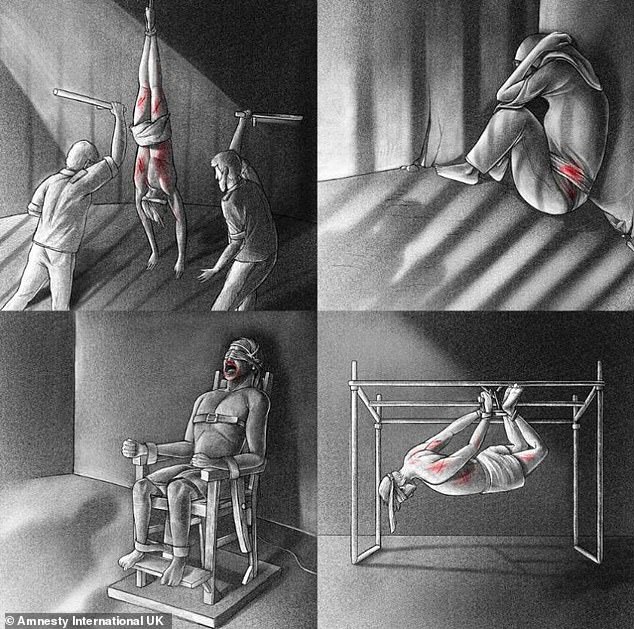
Amnesty has documented cases in which detainees were suspended by their hands and feet from a pole in a painful position referred to by interrogators as ‘chicken kebab’, forcing the body into extreme stress for prolonged periods
Sexual violence has also been documented as a method of abuse. A Kurdish woman told Human Rights Watch that in November 2022 two men from the security forces raped her while a female agent held her down and facilitated the assault.
A 24-year-old Kurdish man from West Azerbaijan province said he was tortured and raped with a baton by intelligence forces in a secret detention centre.
And a 30-year-old man from East Azerbaijan province said he was blindfolded, beaten and gang-raped by security officers inside a van.
Another detainee said that when he told interrogators he was not affiliated with any political party and would no longer protest, officers tore his clothes apart and raped him until he lost consciousness.