Bravery is a precious quality in the modern world. The people of Iran are brave, daring to stand up to a vile regime whose brutality knows no bounds. The victims of the grooming gangs are brave, confronting their tormentors, many of whom still live among them.
The men and women who have kept a 24-hour vigil outside the Chinese embassy in London for the past 20 years in protest at the mistreatment of Falun Gong and Uyghur Muslims are brave. Volodymyr Zelensky is brave, no explanation needed. Alexei Navalny was brave, right up until the moment Putin poisoned him. Exceptional, all.
Most people are not brave. They don’t take a stand, prefer not to rock the boat, look the other way. They protect their own interests and those of their loved ones – and leave the rest to fend for themselves.
If challenged, they take the path of least resistance, mirroring the views of those who shout the loudest or are most forceful for fear of drawing their ire.
On one level it’s understandable; on another, it’s one of the main reasons politics is so degraded and the world is such a bloody mess. Moral cowardice is a contagious disease, and it’s easily spread via social media. It’s why 20 per cent of university undergraduates say they wouldn’t share a house with a Jewish student; it’s why Parliament has just voted to allow the murder of full-term babies in their mothers’ wombs. It’s hard work standing up to this nonsense, and not everyone has the stomach for it.
That is why I have so much admiration for people such as Ayaan Hirsi Ali, J.K Rowling, Salman Rushdie, Douglas Murray, Nimco Ali and many more who are prepared to swim against the tide. They are the ones who risk their sanity and safety to take on the pitchforks.
Dame Jenni Murray was brave in that way. I was so sad when I found out on Friday evening that she had died, aged just 75. Her health had not been good ever since she left – or was edged out of – her job as the iconic presenter of the once-great Woman’s Hour, now better known as ‘Woke Hour’, a sloppy, dreary mess of self-congratulatory, knit-your-own tampon nonsense that no one in their right mind would possibly listen to unless someone was holding an electric whisk to their vagina.
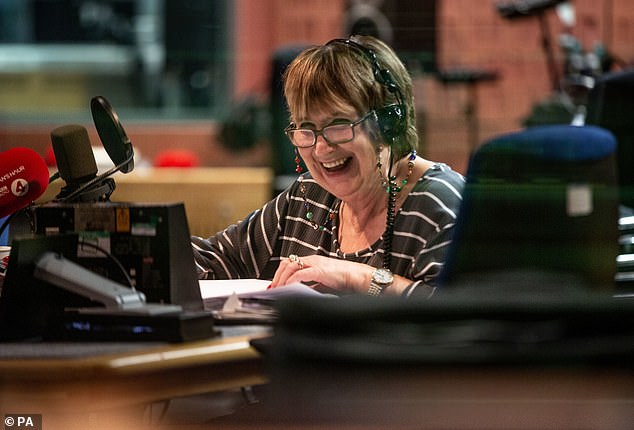
Dame Jenni was brave when she announced live on air, in 2006, that she had been diagnosed with breast cancer, writes Sarah Vine
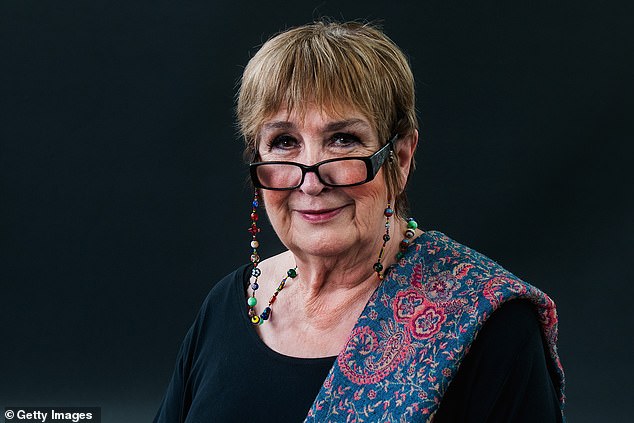
Dame Jenni’s health had not been good ever since she left – or was edged out of – her job as the iconic presenter of the once-great Woman’s Hour
For 30-odd years she presided over a rigorously professional show in her own inimitable way. She had one of the best voices on radio, comforting and disarming, and an interview style that often drew surprising results. She had a natural authority that made her more than a touch intimidating – but being someone who was quite vulnerable herself (she was refreshingly candid about her personal and emotional struggles) she was never cruel.
She knew how to get the best out of people, and that was because she herself was that rare thing in broadcasting: not a raging narcissist. She spoke to people on the basis that they were the ones the listener wanted to hear about, not her. She was simply the presenter, the conduit, not the star, not in her mind anyway – again, one suspects, having read her memoirs, that this is the legacy of a mother who always belittled her and from whom she could never quite elicit the love she craved.
And yet Murray was not self-effacing. She could be perfectly fierce when the occasion required it, often when speaking to formidable women such as Margaret Thatcher and Hillary Clinton – although her Joan Baez interview in the late Eighties was pure emotion, Dame Jenni describing herself as ‘sobbing inside’.
She was brave because she was a trail-blazing woman in a male-dominated industry (she joined BBC Radio Bristol as a copytaker in 1973 and was presenting Newsnight by 1983) whose hard work and professionalism paved the way for the next generation of women in broadcasting and journalism.
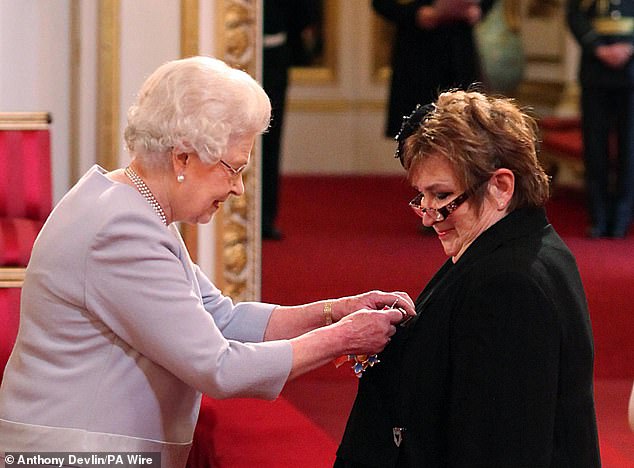
Jenni Murray is made a Dame Commander by the Queen at Buckingham Palace in 2011
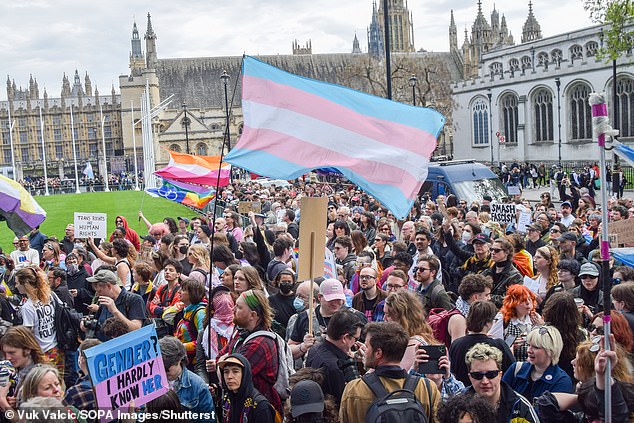
Where Dame Jenni was bravest was probably in her defence of women, particularly vulnerable ones, and her stance on the immutability of biological sex, writes Sarah Vine
She was brave in her presenting style, asking the questions no one else dared to, such as why Monica Lewinsky never had that dress dry-cleaned, and what Thatcher thought about Mitterrand’s famous (possibly apocryphal) comment about the Iron Lady having ‘the eyes of Caligula and the lips of Marilyn Monroe’.
She was brave when she announced live on air, in 2006, that she had been diagnosed with breast cancer – and proceeded to share details of her treatment with her audience, as part of her mission to ‘demystify’ the disease.
But where she was bravest was probably in her defence of women, particularly vulnerable ones, and her stance on the immutability of biological sex.
There are many now who boldly subscribe to this so-called ‘gender critical’ view, but back in 2017 when she waded into the argument, via an article in The Sunday Times under the headline ‘Be Trans, be proud – but don’t call yourself a real woman’, even to entertain such an opinion was considered blasphemous by trans activists fuelled by a quasi-religious belief in their cause.
Like all ideologues and fanatics, there was – and in many cases still is – no reasoning with trans hardliners. If you don’t subscribe to their belief that a woman can have a penis, then you are not just wrong, you are evil. It is their version of Sharia law, and unbelievers must be punished. That’s why most people, including the Prime Minister Keir Starmer, the leader of the Green Party and many others just give in. It’s easier than arguing the truth.
Murray’s article was beautifully written and measured, but she forgot one thing: you can’t reason with zealots. Their brains are so rage-addled, they simply don’t have the capacity to entertain any form of intellectual challenge, and so they resort to the only thing they understand: intimidation. It’s like arguing with a hurricane: you’re bound to get flattened.
Murray might have got away with it had she got back in her box. But she wasn’t a back-in-the-box kind of woman. She didn’t just object to the notion that sex is mutable, she also objected to the manipulation of the semantics of womanhood, and in particular to the ugly use of the word ‘cis’ and idiotic expressions such as ‘pregnant people’.
She advocated for single-sex spaces for biological women and argued that, while trans women were perfectly within their rights to live and look like women, it was impossible for them to truly comprehend what that meant since they had no experience of growing up female in a fundamentally patriarchal society.
Her refusal to give in to the trans mob ultimately led to the end of her long and distinguished BBC career. Having given her entire life to the Corporation, it hung her out to dry, barring her from discussing trans rights, claiming her views breached its impartiality rules. Impartiality rules that, strangely, seemed not to apply quite so strictly to other (male) presenters such as Gary Lineker.
Was she hurt? Actually yes, I think she was, deeply. When I spoke to her after it all, she was still in shock, not just at the complete lack of loyalty displayed by the BBC but also at the level of vitriol subsequently aimed at her. I think she understood, as so many women who have fallen foul of this particular mob do, that at the heart of it all lies a deep-rooted misogyny, a visceral hatred of women – and especially strong, brave, clever women such as Murray.
It was my great privilege to have known her. She was an inspiration, an icon and a towering intellect. I hope she’s giving them all a good grilling in Heaven. ‘So, Mary, tell me: how did your husband Joseph react when you first told him you were pregnant by the Holy Ghost…?’