In modern Britain, it seems there are some subjects that simply cannot be discussed – at least not honestly – without inviting a storm of outrage.
The latest victim of this reflexive indignation is the Shadow Lord Chancellor Nick Timothy.
His supposed offence? A short post on X in which he argued that: ‘Mass ritual prayer in public places is an act of domination.’ He added: ‘Perform these rituals in mosques if you wish.
‘But they are not welcome in our public places and shared institutions.’
The ritual to which Timothy was referring was an event in London’s Trafalgar Square, where around 3,000 Muslims gathered for a mass prayer event on Monday marking the end of Ramadan. Organised by a charity called the Ramadan Tent Project, it was a highly visible act in the heart of the nation’s capital, and one which Timothy had every right to question.
He did not, notably, comment on Muslims as people. He did not question their right to worship or call for restrictions on private belief.
What he did do was to raise a question about the appropriateness of large-scale religious ritual in shared civic spaces. Nonetheless, within hours, the outrage began, spearheaded by Sir Keir Starmer, who described Timothy’s words as ‘utterly appalling’ and demanded that Kemi Badenoch sack him. Shamefully, the PM suggested that the Conservative Party has a ‘problem with Muslims’.
In an equally inflammatory tone, Labour chair Anna Turley labelled Timothy’s comments ‘despicable’ while London Mayor Sir Sadiq Khan – who notably presided over and participated in the mass prayer – declared himself ‘heartbroken’ and suggested that British Muslims would feel ‘scared’ and ‘singled out’. Singled out for what, exactly?
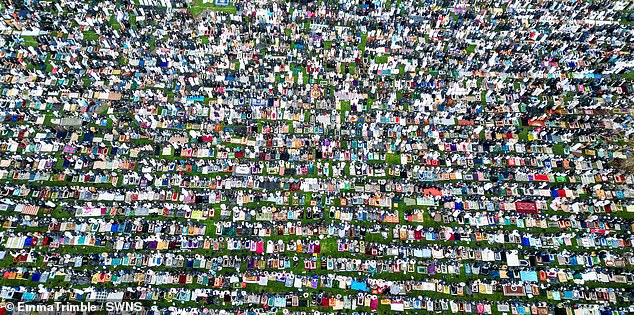
Worshippers in Small Heath Park, Birmingham. As a former Muslim, I feel compelled to point out Islam does not require mass public prayer in civic squares, writes Khadija Khan
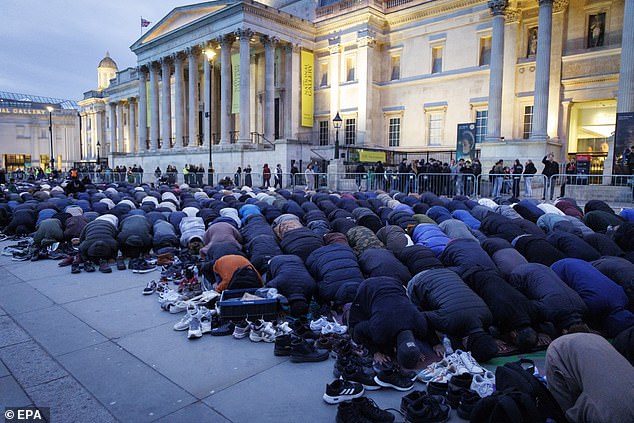
In London’s Trafalgar Square around 3,000 Muslims gathered for a mass prayer event on Monday marking the end of Ramadan
There is not a Muslim in Britain today who is prevented from practising their faith, attending a mosque, or going about their daily life. That is as it should be in a free society.
But those like Starmer, quick to cry ‘Islamophobia’, seem curiously uninterested in the nature of the event itself.
Commentators have pointed out that women were relegated to the back rows – literally placed behind men.
These are not fringe practices; it is entirely consistent with what I myself witnessed raised in a Muslim household in Pakistan, where it was made abundantly clear that women were not men’s equals. What is truly remarkable is not that such practices exist – but that so many Western feminists, otherwise so eager to denounce sexism and misogyny, fall into a deafening silence when confronted with it in this context.
Their silence is not accidental. It is part of a broader unwillingness to engage honestly with difficult questions about religion, culture and integration – questions that are instead dismissed as bigotry the moment they are raised –although only, it seems, in relation to Islam. Nor did this episode emerge in isolation. It is part of a trajectory that many ordinary Britons can see plainly, even if politicians refuse to acknowledge it.
One that started with the ongoing scandal of grooming gangs, where authorities too often failed to act against Muslim perpetrators for fear of being accused of racism. One that led to a terrified Religious Studies teacher in Batley, Yorkshire, being forced into hiding, where he remains to this day, after showing pupils a caricature of Mohammed.
And one that saw authorities last year allow an ‘inclusive’ Muslim-organised charity run to go ahead in a London park, despite the fact that it excluded women and girls over the age of 13.
One need only imagine the reaction if a Christian event in a major public square enforced visible gender segregation. We have seen as much in other contexts: last year, a Christian pastor was arrested for preaching in Bristol on issues of gender and religion – speech that, while controversial, did not break the law. Others individuals have been arrested merely for praying silently near abortion clinics.
Yet earlier this month, the Government announced special legal protections for so-called ‘anti-Muslim hostility’ – a concept so vaguely defined that it risks becoming a blasphemy law by the back door – and the appointment of a new Islamophobia tsar.
The message seems clear: In modern Britain, some beliefs are to be scrutinised relentlessly, while others are placed beyond criticism. What is this if not the creeping sectarianism of public life, as the Conservative leader Kemi Badenoch was courageous enough to point out earlier this year?
Join the debate
Should public spaces be used for large religious displays, or does this risk eroding shared values?
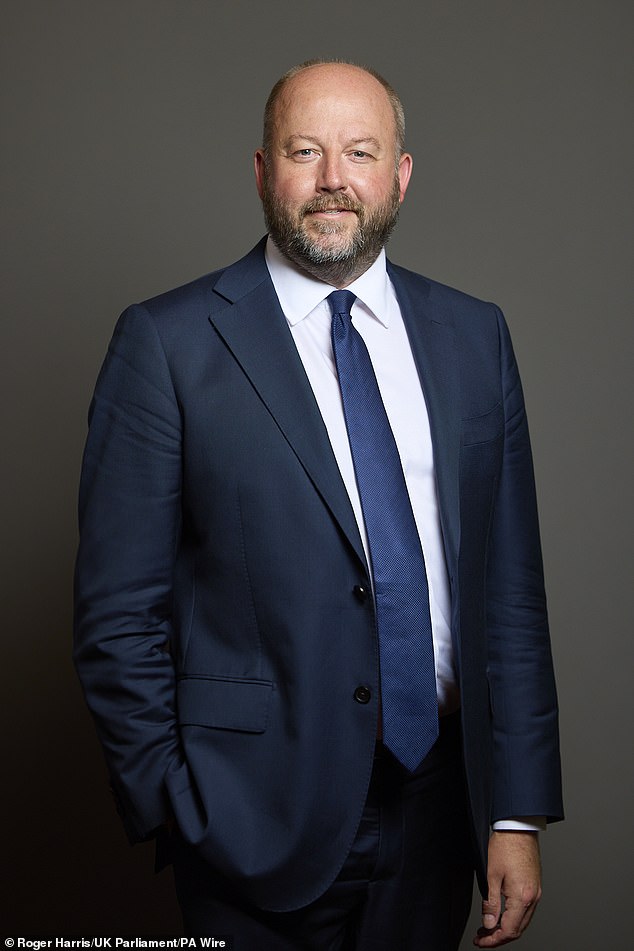
Nick Timothy merely raised a question about the appropriateness of large-scale religious ritual in shared civic spaces, but he was faced with calls for Kemi Badenoch to sack him
We are told, repeatedly, that these concerns are overblown. That to dare to articulate them is to inflame division. But the opposite is true. It is the refusal to address them that breeds resentment and mistrust. As a former Muslim, I also feel compelled to point out something else that has been conveniently ignored: Islam does not require mass public prayer in civic squares. Men are instructed to pray in mosques, women, needless to say, in the home. What we saw in Trafalgar Square was not a religious necessity, but a deliberate public display. The distinction matters.
A coordinated mass gathering in a symbolic national space is, by its very nature, a statement, and it is surely not beyond the bounds of acceptable discourse to ask what that statement is intended to convey.
It is why this performative outrage by Labour’s apparatchiks sickens me, not in the least because it reeks of naked opportunism. Labour has recently faced a sharp decline in support among Muslim voters, losing ground in areas where it once enjoyed near-unquestioned loyalty, as ‘independent’ pro-Gaza MPs challenge its former sectarian strongholds, while the Green Party candidate in the Gorton and Denton by-election last month campaigned in Urdu.
It does not require a particularly cynical mind to wonder whether the party’s opportunistic calls for Timothy’s defenestration this week have something to do with efforts to win that support back.
The hypocrisy, too, is staggering. Five years ago, Keir Starmer, then leader of the opposition, pulled out of an event hosted by the Ramadan Tent Project after learning of links between its founder and chief executive Omar Salha to a controversial advocacy group called CAGE.
At that point he was trying to woo the Jewish vote. Fast forward five years, however, and it seems his concerns have pivoted in direct correlation to the declining Muslim vote for his party.
The deplorable attempt to hound Nick Timothy out of his position is not about defending communities. It is pure politicking – and all of those participating in it should feel nothing but shame.
n Khadija Khan is politics and culture editor at A Further Inquiry magazine, and is also co-host of A Further Inquiry Podcast.