An Italian family who ran an unlawful car repair business from a lane behind their neighbour’s home has been hit with a £150,000 bill following a legal battle.
Rocco Grasso, his siblings Vito Grasso and Rita Palmieri and their cousins Michelle Viscido and Loredana Di Spirito had sought to assert a historical right to park in the lane behind terraced homes they own in Arnos Grove, north London.
Their applications were opposed by next-door neighbour Raffaele Raimondo, who has a garage at the end of the lane, home to his ice cream van and another vehicle.
Mr Raimondo, an ice-cream man for the last 40 years, claimed his and his family’s access was obstructed by Rocco, his brother Vito and his nephew Massimo Palmieri, who fixed cars in the lane before selling them on.
This laid the ground for a legal battle that culminated in an absurd seven-day-long court battle in the First-Tier Tribunal Property Chamber – where the case made by Mr Grasso and his family fell apart in spectacular fashion.
In farcical scenes in court, their Italian-speaking witnesses submitted ‘similar, if not identical’ written statements in English they did not understand, which had to be read back to them line by line in their native tongue.
And denials of car sales were undermined by photographs of broken cars being delivered – and screenshots of the newly repaired motors appearing on Auto Trader.
The family denied running a commercial business from the garages, asserting that they only sought an ‘easement’ to park there because they had regularly parked behind the garages since the 1970s.
But trial judge Ewan Paton said it was likely that the applications had been motivated by Rocco Grasso’s ‘desire’ to fix cars – evidenced by a denied planning application and enforcement notices served by Enfield Council for carrying out car repairs.
The five applicants now face having to pay Mr Raimondo’s costs – understood to be £150,000 – on top of their own, following a protracted case that the judge despaired at as having ‘spiralled out of control and out of all proportion to the issues at stake’.
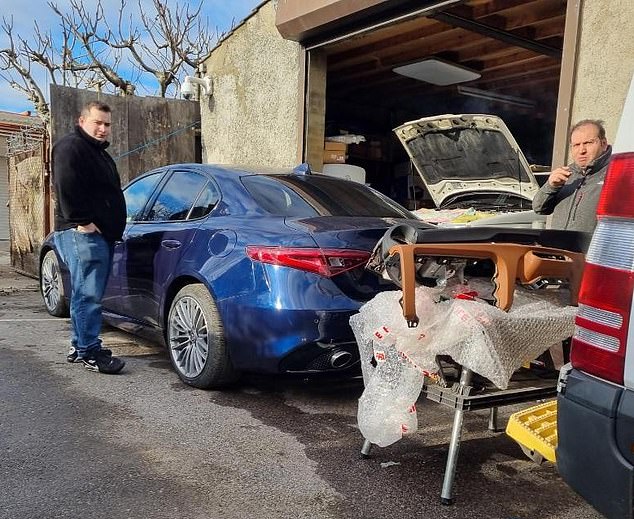
Massimo Palmieri and Rocco Grasso pictured in the lane. The pair were alleged to run an unlawful mechanic business, obstructing access
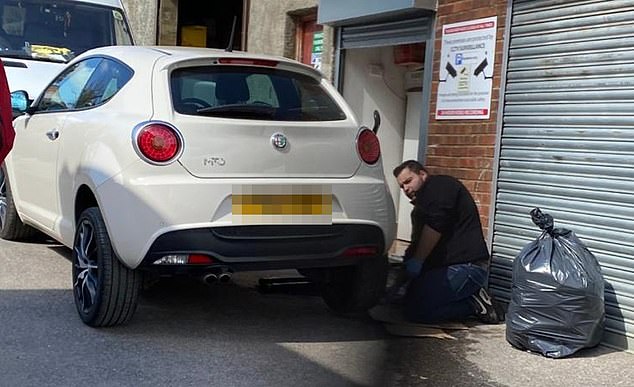
Massimo Palmieri seen kneeling beside a car in the lane that led to the legal dispute
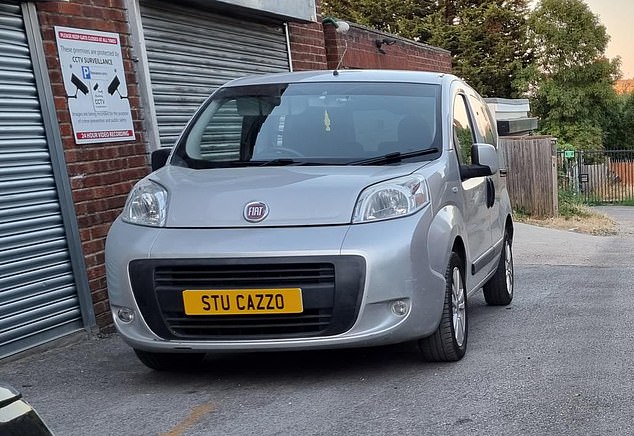
When Mr Raimondo bought the lane and hired private traffic wardens, Mr Grasso and co responded by covering up their number plates with Italian vulgarities
The row dates back to 2013, when Vito and Rocco Grasso, along with Mr Palmieri, are alleged to have started fixing cars in the lane.
The court heard that this made it more difficult for Mr Raimondo, his wife Carolina and their children Luisa, Vincenzo and Michele to drive up the lane, and impossible to execute a three-point turn.
In this time, Rocco Grasso failed in his bid for a change of use in the lane to allow him to run a commercial car business, and was sanctioned by the council for building an unauthorised dropped pavement at the front to facilitate parking.
Enfield Council also served two enforcement notices in 2014 and 2020 after they continued to fix cars nonetheless.
Seven years later, Mr Raimondo purchased the deed to the lane itself for £7,500 – giving him the right to hire private parking enforcement in order to ‘police’ the lane.
This prompted a tit-for-tat response from Mr Grasso and his family, who covered up the number plates of cars parked in the lane with a parcel tape and vanity plate bearing the Italian vulgarity ‘stu cazzo’.
Mr Grasso, described in court as repeatedly trying to get his own way, then submitted an application to the Land Registry to claim a historical right to park on the land – known as an ‘easement’.
His cousin Michelle and her sister Loredana submitted a similar application for an easement on the land behind their house next door.
Mr Raimondo contested it, suspecting the applications to be a smokescreen in order to continue the unlawful mechanic activity on his land.
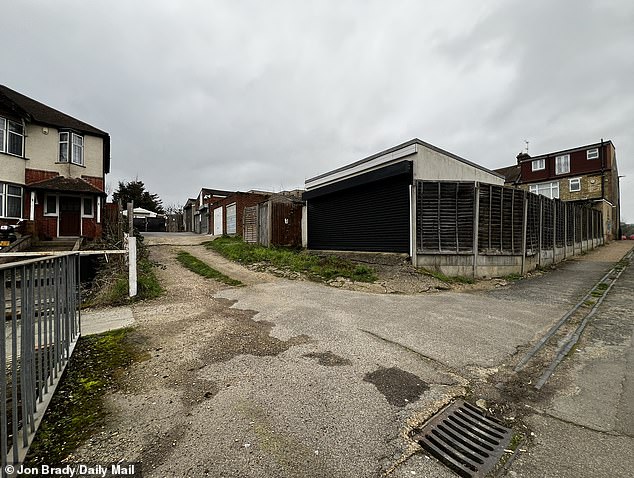
The lane sits behind a row of terraced houses in Arnos Green, north London, where the families have each lived for decades
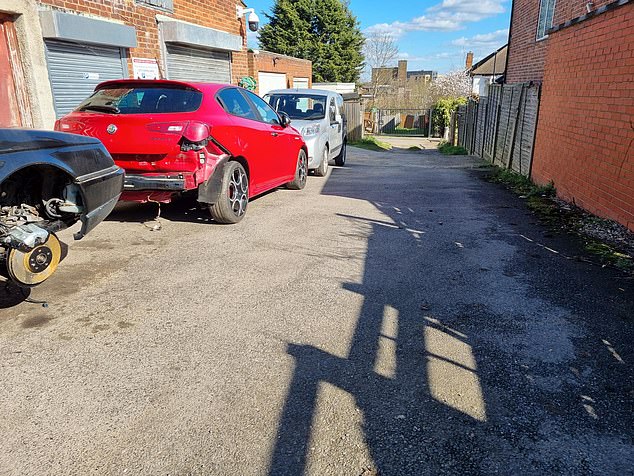
The lane with cars along one side outside the garages, including one with no rear bumper and one with its wheel removed
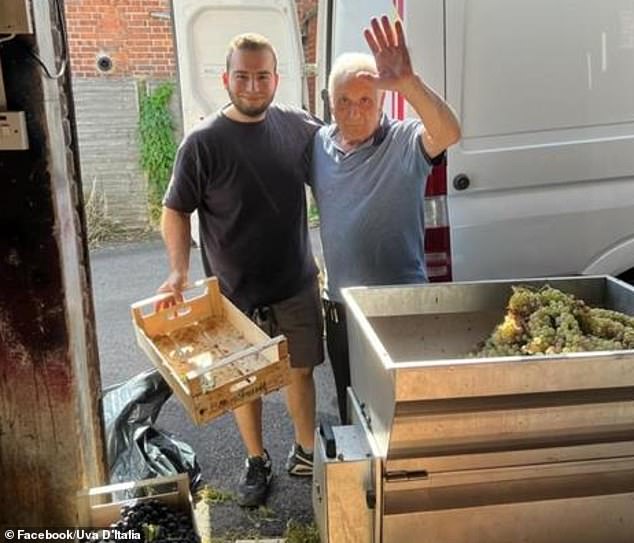
Massimo Palmieri pictured with Giuliano Grasso, Rocco Grasso’s father – who, the court ruled, had given a statement supporting the parking bid in ‘legal’ language that was ‘not his own’
Both applications were made under prescription and the common law doctrine of ‘lost modern grant’: essentially, Mr Grasso and his family claimed to have a long-standing right to park on the land as they had been doing so for more than 20 years.
But in astonishing scenes, seven supportive witnesses including Michelle’s father Gerardo had to have their statements read back to them in Italian amid doubts over their veracity.
Mr Grasso’s father Giuliano gave a statement to the court claiming he had parked in the lane since 1976, denying claims by Mr Raimondo that the van was normally parked outside a Harvester pub across the street.
But the statement was written in what the judge described as ‘”legal” language which I do not consider was his own’.
The judge noted that it was ‘likely that their brief witness statements were drafted for them by or on the instructions of their children’.
Gerardo gave a statement claiming he had parked behind his house next door since 1980, but the ‘very brief and generic’ passage had to be read back to him in Italian via an interpreter – as did other witness statements.
Lawyers acting on behalf of Mr Grasso and co were even forced to withdraw reliance on one key witness when it emerged that he did not read English to any significant level. They had not been told this before the start of the seven-day trial.
Mr Grasso’s other supporters in court included old school friends and acquaintances or business associates of his father – who did not always declare their personal connections in their witness statements.
The farce prompted Judge Paton to question whether the statements were ‘genuinely in these witnesses’ own words’ or had been ‘fed’ to them.
Loredana, meanwhile, did not give evidence despite being one of the five people named as applying for the right to park behind the houses – the court hearing that she has not spoken to her sister in years.
This was, the judge said, ‘striking’ – and gave credence to a theory that the applications were largely being driven by Mr Grasso.
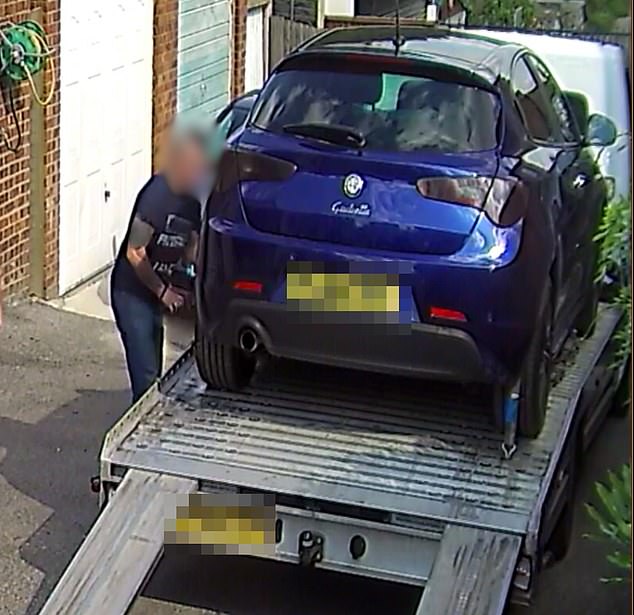
A car being delivered on the back of a flatbed lorry into the lane
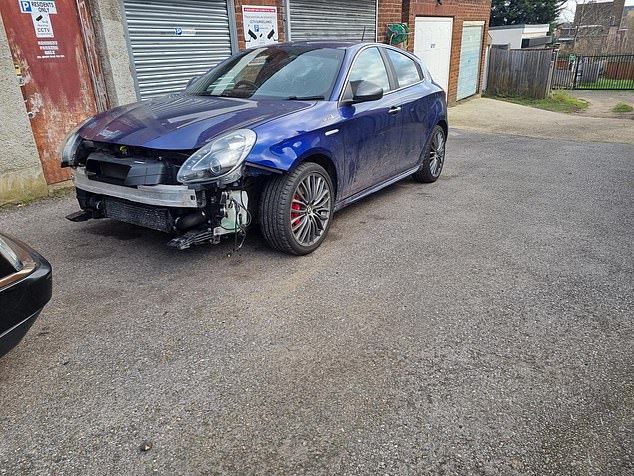
Mr Grasso denied fixing cars for commercial gain despite being served enforcement notices for doing that by the council (pictured: an Alfa Romeo that arrived damaged)
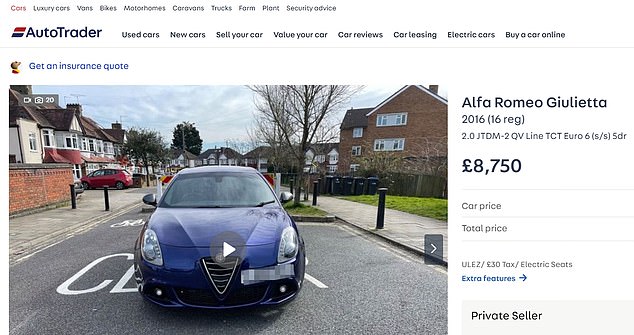
The same Alfa Romeo as it appeared on Auto Trader after it had been repaired in the lane
While the legitimacy of the business was not a matter for the case, it was ‘clear’ that Grosso and Massimo Palmieri were using the lane as a mechanic’s garage and selling the cars on Facebook and Auto Trader, evidenced by photographs.
Mr Palmieri, despite the evidence to the contrary, claimed during the trial that the cars were a ‘hobby’ and for ‘personal’ use.
Mr Raimondo, on the other hand, produced several neighbours unknown to both him and Mr Grasso, including a man who had lived nearby since 1959, who said he had never seen cars parked on the lane until the mechanic trade began.
Tribunal Judge Ewan Paton noted that both sides ‘exaggerated(d) their positions’ – but found in favour of Mr Raimondo as any parking behind the garage was ‘occasional, and often temporary… at best’.
In a written judgment, he said it was ‘clear’ that Mr Grasso and Massimo Palmieri had been working on cars in the lane, and that the application to park on the land could be ‘traced back’ to his previous planning applications for a change of use.
He also concluded that the Grassos and their wider family would ultimately ‘oust’ Mr Palmieri from the lane if allowed to park there – which the law could not allow.
The judge added: ‘I consider that (Rocco Grasso’s) desire to establish this parking right, where other attempts have failed, has coloured his evidence and also influenced others enlisted to support the application.
‘The rights claimed in this case could not in any event have existed in law as easements.’
Judge Paton also lamented the scale of the case, with some 47 witnesses called and swathes of evidence submitted for what amounted to a parking dispute.
‘The proceedings have, on one view, spiralled out of control, and out of all proportion to the issues at stake,’ he wrote.
‘As between two very closely knit, hard-working and successful families of Italian origin, owning attractive properties with large gardens and garages, a dispute on this colossal scale over parking rights in a lane is deeply regrettable.
‘I conclude by expressing the wish that, despite the length, cost and bitterness of this dispute, the parties are from now on able to co-exist and co-operate as neighbours as best they can.’
The Daily Mail sought to contact each family at their homes in Arnos Grove. Michelle Viscido told our reporter the family would respond in due course – she did not answer further requests for comment.
Mr Raimondo’s family declined to comment when approached.