- Love Needs No Words by James Hunt (Gallery £16.99, 352pp)
When the writer James Hunt learned he was going to become a father, he expected to have children rather like the little boy in Jerry Maguire: ‘chatty, clever, funny’ delights who’d make witty remarks as he carted them to parties and football matches.
But the reality turned out to be quite different.
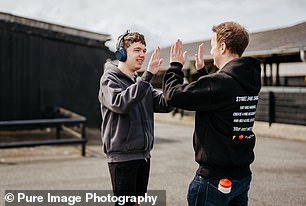
Hunt’s children
Hunt’s first son, Jude, was diagnosed with autism at 18 months, and has grown into a non-verbal teenager. A few years after Jude’s birth, Hunt and his then wife Charlotte had another boy, Tommy, who also went on to be diagnosed with autism. Today, Tommy is more communicative than his brother but Tommy cannot form sentences and will never be the conversationalist Hunt imagined.
Hunt’s memoir records the often gruelling life that he has led as his two boys’ carer.
The first diagnosis, he writes, plunged him into a bewildering world of leaflets and acronyms and the second was devastating, as he now had an idea of what might be in store: the sleepless nights, the constant vigilance, the tuts from strangers. Hunt is happy to admit he sometimes mourns the life he and his sons have been unable to lead.
He recalls a trip to a zoo with parents from his prenatal class who’d had ‘normal’ children: ‘I watched the other parents laughing, chatting, snapping photos of their kids. All I could think was we’re not a part of this any more.’
He is also frank about the toll that years of caring for Tommy and Jude had on his marriage. The boys do not always rub along well; though they both have autism, it expresses itself in different ways.
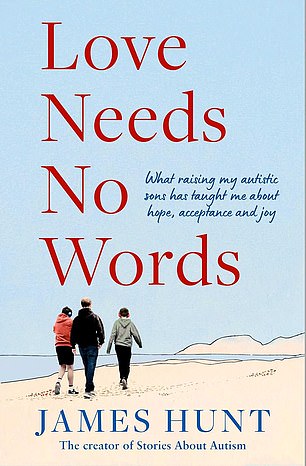
Love Needs No Words is available now from the Mail Bookshop
Eventually, Hunt and Charlotte realised while they’d poured everything into supporting the boys, their relationship had quietly died.
Hunt writes a popular blog, Stories About Autism, and is, like Charlotte, active on social media about the condition.
The book feels geared towards parents of autistic children, but it deserves to be read widely. What will stay with me is the relentlessness of Hunt’s schedule. He cannot fall asleep after Jude – but Jude has virtually no body clock, so regularly falls asleep past 3am, only to rise a few hours later. Even a small departure from the boys’ routine can wreak havoc, leading to violent meltdowns.
A chapter in which Hunt confronts what will happen to his boys after he and Charlotte die is particularly moving.
You will finish the book filled with admiration – not only for Hunt, but for his ex-wife and her partner, who have, along with their two daughters, formed a support system for the boys.
And for all that Hunt is unsparing in his descriptions of what life as a carer entails, his ‘fierce, unshakeable’ love for his sons shines through.