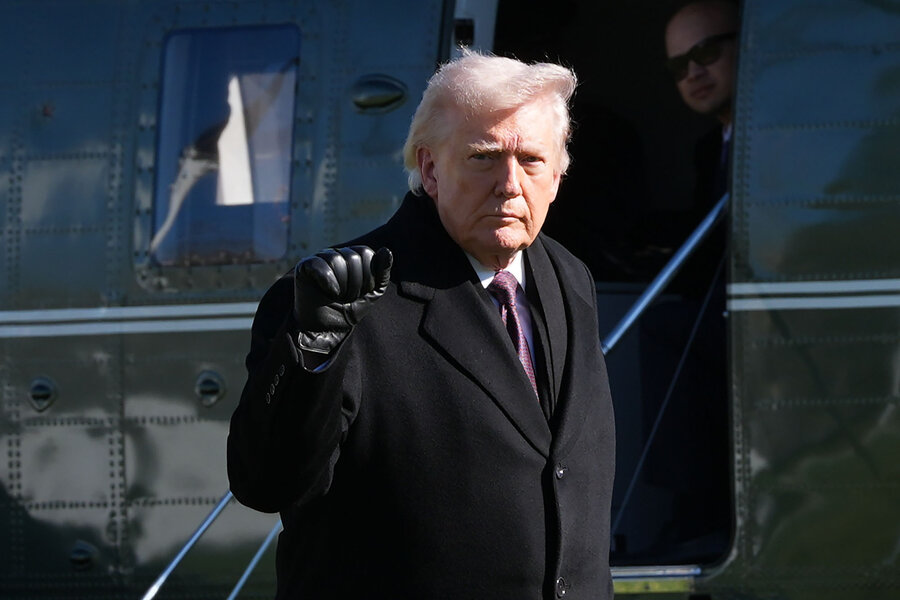
For a hot minute, it appeared that President Donald Trump’s bold decision to go to war with Iran would fracture his MAGA base.
Outside criticism was immediately fierce, as movement influencers, including Tucker Carlson, Megyn Kelly, and Candace Owens, made clear their opposition in the name of “America First.”
This week, top Trump counterterrorism official Joe Kent resigned over the war and is now under investigation by the FBI. Speculation was rampant that his boss and ally, Tulsi Gabbard – the director of national intelligence and a longtime opponent of U.S. interventionism – might also quit or be fired. Vice President JD Vance, another anti-interventionist, is also out of sync with the president on foreign wars.
Why We Wrote This
Polls show that President Donald Trump’s war against Iran has strong support among self-identified MAGA voters, despite strident criticism from some conservative commentators. How long the president can maintain that support, as war costs rise and gas prices mount at home, is unclear.
But a funny thing has happened on the way to the MAGA crackup: It hasn’t actually materialized – at least, not yet.
Polls show that President Trump, who launched the movement with his 2016 campaign slogan, “Make America Great Again,” still has the rock-solid support of MAGA voters. While a majority of Americans – including a quarter of Republicans – oppose the U.S.-Israeli war against Iran, surveys show some 90% of voters who self-identify as MAGA Republicans support it. And their devotion to Mr. Trump is firm, for now.

“The base of the party trusts Trump’s instincts on most issues, but particularly on foreign affairs,” says Scott Jennings, a Republican strategist.
This doesn’t mean Mr. Trump can do whatever he wants overseas with impunity. It’s still early days in the Iran war. His campaign promise of “no forever wars” holds deep meaning for his supporters, many of whom see America’s previous military ventures in Iraq and Afghanistan as expensive, unnecessary quagmires.
And while “America First” doesn’t equal isolationism, it does suggest an emphasis on domestic priorities and helping working Americans economically.
Thus, when Vice President Vance spoke at a manufacturing facility in Michigan this week, soon after the Kent resignation, his remarks were closely followed. He appeared to choose his words carefully, treading lightly on any opposition he might have expressed in the run-up to the U.S. war against Iran that began on Feb. 28. He made clear that his job is to support the president, no matter his personal views.

Julia Demaree Nikhinson/AP
“It’s fine to disagree,” Mr. Vance told the crowd. But “once the president makes a decision, it’s up to everybody who serves in his administration to make it as successful as possible.”
Ms. Gabbard, the director of national intelligence, also deferred to the president during two congressional hearings this week. In her prepared remarks, she noted that Iran had not resumed uranium enrichment, which suggests there was no urgency around Iran’s nuclear capability. But she skipped over that point in her public statement before the Senate Intelligence Committee.
Instead, she emphasized that it’s up to the president, as commander in chief, to determine “what is and is not an imminent threat” and to act accordingly.

Still, while Mr. Trump appears to be holding his administration in alignment on Iran, at least publicly, voter opinion might be harder to control. The MAGA base accounts for about half of Republican voters, and among the general electorate, it represents a distinct minority. A spike in gas prices caused by the war, as well as rising inflation overall, could well test the patience of core Trump supporters.
Among the overall electorate, the war is unpopular, and Mr. Trump himself has lost significant support among independents; he now has just 28% approval among that group in the latest Quinnipiac University poll. Those voters were key to his victory in 2024, and will be crucial in November’s midterm elections.
The impact of conservative influencers who oppose the war, such as Mr. Carlson and Ms. Kelly, remains a wild card. Their popular podcasts reach millions of people, and they provide a platform for views that now run counter to Mr. Trump’s messaging.
Mr. Kent, the just-resigned counterterrorism chief, appeared on Mr. Carlson’s podcast on Wednesday. He argued that an immediate threat to the United States from Iran “just simply did not exist,” and that Israel had pushed the U.S. into war. Israel has become a key point of division within both parties, but particularly on the right.

Tom Williams/CQ Roll Call/AP/File
Marc Farinella, a senior adviser at the Harris School of Public Policy at the University of Chicago, says that most people who aspire to be opinion leaders have deeply held beliefs, so “it’s not surprising that the influencers would not be as likely to just snap into line behind whatever Donald Trump wants.”
In addition, “there’s a lot of ambiguity about what ‘America First’ actually means, even among the MAGA base,” Mr. Farinella says. That leaves commentators a wide opening to present alternative views, which might well resonate with some voters.
It might also be that in these early days of the Iran war, polls are simply reflecting a “rally around the flag” effect, at least among Trump supporters. As time goes on, that burst of support could fade – especially if gas prices remain high, and voters find the cost of living increasingly untenable.
That could be the ultimate test of MAGA cohesion.