Families could face three interest rate rises this year as the economic fallout from the Iran war begins to bite.
The Bank of England warned yesterday that the growing conflict in the Middle East could send inflation spiralling and trigger a surge in unemployment – and any ‘protracted’ shock could force it to put up rates.
This would spell misery to millions of borrowers, with three base-rate increases of a quarter point adding around £100 a month to repayments on a £250,000 mortgage.
Iran warned yesterday that it could cause the ‘complete destruction’ of the Middle East’s oil and gas infrastructure on which the global economy relies.
Oil prices spiked 11 per cent to $119 a barrel and gas prices jumped by more than 30 per cent as the conflict escalated.
Andrew Bailey, governor of the Bank of England, said the surge in energy costs could affect wider inflation – including food prices.
Aviation chiefs warned that travellers faced a summer of price rises and cancellations as a global shortage of jet fuel started to bite.
After freezing interest rates at 3.75 per cent, Mr Bailey said: ‘War in the Middle East has pushed up global energy prices. You can already see that at the petrol pump and, if it lasts, it will feed into higher household bills.’
Many of the cheapest mortgage deals have been withdrawn in recent days. Most energy deals offering rates below the price cap had also been pulled by last night. Analysts had predicted two more interest rate cuts this year, with inflation expected to ease.
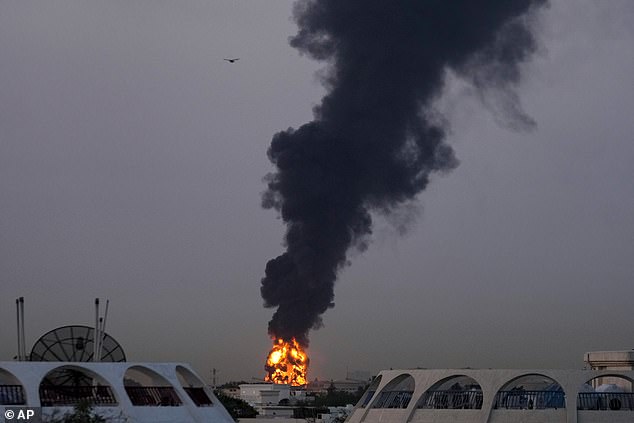
Flames and plumes of smoke pour upwards from a fuel tank near Dubai airport that was hit by shrapnel from an Iranian drone
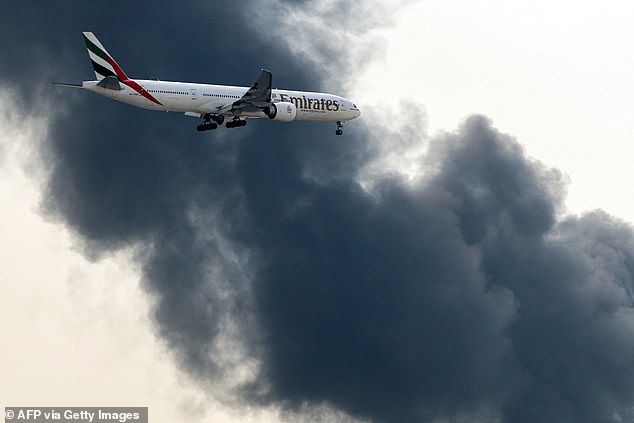
Flights to the major travel hub were temporarily suspended, though some still landed against a backdrop of smoke
But with the war in Iran threatening to trigger a full-blown energy price shock, those expectations have been thrown into reverse as experts warn the world faces crippling ‘Trumpflation’.
Sir Keir Starmer chaired an emergency meeting of the Government’s Cobra emergency committee yesterday to discuss the economic impact of the war on the cost of living.
Downing Street urged all sides in the conflict to ‘de-escalate’.
British military planners are also working on a strategy to protect tankers that have been unable to pass through the Strait of Hormuz following attacks by Iran.
But defence sources acknowledge privately that it will be almost impossible to reopen the vital shipping route – which usually carries a fifth of the world’s oil – until the conflict cools.
The crisis is a political disaster for Sir Keir, who put living costs at the heart of Labour’s agenda at the start of this year and asked to be judged on his success in bringing them down.
Soaring energy costs now threaten to wreck any progress, as well as blowing a hole in the public finances. Ministers admit they may need to fund a major bailout to help with energy bills if the crisis continues beyond the current price cap at the end of June.
The Prime Minister’s spokesman said: ‘We have been clear that the Government will fight people’s corner to tackle the cost-of-living crisis.’
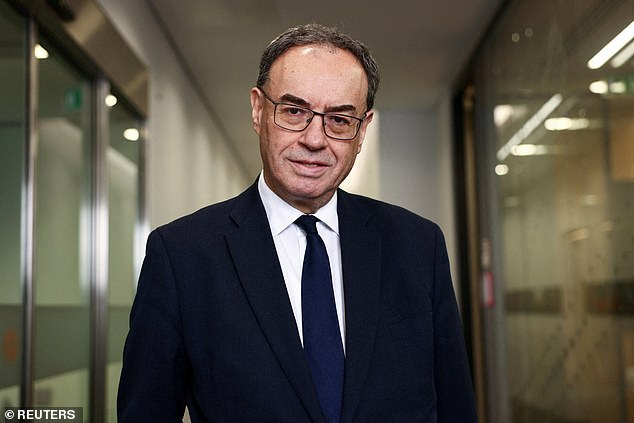
Andrew Bailey, governor of the Bank of England, has said the surge in energy costs could affect wider inflation
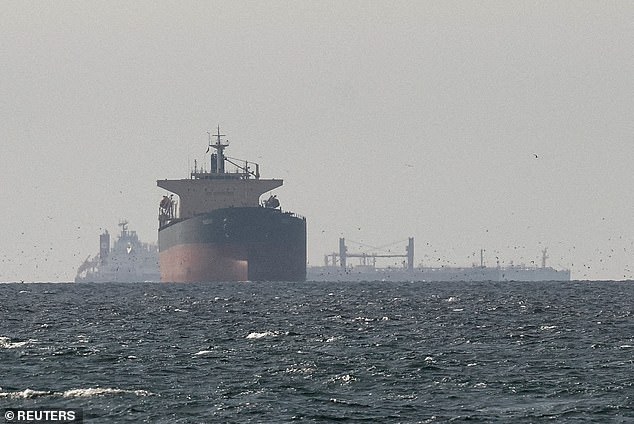
Tankers lined up in the Gulf outside the Strait of Hormuz, which is effectively closed
Downing Street insisted that petrol stations in the UK were ‘well stocked’ and urged drivers to ‘fill up as normal’. Ministers have already warned petrol retailers against ‘price-gouging’.
No10 said it was also talking to airlines about ensuring a supply of jet fuel and limiting increases to ticket prices. It warned the travel insurance industry to brace itself for ‘an increase in claims’ and urged airlines to keep tickets ‘fairly and appropriately priced’.
The latest warnings came after Iran attacked key energy facilities in the Persian Gulf, including the world’s largest liquid natural gas (LNG) complex in Qatar, knocking out a sixth of the country’s LNG exports for between three and five years.
The attack came in revenge for an Israeli strike on its huge South Pars gas field, and Iran warned that any repeat would result in the ‘complete destruction’ of enemy infrastructure.
Global stock markets tumbled, with the FTSE 100 falling more than 2 per cent as fears of a prolonged war fuelled the prospect of a cost-of-living squeeze and economic slump.
Meanwhile, Government borrowing costs soared to their highest in more than a year as investors dumped UK bonds.
However, as governments and central banks across the world tried to contain the fallout, US secretary of war Pete Hegseth launched an extraordinary rant against European allies for being ‘ungrateful’ after they refused to take part in the conflict.
The turmoil spells misery for UK borrowers. Before the war broke out last month, hopes were high that the Bank of England would cut interest rates further this year, starting yesterday.
Those hopes have now been wiped out as rate-setters left the cost of borrowing on hold at 3.75 per cent – and warned it may even have to rise.
It prompted traders to bet that there would be three increases this year. Mr Bailey cautioned against making ‘any strong conclusions’ about rate rises, but by last night markets were still betting on three.
In an interview with the broadcaster LBC he admitted rate cuts were ‘not on the horizon’.
Earlier, Mr Bailey said he was ‘monitoring developments extremely closely’ after the war sent oil and gas prices surging.
It came as latest figures from the RAC showed petrol prices had already climbed by 10.5p to more than 143p a litre since the war began. Diesel prices are up by 21.4p to nearly 164p.
Mr Bailey said he was ‘ready to act as necessary’ to keep a lid on inflation – apparently opening the door to a possible rate rise as soon as next month.
He also warned of further knock-on effects for the cost of living, telling LBC the crisis is likely to ‘create pressure’ on food prices as the cost of growing crops rises.
The Bank also said it was watching out for the prospect of an economic downturn that ‘could result in a more rapid or larger rise in unemployment’.
It said the surge in oil and gas prices had derailed hopes that inflation will fall to its 2 per cent target this spring. Instead, the Bank believes inflation will climb to 3.5 per cent this month.
The energy price shock has come at a time when economic activity is already ‘subdued’, with growth flatlining in January.
The Bank said the jobs market remained ‘weak’, with unemployment stuck at 5.2 per cent.
Its regular survey of business conditions suggested that firms were gloomy even before the conflict started.
It stated: ‘The overall picture is still lacklustre. There is little evidence of consumer spending rallying.’