Donald Trump said he warned Benjamin Netanyahu not to strike any more gas fields after a controversial Israeli attack sent global energy prices spiralling.
The US President sparked speculation of a split with his ally after insisting he ‘knew nothing’ of its plan to hit South Pars in Iran, the world’s largest gas field.
Tehran ignored calls for restraint yesterday and furiously retaliated with its own strikes on energy infrastructure in Israel, Kuwait, Qatar, and Saudi Arabia.
And, despite warnings, attacks were continuing overnight, with drones sparking a fire at a refinery in Kuwait.
As the war spiralled, Mr Trump insisted the ‘little excursion’ will be ‘over pretty soon’ and said he has spoken with the Israeli PM about striking oil and gas fields.
‘I told him, don’t do that, and he won’t do that,’ the President told reporters as he met Japan‘s prime minister.
‘We’re independent, but get along great,’ he added, explaining that the strikes are ‘co–ordinated’ but occasionally Mr Netanyahu will ‘do something’ that he opposes.
It came after he appeared to lambast Israel in the immediate aftermath of the South Pars strike, accusing them on Truth Social of having ‘violently lashed out’.
He said: ‘The United States knew nothing about this particular attack,’ adding that ‘NO MORE ATTACKS WILL BE MADE BY ISRAEL’ on the South Pars field unless they’re provoked by Iran.
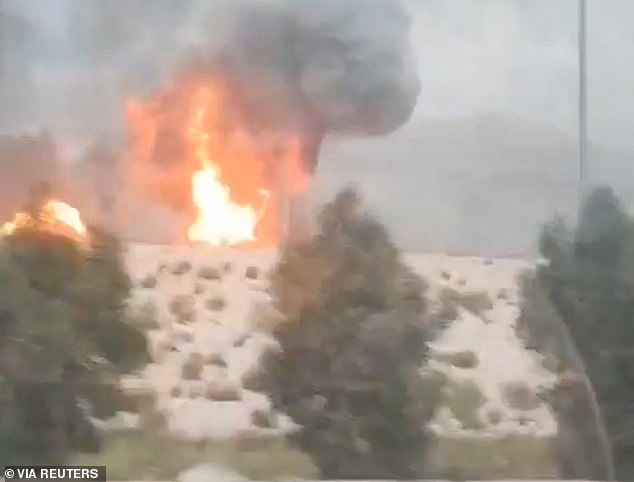
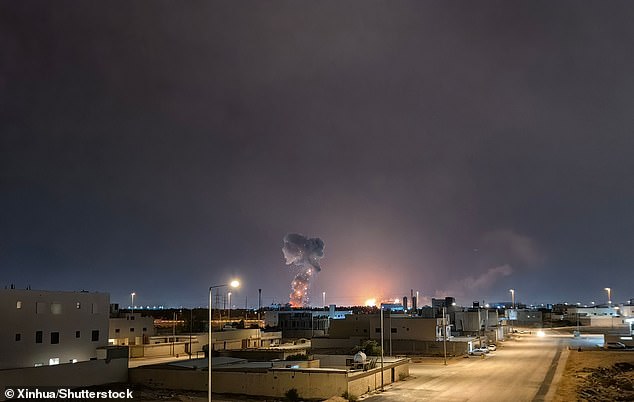
Smoke and flames rise from the South Pars gas field following an Israeli strike, as seen through the window of a moving vehicle
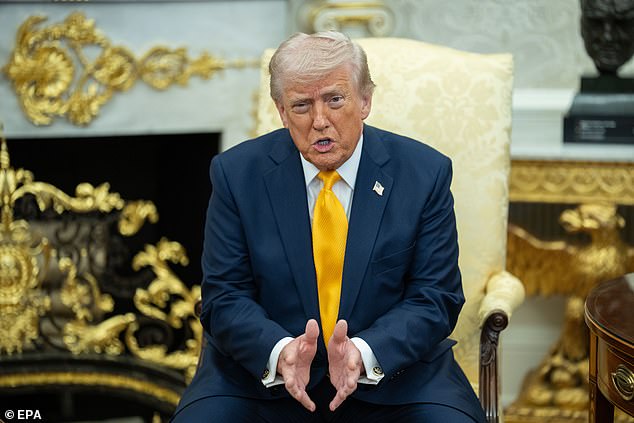
Donald Trump said he warned Benjamin Netanyahu not to strike any more gas fields after Israel’s attack sent oil prices soaring
But Mr Trump also warned that if Iran did not back down, Washington would ‘massively blow up the entirety of the South Pars gas field at an amount of strength and power that Iran has never seen or witnessed before’.
Mr Netanyahu last night denied ‘dragging’ the US into the war, branding such claims ‘fake news’ before saying ‘does anyone really think that someone can tell President Trump what to do?’
The Israeli PM said Israel ‘acted alone’ on the attack on Iranian gas fields, admitting that ‘President Trump asked us to hold off on future attacks and we are’.
He also said Iran is ‘weaker than its ever been’, while Israel is stronger.
Alex Gandler, spokesman for the Israeli embassy in London, told the BBC there was ‘no daylight’ between the US and Israel.
He added: ‘We are very much aligned on most or all of our goals regarding the Islamic regime in Iran, the IRGC [Islamic Revolutionary Guard Corps], their ballistic and nuclear programmes. We want the same thing.’
Three separate Israeli officials also told Reuters that the attack was coordinated with the US in advance, though is unlikely to be repeated. Speaking anonymously, they added that they were not surprised by Mr Trump’s comments.
US Secretary of War Pete Hegseth tried to dampen claims of a rift, saying Israel was ‘an incredible and capable partner’.
Specifically on South Pars, Mr Hegseth added that Israel had ‘sent a warning’ to Tehran.
But Tulsi Gabbard, the US director of national intelligence, said US and Israeli war goals were ‘different’.
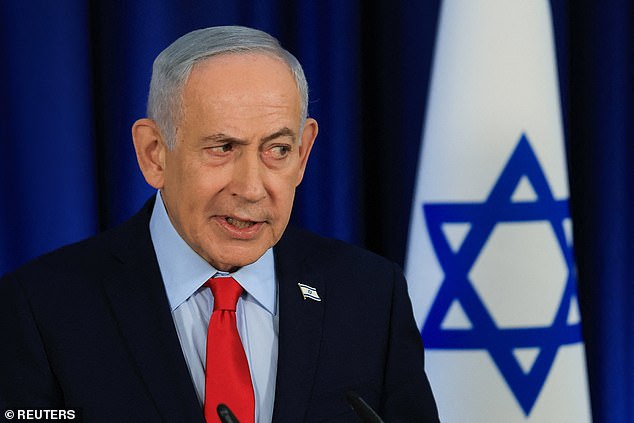
Mr Netanyahu last night denied ‘dragging’ the US into the war, branding such claims ‘fake news’
Saudi Arabia threatened Iran with military action as it claimed any trust with Tehran had been ‘shattered’ after Riyadh was targeted by ballistic missiles. (Pictured: Saudi air defences intercept missiles in the capital on Wednesday)
Israel was ‘focused on disabling the Iranian leadership’ while the US wants to ‘destroy Iran’s ballistic missiles launching capability, their ballistic missile production capability, and their navy’.
Ms Gabbard is one of the leading voices in the Trump administration sceptical of foreign intervention, but while she has so far supported the war, her close ally Joe Kent resigned as National Counter–terrorism Centre Director over the conflict this week.
Meanwhile, Saudi Arabia threatened Iran with military action as it claimed any trust with Tehran had been ‘shattered’ after Riyadh was targeted by ballistic missiles.
In the harshest comments to come out of the Gulf kingdom since the war started, Saudi Foreign Minister Prince Faisal bin Farhan accused Iran of premeditated actions against its neighbours.
He said: ‘This pressure from Iran will backfire politically and morally and certainly we reserve the right to take military actions if deemed necessary.
‘What little trust there was before has completely been shattered,’ bin Farhan said following a meeting between foreign ministers of Gulf and Arab countries in the Saudi capital.
‘We’re going to use every lever we have – political, economic, diplomatic and otherwise, to get these attacks to stop.’
An oil refinery in Saudi Arabia was hit on Thursday while eight ballistic missiles targeted the capital.
And interceptors were seen fired from near the Riyadh hotel where the conference was held.
‘I cannot see it as coincidental,’ bin Farhan said. ‘That’s the clearest signal of how Iran feels about diplomacy. It tries to pressure its neighbours, and that’s not going to work.’
Late on Thursday evening, the Kingdom said it intercepted and destroyed two drones in the country’s eastern region.
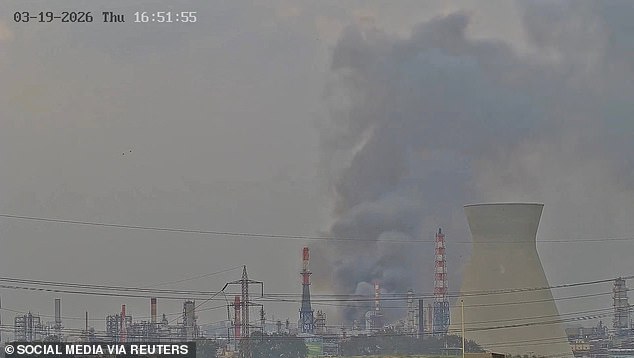
Iranian ballistic missiles damaged an oil refinery (pictured) in Haifa, a port city in Israel’s north
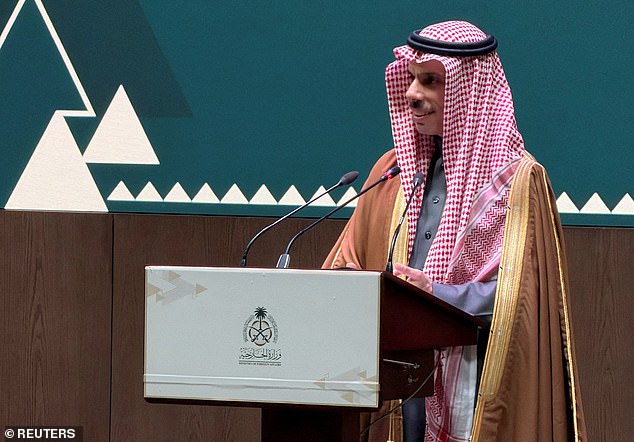
Saudi Foreign Minister Prince Faisal bin Farhan accused Iran of premeditated actions against its neighbours in the harshest comments to come out of the Gulf kingdom
Sirens in Jerusalem blared overnight as Iran sent another barrage of missiles at Israel, while an oil refinery in Haifa, a port city in the country’s north, was damaged.
Iran warned attacks on its energy infrastructure were a ‘big mistake’ and told Israel any repeat would lead to strikes on ‘your energy infrastructure and that of your allies until their complete destruction.’
Qatari officials said Iran’s missile attacks have reduced the country’s export capacity of liquified natural gas by 17 per cent and caused an estimated loss of $20billion (£14.9billion) in annual revenue.
Despite Mr Trump’s warning to Tehran, the regime responded to Israel’s strike by hitting Qatar’s Ras Laffan, the biggest LNG facility on the planet, sending gas prices rocketing by 35 per cent.
French President Emmanuel Macron slammed the ‘reckless escalation’ and urged Iran, Israel and the US to halt strikes on critical infrastructure. But the regime continued, hitting an Israeli oil refinery in Haifa with a missile yesterday. There were also drone attacks on the Kuwait Petroleum Corporation and Samref refinery in the Red Sea port of Yanbu in Saudi Arabia.
Iranian foreign minister Abbas Araghchi said: ‘Our response to Israel’s attack on our infrastructure employed [a] FRACTION of our power. The ONLY reason for restraint was respect for requested de–escalation. ZERO restraint if our infrastructures are struck again. Any end to this war must address damage to our civilian sites.’
With the world reeling from spiralling energy prices, Britain yesterday vowed to help reopen the Strait of Hormuz, a vital shipping route through which 20 per cent of global oil passes.
In a joint statement with the leaders of France, Germany, Italy, the Netherlands and Japan, the UK said: ‘We condemn in the strongest terms recent attacks by Iran on unarmed commercial vessels in the Gulf, attacks on civilian infrastructure including oil and gas installations, and the de facto closure of the Strait of Hormuz by Iranian forces.’
It added: ‘We express our readiness to contribute to appropriate efforts to ensure safe passage through the Strait. We welcome the commitment of nations who are engaging in preparatory planning.’
Meanwhile, the International Maritime Organisation (IOM) said it was confident the strait would reopen soon.
Mr Araghchi yesterday tried to rally support from counterparts in Turkey, Egypt and Pakistan against the ‘destabilising and escalatory actions’ by the US and Israel.
While the three countries have previously condemned the strikes, they have also joined a declaration demanding Tehran stop attacking its neighbours.
With no sign of de–escalation, Mr Hegseth said: ‘Again, today will be the largest strike package yet, just like yesterday was.’ He also said US forces could receive as much as $200billion (£150billion) from Congress to help fund the war effort and America’s wider military security, adding: ‘It takes money to kill bad guys.’