The Scottish Parliament arrived at the right decision. Westminster should do the same
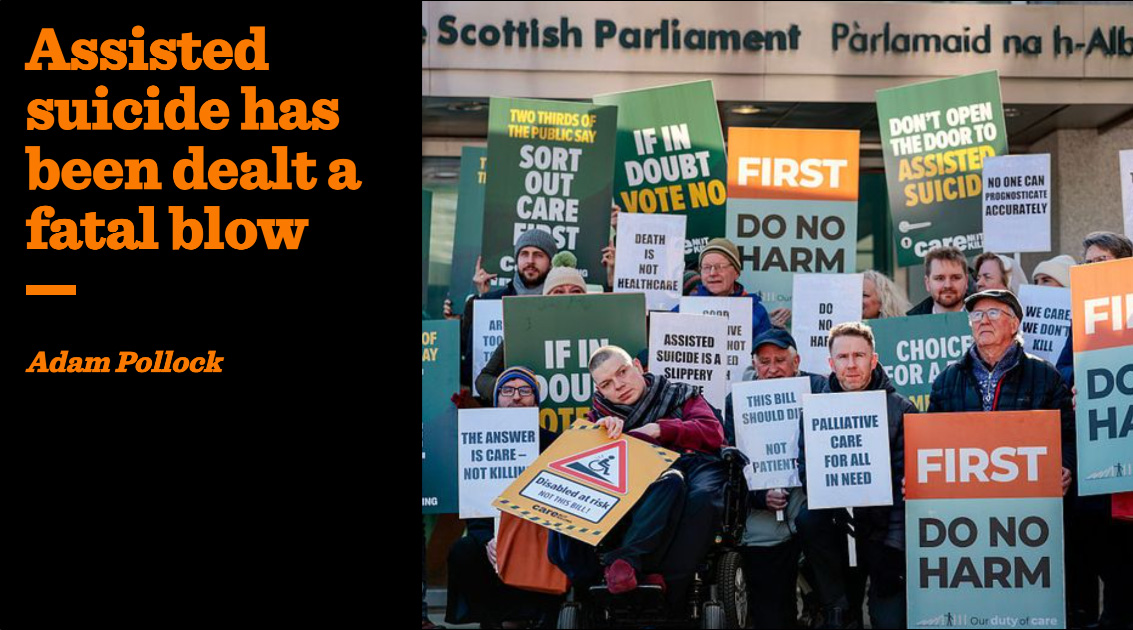
On a Saint Patrick’s Day to remember for this particular Irishman, the Scottish Parliament delivered a resounding victory for the most vulnerable people in society by rejecting the assisted suicide Bill.
While in the lead-up to the final vote, it appeared as if the result could fall either way, common sense won out in the end, with Holyrood rejecting the flawed Bill by 69 votes to 57. The victory was met not with the usual claps of support from attendees, but with a silence punctuated by the deep relief from the majority of MSPs that such a dangerous piece of legislation would not become law.
To reject the Bill by such a wide margin, after two years of intense debate and scrutiny, is decisive. Despite claims from the architect of the Bill, Liam McArthur, that the issue “is not going away”, it is certain that it has been dealt a fatal blow by the Scottish legislature.
The public debate around the Scottish assisted suicide Bill differed from that of the separate assisted suicide Bill for England and Wales, which is still plodding through its frequent Friday debates in the House of Lords. Unlike the latter, the Scottish Bill was not beset by false accusations that opponents were filibustering, or that a small handful of individuals were stopping progress by tabling large numbers of unrelated amendments. Assisted suicide lobby groups found themselves largely unable to employ some of their more dubious tactics.
This rejection appears to be sounding the knell for the assisted suicide Bill in Westminster
And yet the Scottish Bill received many of the same criticisms as that of its counterpart in Westminster: a lack of safeguards, the risk of coercion, unanswered questions regarding funding and implementation. It was for these reasons and many others that Holyrood ultimately decided to reject the Bill.
Importantly, this rejection appears to be sounding the knell for the assisted suicide Bill in Westminster. Supporters of the Bill can no longer get away with their spurious claims of filibustering. Peers are simply dedicating even more time to scrutinise many of the exact same issues as were debated in Scotland, and still managing to highlight new issues every week. It is clear from both debates that assisted suicide legislation must be completely watertight, foolproof, and extensively well-drafted; in both debates, it has been made clear that this isn’t the case with the bills before lawmakers.
For the main sponsors of the Westminster Bill, Kim Leadbeater and Lord Falconer, the rejection of assisted suicide by Scotland will be seen as yet another nail in the coffin of their thanatological plans.
Now that Scotland has rejected assisted suicide, it will create even more practical considerations for any implementation of assisted suicide in England and Wales — considerations that would require yet more debate and scrutiny before any proposals could be made safe.
Among these issues are various questions, such as the eligibility for assisted suicide of Scottish students studying in England and Wales — would they meet the criteria for being ordinarily resident in a region that allows assisted suicide? There is also the question now of the eligibility of people who have their main home in Scotland and a second home in England, which is the case for a great many people, for reasons as diverse as work and tax benefits. Would they also be eligible? These questions are, as yet, unanswered, and only further more debate and scrutiny of the legislation in Westminster could clarify them.
This will not happen; there are only three more sitting Fridays set aside in the Lords for scrutiny of the assisted suicide Bill, and there is no hope of getting through what amendments have already been marshalled without adding yet more concerns to the mix.
At the end of 2024, the Senedd in Wales also decisively voted against the principle of assisted suicide, meaning that two out of three nations of mainland Britain have now decreed that they do not want assisted suicide to become a normal part of the end of life. Come May, and the end of this Parliamentary session, it is likely that this will become three for three, and assisted suicide will be left for dead. I’m sure I speak for a great many people when I say it will not be missed.