This article is taken from the March 2026 issue of The Critic. To get the full magazine why not subscribe? Get five issues for just £25.
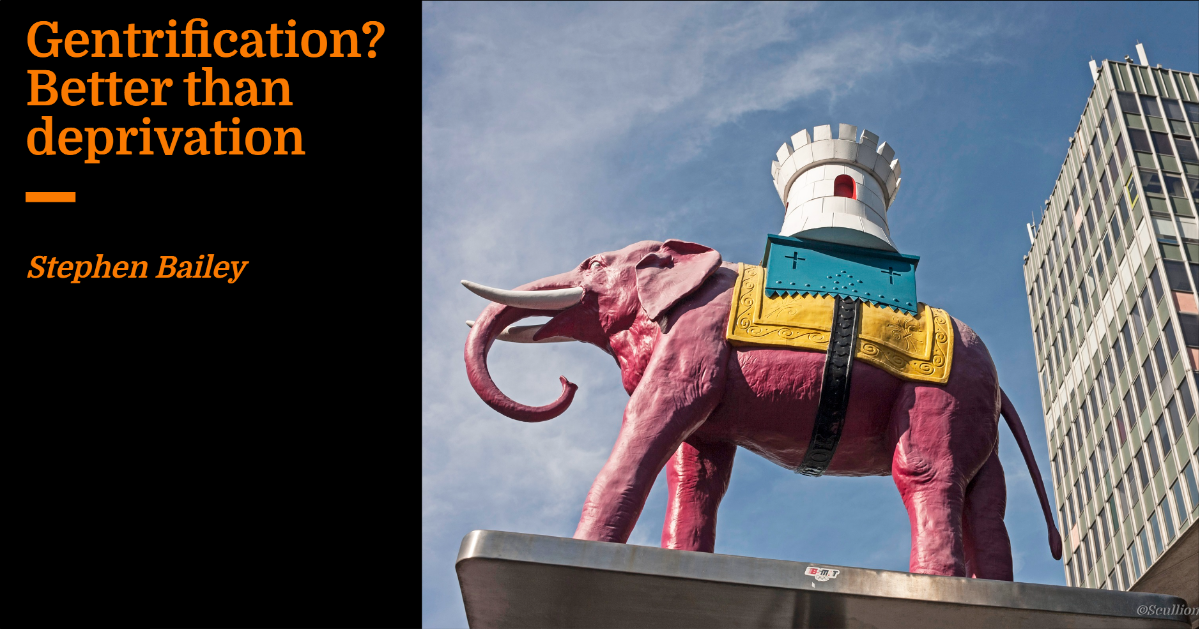
If you enjoy busy cities, and I do, the Elephant and Castle is a very fine place. You never want to live where it is easy to park — and parking in the Elephant can be remembered only by people now in their eighties. Yet my concept of “busy” has been an inferno of frustration and fear to some. Exploitation, too.
The Elephant’s frantic circulatory system is a legacy of Patrick Abercrombie’s 1944 Greater London Plan which made the case — which was advanced thinking in its day — for enlarged traffic intersections. The case was so successfully made that a normally bold and worldly North London friend will not travel south because she is afraid of the enormous roundabouts.
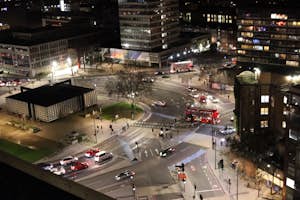
Many North Londoners see the Elephant and Castle as the reason they never travel south for any reason whatsoever. A well-known restaurant critic described it as a “stabby shithole of staggering grimness”. More positively, in Harry Potter, the Elephant is recognised as a magical area where toilets explode.
There are even finer literary references. Shakespeare mentions the Elephant in Twelfth Night, a reference to a local tavern of that name. So does Virginia Woolf in A Room of One’s Own where she remarks, not with much enthusiasm, on the number of buses in the area. In Down and Out in Paris and London, George Orwell describes the Elephant’s Rowton House, an 1897 “poor man’s hotel” created by philanthropist Lord Rowton, Disraeli’s private secretary.
This was a doss-house where card-playing was forbidden, so they stole the soap instead, but residents were given the dignity of personal cubicles. It was converted into the truly terrifying “tourist-class” London Park Hotel, a spectre of horror that would have made Kafka uneasy. This in turn made way — I think to widespread relief — for an ambitious leisure centre which, bright and cheerful, was a welcome signal of improvements to come.
The area’s architectural history is as rich in character as its past residents. George Dance the Younger, whilst city surveyor, had a magnificent, but unrealised, scheme for a plan of elegant and generous boulevards. Suggestions of what it might have been survive in the handsome Kennington Road which is nearby. The old London College of Printing (now the London College of Communication, “print” being so yesterday) was on the site of the ancient Worshipful Company of Fishmongers.
The post-war mood of the Elephant was established by the fabulously bombastic Anglo-Hungarian architect Erno Goldfinger, a pupil of Le Corbusier. He built Alexander Fleming House in 1958, as fine an example of unforgiving municipal Brutalism as you could wish to find. It might have a slightly sinister Soviet vibe, but if you are open to it, and I am, Goldfinger’s design is careful, disciplined, sensible and properly metropolitan in size and scale. Did you want to see a thatched cottage here?
When the DHSS moved out in 1998, Alexander Fleming was painted cream and converted to Metro Central Heights, launch-pads for the socially mobile — another prediction of things to come. Just across the traffic island, Roger Walters’s Perronet House of 1970 is a beautifully considered and nicely detailed modernist building. (Jean-Rodolphe Perronet was the architect and engineer who founded the Ecole National des Ponts et Chaussées, the world’s first civil engineering school, which gives you an idea of the ambition prevalent hereabouts in Goldfinger’s and Walters’s day.)
Time to sort out the origin of the name. In a 2013 book, Stephen Humphrey demolished the romantic, but fanciful, idea that the famous name was a garbled reference to the Infanta de Castile, Henry VIII’s Catherine of Aragon.
Instead, the records show that this area of Newington-Walworth was first called the Elephant and Castle in 1765 when a pub of that name opened here, although Shakespeare suggests such a thing had existed long before. The device of an elephant carrying a castle (a howdah) was a familiar one in metropolitan life, used, for example, by the Royal African Company soon after it was incorporated in 1660.
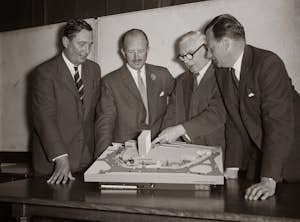
Once known, on account of its dancehalls and other (some more sordid) entertainments, as the ”Piccadilly of the South”, the Elephant was all but flattened by the Luftwaffe. Despite the confidence and authority of Goldfinger’s and Walters’s post-war buildings, the ineffable Ian Nairn found the area a “chronic muddle”. But Nairn’s London of 1966 was dedicated to the elegant John Nash, so brutality was bound to disappoint.
Gentrification is the elephant in today’s Elephant and Castle. This dread word was given popular currency by German-born sociologist Ruth Glass in a 1964 book London: Aspects of Change and it has become shorthand for callous opportunism, class-based social cleansing, wicked speculation, greed, and a blind eye or deaf ear to concepts of established community.
But myths of working-class utopias are weirdly skewed from reality’s axis. Cities are dynamic, or should be. Seventy years ago, John Betjeman wrote about a street off Chelsea’s King’s Road being careworn and grubby. Now it’s where Charles Saatchi lives.
Isn’t “gentrification” just a sniffy, deprecatory term for “improvement”? It’s routinely employed by miseries who choose insulting imperialist language and talk of re-colonisation, sequestration of affordable housing and forced emigration of the urban poor. A half-truth at best.
I would prefer to think of any city as a work-in-progress, a project that can be optimised, a map with no borders, a place with some losers but more winners. My version of gentrification means re-purposing neglected buildings, refreshing tired townscape, giving new life where only crushed weariness, rats and black mould existed before.
But there is always resistance to change even when obvious material benefits are on offer. Reactionaries were once on the right but are now on the left.
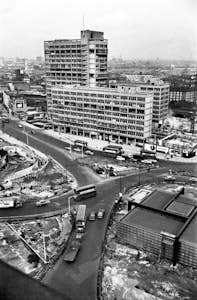
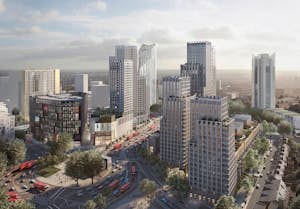
In 2026 the Elephant and Castle is gentrification writ very large. It’s not just sprucing up exhausted housing stock, it’s an entire townscape that is being first, re-imagined; and second, re-made.
The latest scheme, nearing completion, is the fifth to be considered for the site in the past twenty or so years. The master-developer is Lendlease, an Australian multinational. The focus is the central island which is, as these things always are, the milquetoast ”mixed use”. (How I long to read of a development as “patronising the poor” or “cynically targeting the privileged”).
What we now have replaces an unloved 1965 “shopping centre” by Boissevain & Osmond, stalwarts of British mid-century modernism. They designed a block erected upon a podium designed for those long-ago shoppers who would arrive by car. Ian Nairn, not wanting to flatter, called it “mediocre”. Lately painted a gruesome pink never the original intention, it was demolished in 2021.
But the first episode of the latest Elephant regeneration began with the demolition of the notorious and deeply, deeply dystopian Heygate Estate, a long-drawn-out process that started in 2011. Heygate was a seventies design by Tim Tinker, a student of the Smithsons, champions of austerity in design. “Ordinariness and light” was their motto.
Alas, Heygate fell short of even austerity. Twelve hundred and sixty dwellings were spread over six gigantic and forbidding blocks. Even enthusiasts for the nuances of Brutalism found Heygate difficult to love, but an ironic campaign to save it lasted until the last resident was “decanted”. Old whines were shipped out to Zone 5 and put into new bottles.
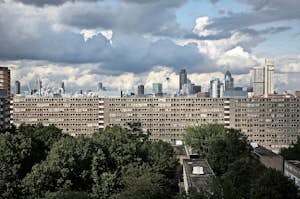
The demolition of the shopping centre was described by some as “a gutting of the community heart”. Most gutted was a pressure group called Latin Elephant, comprising the busy vendors of empanadas, arepas and frijoles: the Elephant has attracted South Americans and other exotics since the 1980s.
The new shopping centre is by Allies and Morrison who describe their task as urban “correction”. It is reliably decent 21st century vernacular, but a design whose ambition has perhaps been constrained by existing tubes, road and rail, not to mention the dauntingly muscular Christian Metropolitan Tabernacle whose classical arrangements survived the Blitz and, nearly opposite, Rodney Gordon’s bizarre Faraday Memorial.
Real effort has been made to retain a mix of future shopping with a variety of formats available to let. London College of Communication moves across the street from its very ordinary modern home to a more handsome “signature” twelve-storey building, anchoring the site of three taller residential towers.
The architects wisely see “universities as urban catalysts”. To this end, much of the new accommodation will be accessible to young graduates: incubators, I suppose, for a future generation of property-owning democrats.
Meanwhile, the Heygate Estate has been replaced by Elephant Park, where a consortium of architects has worked to a civilised masterplan by Gillespies. Whilst the landscape could not be mistaken for Stowe or Blenheim, it is a masterpiece of its kind: tranquil, calming and elegant. A fine replacement for the staggering grimness present heretofore.
However, to opponents of gentrification and its iconography, Elephant Park and its region are almost parodic. There is a statement gardening shop, as middle-class as an asparagus kettle.
You will find a coruscating Asian supermarket, as remote from a greasy empanada as Shangri-La is from Bogotà. Just around the corner, sourdough pizza! Artisan coffee! Ramen! Gelato (Badiani, Firenze, 1932)! And, of course, Gail’s, a synecdoche of social promotion, not so much a bakery as a command module for lofty ambition.
But by what principle or calculation is this not better than defeated poundstores, gum-splotched pavements, underpasses repurposed as pissoirs, disintegrating sixties concrete, stalls selling dulce de leche stiff with pathogens and vendors of “phone covers” who are really covers for money laundering?
Whatever else it might now be — although we could start with “safe and clean” — the Elephant and Castle is no longer a stabby shithole.
Forty years ago I toured the area on an open-top bus for a television programme. The then Prince of Wales was in his Poundbury moment and at his most vocal in condemning modern architecture. Unreasonably so, I thought. Hence my quixotic decision to defend a slum and a calamity, both characterised by ham-fisted building designs and depressed municipal vision. But that has all now been swept away. The King and I? We have each moved on.
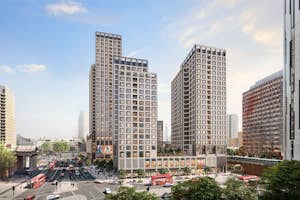
The new Elephant and Castle asks a simple, but huge, question: “What is the future for our cities?” You don’t have to be a Guardian-flavoured reactionary to find insensitivity in the great replacement of the dug-in urban poor to make way for incoming buyers of Sainsbury’s wagyu and Kiki & Miumiu’s Hot Chicken Flavoured Topokki. Some estate agents have dabbled in toponymic inflation and rebranded the Elephant as “South Westminster”.
I rather like the new South Westminster. But what if every slum is replaced by an architectural Esperanto of high-concept retail brands and polite modernist apartments? Does anybody actually know how to design for variety and texture? How to change, but stay the same? I am really not sure.
To what extent are we willing to encourage, or even tolerate, the never-ending expansion of Gail’s? Personally, I don’t have a good answer, but feel the future depends more on sourdough than sour grapes.
Either way, there’s still nowhere to park.