When news broke that John Galliano would be designing a collection for Zara, it’s fair to say that not even the most assiduous fashion watcher had it on their bingo card for 2026.
Many believed the announcement was an early April Fool. Galliano, after all, is a couturier, widely regarded as one of the greatest designers of his generation – and also a hugely controversial figure following a racist and antisemitic outburst that led to him being cancelled more than a decade ago.
Zara, meanwhile, is a high street giant, widely regarded as churning out ‘fast fashion’, whose affordability and disposability is the antithesis of haute couture and all that it stands for.
They say that opposites attract, but in the case of Galliano and Zara, the polarity is oil-and-water extreme. The odds would have been more favourable on Nigel Farage and Zack Polanski forming an alliance than these two.
While designer/high street collaborations are nothing new, Zara’s harnessing of Galliano feels different from anything that’s come before – its closest parallel being H&M’s collaboration with Karl Lagerfeld in 2004.
Like Lagerfeld, Galliano is a couturier, a rare talent for whom the word ‘genius’ isn’t hyperbole. As one insider puts it: ‘This is a big get. Everyone knows that Zara has deep pockets, but Lord knows how many zeros were on that cheque.’
At 65, Galliano may not be at the peak of his career, but nor is he at the point, as some have carped, where he’s only doing it for the money. Sources close to the designer insist his main motivation is the opportunity to dress a broader range of customer, for whom his previous designs were wildly unaffordable.
As legacies go, a Zara collaboration may not be the loftiest, but it will certainly have an impact, and is sure to sell out. As has Galliano himself, according to some critics.
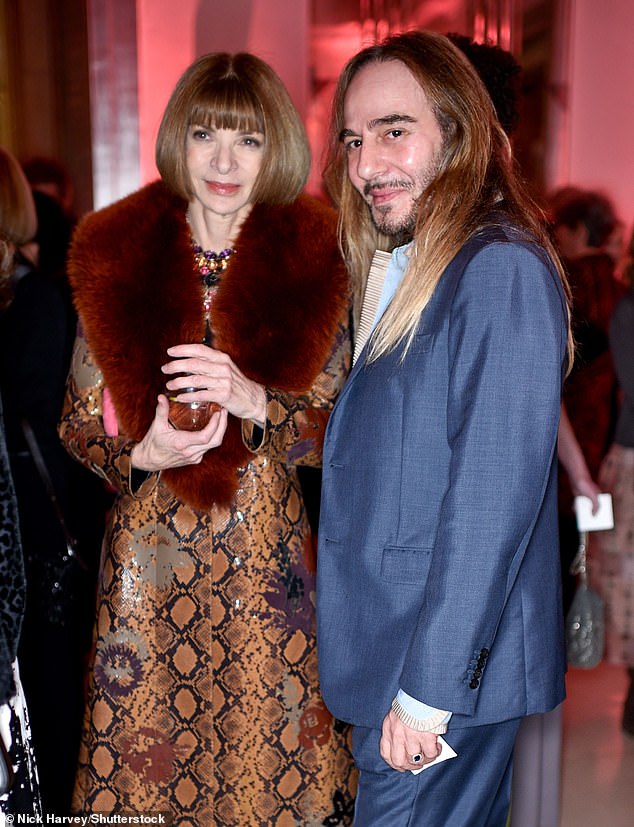
Controversial designer John Galliano pictured beside Anna Wintour. The announcement of his appointment at Zara was believed by many to be an early April Fool’s joke
And yet it’s also true that Galliano’s disgraceful behaviour of 2011 – when he was filmed in a Parisian bar making anti-Semitic comments – makes this a distinctly risky collaboration for Zara too.
So what’s behind the partnership – and who will it benefit most?
After 30 years at the summit of high fashion, it is a stretch to imagine Galliano is broke. The first British designer to head a major French couture house (Givenchy, in 1995), in 1996 he was appointed by Bernard Arnault, owner of luxury brand LVMH, as creative director of Christian Dior, one of the most coveted jobs at one of the most fabled names in fashion.
During his 15-year reign, Galliano’s theatrical shows became the stuff of legend, as did blockbuster bestsellers such as the Dior Saddle Bag – one of many hits that saw him turn a relatively sleepy house into a major luxury brand with annual revenues in excess of $1 billion (£750 million). His gowns were a frequent staple on the red carpet, with loyal fans including model Carla Bruni and actresses Nicole Kidman, Penelope Cruz and Charlize Theron.
While exact details are yet to be revealed, Tuesday’s announcement by the Spanish chain described a two-year creative partnership which will see Galliano ‘reauthor the brand’s archives through a series of seasonal collections’.
The press release continued: ‘Mr Galliano will be working directly with garments from Zara’s past seasons, deconstructing and reconfiguring them into new seasonal expressions and creations. Guided by a couture process and authorship, the collections will be released seasonally over the course of the partnership, beginning in September 2026.’
For many fashion lovers, the announcement raised more questions than it answered. On social media, many users scoffed at the idea of a high street chain such as Zara having ‘archives’ – a lofty term more commonly applied to the highest echelons of luxury fashion. ‘Chanel has archives. Zara has landfill,’ was one of the more scathing comments.
Other users posted memes of Zara’s £40 ‘viral’ black and white polka dot dress, a garment so popular during the summer of 2019 that it even spawned its own Instagram account. ‘I never want to see that dress again, not even if John reworked it, cut it on the bias and put it on Zendaya,’ one user quipped, alluding to the dress’s ubiquity.
While the news was interpreted by some as Galliano repurposing or ‘upcycling’ existing garments from past collections, to the chagrin of environmentalists sources at Zara tell me this will not be the case.
Instead, Galliano will study Zara’s archives and draw on past designs before creating his own spin. While the designs themselves might be old, the clothes will be entirely new. Rather than focusing on items that sold well at the time, the priority will be wardrobe classics.
For many, however, the biggest surprise isn’t Galliano’s partnership with Zara, but the fact he was approached in the first place.
In 2011, he was dismissed from Dior in disgrace after a video surfaced of him making those racist and antisemitic remarks at La Perle cafe bar in Paris while appearing to be under the influence of alcohol. He was later convicted in a French court for hate speech, and was seen as unemployable.
Join the debate
Should brands give controversial figures like Galliano a second chance, or are some lines uncrossable?
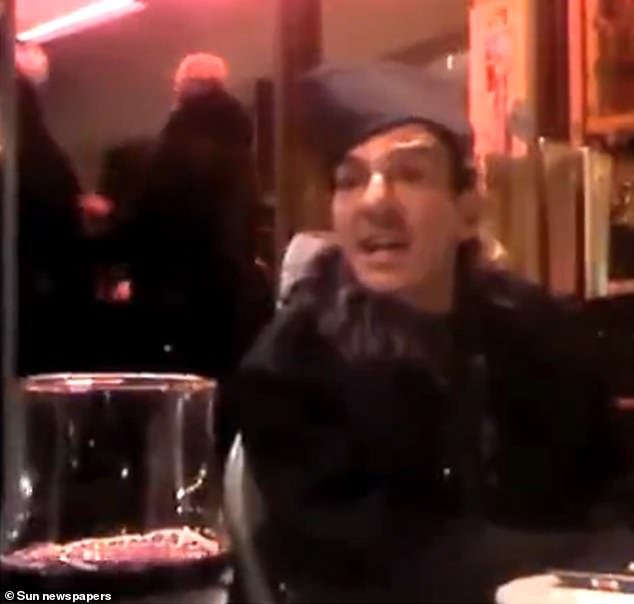
A still taken from the video showing John Galliano in a Parisian bar making anti-Semitic comments 15 years ago
For two years, he stepped away from public life, entering rehab for alcohol and substance abuse which he later said had contributed to his behaviour.
During this period, he also began learning about Jewish history and culture.
After reportedly being shunned by the Jewish community in Paris, an approach was made to the Anti-Defamation League in New York, which introduced him to the London-based Rabbi Barry Marcus in a meeting brokered by the chairman of Conde Nast, Jonathan Newhouse.
This is significant. Conde Nast is the parent company of Vogue, and no one has done more to support Galliano through thick and thin than Anna Wintour, the British-born fashion colossus who was editor-in-chief of American Vogue for 37 years from 1988 until her shock resignation in 2025.
Wintour is still Vogue’s global editorial director, as well as Conde Nast’s global chief content officer, overseeing each of its magazine brands worldwide.
A vocal supporter of her fellow Brit (Galliano was born in Gibraltar but moved to London aged six) ever since he graduated from Central Saint Martins in 1984, it was Wintour who masterminded his reintroduction to a hostile fashion world.
It’s no accident that her close friend, the designer Oscar de la Renta, was the first to reach out to Galliano in 2013, offering him a short residency at his New York studio in a bid to test the waters.
A bolder move came in 2014 when Galliano was appointed creative director at Maison Margiela, then owned by OTB Group, a lesser known entity than LVMH, which would have attracted a bigger backlash.
Many believed Margiela’s avant garde identity made it a more forgiving environment for a controversial figure, and Galliano wisely kept a low profile, never taking a bow at the end of his shows and letting his work speak for itself. Which it did.
Over the next decade, his collections were critically acclaimed, helping shift the narrative from scandal to craftsmanship. By the time Galliano left Margiela in 2024, both were on a high.
His final couture show in January that year was critically acclaimed and became a viral phenomenon, with his designs worn by a coterie of high-profile names including actresses Anya Taylor-Joy and Zendaya, singer Ariana Grande and model Kendall Jenner.
While some will never forgive the designer for his odious behaviour, others believe he has atoned. And some are simply cynical.
‘Fashion has an extremely short and selective memory,’ one editor tells me. ‘Morals go out of the window when there’s an opportunity to make money. It wasn’t so long ago that Balenciaga was cancelled after using toddlers dressed in bondage gear in its ad campaigns [in 2022]. Four years later, celebrities are queueing up to wear it.’
Galliano’s rehabilitation, then, was completed long before the Zara deal was brokered.
Even before it was announced, rumours – still unconfirmed – abounded that the Metropolitan Museum of Art’s 2027 exhibition would be dedicated to him, an accolade previously enjoyed by fashion greats such as Karl Lagerfeld.
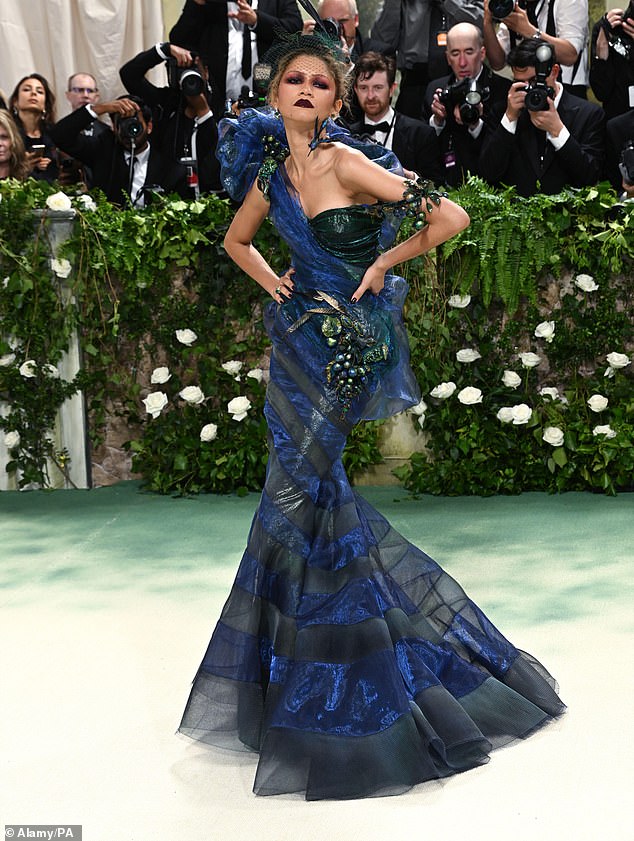
Actress Zendaya dons Galliano at the Met Gala in 2024. The latter is widely regarded as one of the greatest designers of his generation
If this comes to pass, it will be yet another instance of Anna Wintour giving the designer her blessing.
As an elective trustee of the Met, it is Wintour who signs off on every theme.
She has also chaired or co-chaired the museum’s prestigious Met Gala since 1995, transforming it into a high-profile fundraiser that’s garnered more than $300 million (£224 million) for its Costume Institute. Wintour oversees every detail of the planning, the sponsorship and the guest list.
Many believe 2027 will be Galliano’s year. Few would bet against Zara being a sponsor.
Now 76, Wintour’s power and influence over the fashion industry remains formidable. While it would be untrue to say that she brokered Galliano’s deal with Zara, it would be unrealistic to imagine she wasn’t a sounding bo=ard.
‘John will have asked Anna her opinion, of course,’ says one insider. ‘He asks her opinion about everything. If she hadn’t approved, would he have signed the deal? Doubtful.’
The woman who brokered the match, meanwhile, is Marta Ortega Perez, 42, the equally formidable daughter of Amancio Ortega, the richest man in Spain and owner of Zara’s parent company, Inditex, which also owns high street stalwarts Massimo Dutti, Bershka and Stradivarius.
Ortega Perez has been Inditex’s non-executive chairman since 2022, overseeing a strategic shift that has pointedly repositioned Zara as a destination for ‘affordable luxury‘.
‘Marta has been a lifelong fan of John’s work,’ says a source, adding that the designer visited Zara’s HQ in the city of A Coruña in northern Spain before signing the deal.
While Zara’s heft (it has around 2,000 stores in 96 countries) and volume (it produces around 450million garments a year, refreshes its stock every few days and designs around 20,000 new items annually) leads critics to denounce it as one of the most egregious examples of ‘fast fashion’, Ortega Perez would refute this, arguing that the reason so many of Zara’s best-loved styles sell out is because they aren’t produced in vast number.
The chain strives to be reactive to customer demand, and claims that less than 2 per cent of stock is residual or left over.
While Zara’s canny employment of the same photographers, stylists and supermodels that are used by fashion’s most prestigious luxury brands has done much to distance it from the fast fashion sphere, Galliano is by far its biggest coup.
‘This is a game-changer,’ says one fashion editor. ‘Shoppers will want to keep these pieces and hand them down. Provided the quality is there, a Galliano design is guaranteed to have longevity. Surely that’s the opposite of fast fashion.’
All will be revealed in September, giving fans six months to start saving. Not that they’ll need to.
Where a Dior or Margiela gown costs in the region of four figures – and a couture version costs a hefty six – a Galliano for Zara dress will retail for a fraction of the price.
Those who disapprove can keep their wallets closed. Those for whom the exorbitant prices of luxury fashion are out of reach will have all the more to choose from.