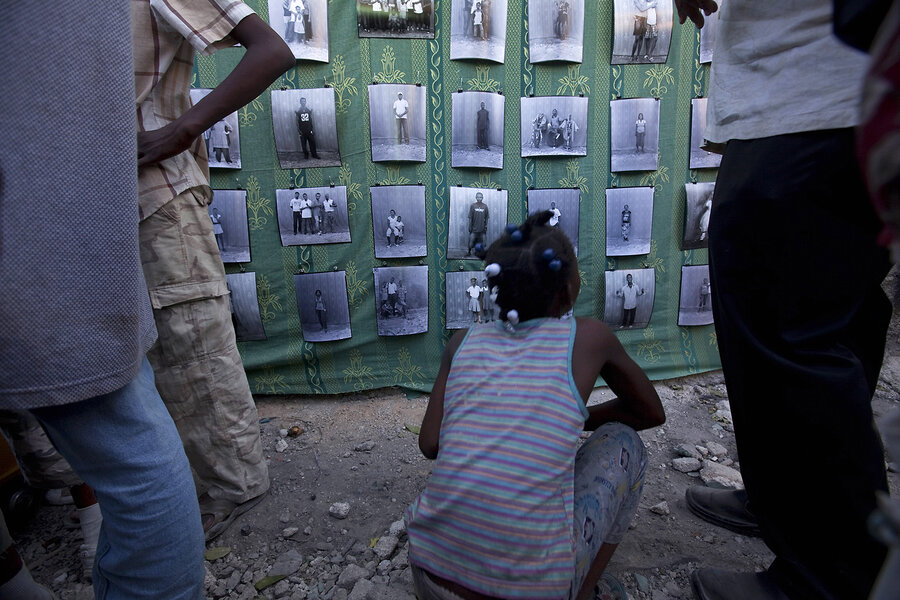
Tucked deep inside a labyrinth of lanes behind Port-au-Prince’s main boulevard, Grand Rue, sits what remains of one of Haiti’s most unique art galleries.
At the entrance is a large, black arch with letters cut from forged scrap metal reading “Atis Rezistans,” Haitian Creole for Resistance Artists. For nearly three decades, discarded objects have been transformed into sculpture here, a practice rooted in the cultural belief that materials, like people, can serve in more than one way.
It’s a philosophy of new beginnings, and it has taken on new meaning over the past two years as the streets surrounding the gallery have been looted, burned, and largely abandoned.
Why We Wrote This
Haiti is in a security and humanitarian tailspin, with millions of people internally displaced. The experience of a Port-au-Prince artist collective shows just how disrupted life has become – and the power of perseverance.
Since the assassination of President Jovenel Moïse in 2021, violence has shaken Haitian society, unraveling and reshaping its cultural life. The experiences of the artists from Grand Rue demonstrate much of that shift. They once helped connect the city’s artists to international audiences. But today, they are displaced across the country. Meanwhile, their gallery sits abandoned at the center of a violent conflict between gangs, police, international security missions, and politicians.
“We take what is broken, abandoned, or poor, and turn it into powerful art that speaks out against injustice,” says André Eugène who helped found the collective in 1996, on the same street where he grew up. He sees art as a way to lead Haiti back toward peace.

“Everyone was welcome”
Mr. Eugène taught himself woodcarving, inspired by sculptors at the capital’s Iron Market and by ceremonies for Vodou, a religion that blends West African spiritual traditions with elements of Catholicism. He started creating art from materials sourced in the streets, primarily the informal car-repair district. With cast-off tires, engine parts, plastic toys, and musical instruments, he made paintings, created jewelry, and fused sculptures.
Art, for him, is a way to tell stories about Haiti. He eschews aesthetics that might appeal to tourists, and instead addresses themes ranging from United Nations interventions to migration.
Other artists joined him over the years, growing into a movement of nearly a dozen members.
“Everyone was welcome there, no matter which neighborhood we came from,” says Ricardo Boucher, an activist who organizes poetry slams for displaced youth. He grew up immersing himself in literature at the National Library, before taking his verses into the streets, often painting walls alongside Grand Rue’s artists.
In 2009, the mostly self-taught artists began hosting the Ghetto Biennale, a cross-cultural arts festival held in informal neighborhoods in Port-au-Prince. It was a political statement, challenging the exclusivity and economic hierarchies of traditional art fairs.
“It was incredibly inspiring,” says Leah Gordon, a British photographer who helped found the Ghetto Biennale. Creating across socioeconomic lines is “something we’ve lost in Britain,” she says.

Nearly two years have passed since civilians could enter the Grand Rue gallery. In March 2024, armed groups launched a wave of attacks in Port‑au‑Prince, arriving at Mr. Eugène’s doorstep.
Members of a powerful gang coalition, Viv Ansanm, “entered with shotguns,” he recalls. But once they got a look at the art, the mood shifted. “You’re Vodou artists,” he recalls them saying. “We won’t harm your place.” Mr. Eugène suspects they were practitioners and superstitious about tampering with his art – though they did commandeer the space to store their weapons.
It wasn’t just Grand Rue that was targeted. The National Library was looted and ransacked, publishing houses and radio studios were set on fire, and bohemian gathering spots where the country’s creative class once thrived were attacked. The National Theater and the Ministry of Culture and Communication have been turned into shelters for displaced people.
An estimated 90% of the capital is now controlled by armed gangs, and almost 1.5 million people are internally displaced. Haiti hasn’t held a national election in a decade. A new multinational security force is scheduled to arrive in April to assist the Haitian police, who are often outnumbered by gangs.

Gratitude for creative outlets
Last year, Mr. Eugène fled the city seeking safety in Port-Salut, in southern Haiti. His recent work accumulates in a yard overlooking cloud-draped mountains. The sculptures cast long, shifting shadows as the sun moves across the coastal valley. He struggles to adapt to the stillness of rural life.
“When they destroy our culture,” he says of the gangs taking over swaths of Haiti, “they destroy our roots.”
Despite the upheaval, the displaced artists of Grand Rue continue their work, setting up new partnerships and exhibitions. At a show in Pétion-Ville, in the hills east of the capital, former Grand Rue artist Frantz Jacques arranges one of his latest sculptural collaborations with artist David Thébaud. It’s a tree, its roots straining against chains that anchor it to the ground.
“It’s a symbol of a country chained in every sense,” Mr. Jacques says. “The enslaved people who rose against Colonial rule. The chains placed on us by nations who oppress us. The mental chains we Haitians place on ourselves.”
Breaking free
In another part of Port-au-Prince, Atis Rezistans co-founder Jean Hérard Céleur is organizing an exhibit. Complementing the show are free art classes for young people, led by Mr. Thébaud.
Odanie Pierre, a former medical student whose studies were cut short by Haiti’s unrest, attends one of these classes, painting a woman in a blue coat. It’s meant to represent protection, she says. Painting “lets me express what’s in my head,” Ms. Pierre says. She’s grateful for the creative outlet.
Outsiders are now working to show the world what Grand Rue cannot.
While Haiti’s last planned Ghetto Biennale was suspended in 2024, it was later hosted by the Utah Museum of Contemporary Art in 2025. Last month, it went on view at the Kochi-Muziris Biennale in India.
As far as Mr. Eugène knows, the work he and his colleagues created before fleeing Port-au-Prince remains in the gallery on Grand Rue, waiting for the artists to return. The hope that they may one day pick up where they left off feels to him like their boldest act of resistance yet.