Labour’s drift from its union roots reveals the party no longer knows what — or who — it is for
The day after Unite announced it was slashing its funding to Labour, I found myself at a dinner with advisers of Labour frontbenchers and the Labour-adjacent “growth” think tank circuit.
The conversation turned, as it always does in these rooms, to the intellectual poverty that stifles the party. A veteran staffer of the soft left issued a challenge: name which Labour MPs are retail politicians — people who pick and choose policies from wherever, no fixed address ideologically — and which are wholesalers — meaning they have a coherent worldview and their positions flow from it. The government is led by retailers, argued one attendee. We all agreed that the leader of a party formerly of socialists has no wholesale criticism to make of the status quo. Starmer doesn’t think the system is broken.
It should come as no surprise, then, that he is not much bothered when unions threaten to disaffiliate from Labour, and they slash funding. It has been widely briefed that his former chief of staff saw unions as baggage they could well do without. But Labour’s attachment to unions goes far beyond the sentimental. If you are a socialist wholesaler, you believe that without a union movement strong enough to counterbalance capital, democracy under capitalism drifts into what Marxists call electoralism. The state “performs” the democratic process without substance. We vote, our parties update their manifestos and swap places in government, but nothing changes because the distribution of power in the economy remains unchallenged.
When I ask around the table what people make of Unite slashing its funding, most drop their shoulders in resigned disaffection. “They’ve been off us for a long time”, says one policy wonk. Luke Akehurst, from Mainstream (the new soft left Labour membership organisation), is more bothered, however: “we should be worried about who replaces them because this will likely have to be individual donors.” For many in the party, it is a badge of honour that, since 2010, Labour’s top five donors have been trade unions, providing 59% of its funding over that period. In total, Labour has received over £249 million in 15 years. In comparison, over the same period, the Conservatives received over £411 million — almost all from individuals and corporations.
And now we have Reform, which, in 2025 alone, received £18.6 million, of which £12 million was donated by a single individual: Christopher Harborne, a crypto billionaire based in Thailand. That’s nearly two-thirds of Reform’s war chest. The £9 million Harborne gave last year is the largest single donation ever made by a living person to a British political party. Days before Nigel Farage announced he was investing in Kwasi Kwarteng’s new Bitcoin Treasury company, Stack BTC, a further £3 million donation was declared. During the 2024 US elections, almost half of all Super PACs’ corporate spending came out of the crypto industry: that’s more than the Pharma and Oil industries.
If a trade union representing workers donates money to Labour, it does so expecting Labour will serve workers’ interests. I am a socialist, and these sound like better masters to me
We don’t have to kid ourselves: business donors expect stuff in return for their donations, not least an economy that serves them best. If a trade union representing workers donates money to Labour, it does so expecting Labour will serve workers’ interests. I am a socialist, and these sound like better masters to me. Why are people who are so scared of the influence of massive organisations with hundreds of thousands of members who at least have a semblance of democratic processes and accountability influencing our politics but not absolutely terrororised by the idea that our next Prime Minister could be funded almost exclusively by highly unusual individuals who have not lived in the UK for over two decades and made his fortune in an industry that is opaque and irrelevant at best, and at worst actively threatening, to the interests and day-to-day realities of 99% of Britons?
The right likes to hold up “culture war” issue motions making their way through the Trade Union Congress floor as examples of union cultural decadence. But, to their shame and for their political convenience, they forget it was the Conservative Party which used its 14 years in government to ban fracking without a plan and turn British industry into an empty husk. It is Unite and the GMB who are still campaigning to lift it. This is not because they are climate change deniers, like many dubious right-wing donors who are sociopathically opposed to transitioning to a green economy. It is because they want to protect the interests of unionised workers in well-paid industrial jobs. In short, they are on the side of national industry as a whole, as long as it treats workers as an equal partner to capital.
In short, they are on the side of national industry as a whole, as long as it treats workers as an equal partner to capital
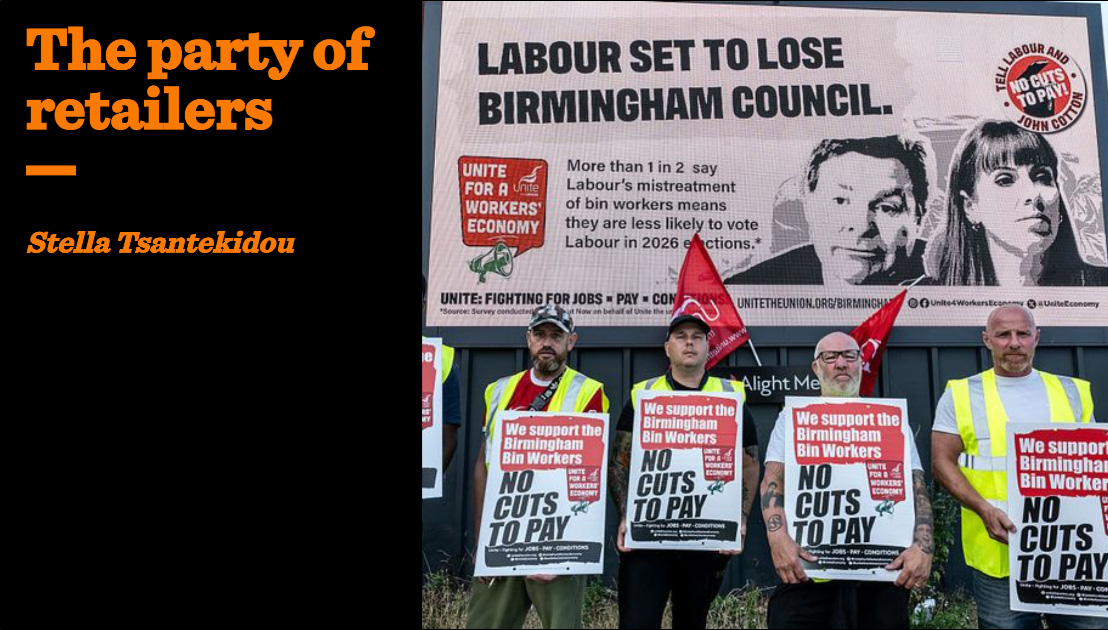
In January this year, Mainstream organised a meeting between striking Birmingham bin workers and Labour MPs and Peers. Akehurst tells me the intention was not to endorse everything the strikers were asking for but to give them the opportunity to put their case forward – which, as he notes, is what union negotiations should always be about. Paula Barker MP, who chaired the meeting, told me she finds the distance between Labour and Unite saddening. She is one of many Labour MPs concerned, and the discontent is not limited to one union. It’s not just the party’s left attending these meetings, either. Luke Akehurst MP — a different person entirely, one associated with the party’s right and previously an organiser with LabourFirst — is among those who signed the Unite group MPs’ letter to the Prime Minister urging him to intervene in the bin strike. He is careful, as moderates tend to be, not to level criticism directly at the government: “It would be a tragedy if the union link was damaged by a dispute with an individual local authority. This Labour Government delivered the landmark Employment Rights Act because Labour and the unions are formally linked. No other party would have done that.”
He is right, and it matters. But as welcome as the Employment Rights Act is, it, does not resolve the deeper question of what Labour is for, which is the question that Unite’s funding cut, Birmingham’s bin strike and the dinner I attended are all circling around. Labour membership has dropped by 300,000 in five years. The remaining members regularly receive fundraising emails highlighting Reform’s dependence on a single billionaire donor — recognising, if only implicitly, that, in a Labour frame of mind, a handful of individuals financing politics runs counter to our values. But that framing only works if Labour has a values-based account of itself that it is willing to defend publicly and govern by. So far, the retailers are in charge.
In January, Louise Gilmour, the GMB’s Scotland secretary, said the effects on jobs and communities of Labour’s net-zero policies will be worse than the effects of the closure of the coal mines in the 1980s. A party with a coherent worldview would seriously engage with what this claim says for our worldview. A party of retailers doesn’t know what to do with it.
So how can you tell whether a Labour MP is a retailer or a wholesaler? Ask them what they make of union discontent. The link with unions is our party’s founding theory of change. Working people, organised collectively, can exercise democratic leverage over capital. Starmer’s lack of this most basic of left-wing theories leaves his team intellectually adrift and the wider political field open to the nihilism of untrammelled, right-wing, personal political donations.