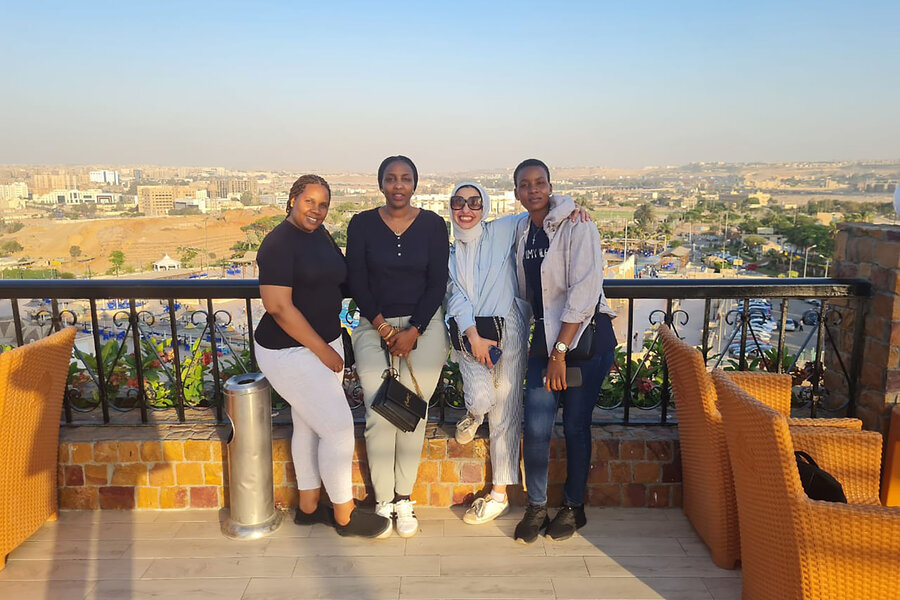
Menna Yasser stumbled upon Swahili unexpectedly. A decade ago, the young language enthusiast was rejected from the English department at Egypt’s Ain Shams University. She decided to pivot to the African-languages faculty and study Swahili instead.
“At a time everyone around me said there was no future in it,” she recalls.
Almost no one in Egypt would say that anymore. Long firmly planted in the Arab world, the country’s government has spent the last several years rekindling its historical relationship with its sub-Saharan African neighbors. Trade, business, and cross-border development projects are on the rise – and with that, a growing interest among young Egyptians in the region’s languages.
Why We Wrote This
In Egypt, the study of sub-Saharan African languages like Swahili is on the rise, pointing to a larger identity shift in how the country sees its relationship to the rest of the continent.
Today, Ms. Yasser shuttles between Egypt and several East African countries, working as a simultaneous Swahili-Arabic interpreter at conferences and a translator for large infrastructure projects like the Egyptian-built Julius Nyerere Hydropower Plant and Dam in Tanzania.
“The language that was the object of sarcasm when I first started learning it has become the magic lantern for everything I never imagined would happen in my life,” she writes in her book “Njiani” (The Path). It chronicles her experience learning Swahili, and is published in both Arabic and Swahili.
A linguistic bridge
Swahili also opened new worlds for Mohamed Hosny, an Egyptian tour operator and trader now living in Tanzania.
After studying Swahili in college in the early 2010s, he began working as a translator for Arabic-speaking businesspeople in East Africa, and quickly saw how many doors the language opened.

And so, as his own business career took off, he also co-founded a project in which graduates of his university offered free Swahili classes three times weekly at a public library in Cairo. Still operational today, the “My Language is African” initiative is designed “to build bridges of knowledge between Egypt … and Africa,” Mr. Hosny explains.
The Swahili language is, in many ways, an ideal bridge. It shares as much as 40% of its vocabulary with Arabic, including the language’s name, which loosely translates as “the language of the coastal people.”
Originally spoken by maritime communities in parts of East Africa, Arab and European expansion brought waves of outsiders to the region. Swahili became a lingua franca and trade language. Today, there are as many as 200 million Swahili speakers, mostly clustered in Kenya, Tanzania, eastern Congo, Uganda, and Rwanda.
But until recently, the language still felt far away for most Egyptians.
While the country has many historical ties to its sub-Saharan African neighbors, relations soured in the 1990s after an assassination attempt on Egyptian president Hosni Mubarak in Addis Ababa, Ethiopia. The attack led the Ethiopian and Egyptian militaries and intelligence agencies to sever most ties, and it became a common perception in Egypt that sub-Saharan African countries were dangerous.
As a result, Cairo “witnessed a relative decline in its presence on the African stage,” explains Maha Abdelkader, a Cairo-based scholar who researches Egypt-Africa relations.
A new chapter
But that started to change in the 2010s as Ethiopia began work on a major project to dam a section of the Nile River. Egypt and Sudan, its downstream neighbors, were alarmed. Meanwhile, in 2011, Egypt’s neighbor Sudan split in two, unsettling old alliances in the region. Suddenly, regional integration became a pressing strategic concern for Egypt, Ms. Abdelkader says.
Then, in 2019, Egypt took over the rotating presidency of the African Union, a role that pushed the country to more closely consider its place on the continent.

As a result, its government began sending trade missions to other African countries to scope out new investment opportunities. At the same time, it set up language projects like the Nasser Scholarship Program, which supports both African students in Egypt and Egyptian students interested in working elsewhere on the continent. The project invited in Swahili experts like Kenyan linguist Kineene Wa Mutiso, Kenyan novelist Nelson Ntimba, and Edelfrida Tibaija, a Tanzanian educator and translator.
They helped students translate tranches of documents into Swahili for the Egypt International Cooperation Forum, an annual event for pan-African cooperation.
Meanwhile, universities across the country founded or expanded programs to teach the language, along with other major African languages, like Hausa – widely spoken in Nigeria and Niger – and Amharic, Ethiopia’s lingua franca.
Studying African languages is important because it gives Egyptians access to the “cultural and intellectual identity of African societies,” explains Hammad Ismail Fawzi, a professor of Hausa language and literature at Cairo University and founder of the African Languages Pavilion, another program promoting language exchange.
For her part, Ms. Yasser, the language enthusiast who stumbled into learning Swahili in college, says she is profoundly grateful for how the language has allowed her to explore other cultures and societies.
Today, she uses the Swahili phrase “chumvi na sukari” – meaning “salt and sugar” as a mantra. “The tireless effort, like salt, is what allows us to savor the sweet taste of sugar,” she explains. “My journey with Swahili was a journey of hard work and dedication and eventually success.”
This article is published in collaboration with Egab.