Less than three weeks after Donald Trump was inaugurated as the president of the United States, he issued an executive order that would send shockwaves throughout South African politics. The executive order immediately cut all aid and assistance and, most controversially, explicitly promoted the resettlement of “Afrikaner refugees escaping government-sponsored race-based discrimination, including racially discriminatory property confiscation.” This program and claims by the Trump administration did not materialise out of thin air but were the result of a specific and controversial law passed in January 2025 by the government led by the African National Congress.
The central issue was land reform. The land reform debate has been ongoing in South Africa since the first democratic elections, but in recent years it has grown more intense. The crux of the matter is that the agreed-upon mechanism after the end of apartheid was generally based on a “willing buyer, willing seller” approach, with the government typically paying market rates for any properties. The exact nature of the laws regarding land reform remained convoluted and highly bureaucratic. While even this article uses the euphemism “land reform”, implicit in its notion is the central goal of redistributing land from the white minority to the black majority using taxpayer money to rebalance economic power in the country. However, due to corruption and the perceived inefficiency of the African National Congress over the past three decades, the land reform process has been seen as slow and ineffective.
Instead of reflecting on whether it was a good use of public funds to engage in land reform in a country suffering from appalling inequality, crime and unemployment, it was decided that the best way forward was to introduce mechanisms to expropriate these properties and provide no compensation. When the law was formally signed into law on the 23rd of January 2025, there was considerable debate over the details of what the law entails and what “nil” means, but the objective is clear, and how it will be applied is obvious. The law explicitly confers mechanisms that allow the state to override the previous arrangement of market value and instead allows expropriation without compensation. The African National Congress has been quite clear that the purpose of the act is transformation. The law facilitates the transfer of land from white people to black people, using a monopoly on legitimate violence to take the property and provide no compensation. The African National Congress contends that the state violently taking property from white citizens is about transformation, and that “transformation is not a danger to anybody … It’s about this principle of inclusivity.”
As with much of Southern Africa’s history, little appears to have been learned, and it seems destined to repeat itself
Those interested in the region and its history might find this eerily familiar. It’s almost as if something very similar already happened in the country just north of South Africa, in Zimbabwe, formerly known as Rhodesia. Their land reform program, instituted by ZANU-PF after 20 years of rule, is similar to what we are seeing now from the South African government. The land reform was deemed necessary to redistribute land from white citizens to black citizens for supposed inclusivity and transformation. What followed was a violent seizure whereby 4000 white owned farms were seized and given to black people, often government-connected individuals. Invariably, thereafter was a mass famine and a complete collapse of the Zimbabwean economy. Zimbabwe now pleads for its white farmers to return and has attempted to meagerly institute compensation to those driven out 25 years ago. As with much of Southern Africa’s history, little appears to have been learned, and it seems destined to repeat itself.
It seems the Trump administration and the United States are the only countries willing to acknowledge or substantially resist the new development affecting this white minority. The United Kingdom and its current government have been silent on the issue, despite having the largest South African diaspora in the world. The Chancellor of the Exchequer, Rachel Reeves, even publicly stated that no British companies have complained to her about the new expropriation bill. It is most regrettable that the British government has taken no action to combat this new and devastating legislation. As with what happened in Zimbabwe, the United Kingdom and the Labour Party are content to let the situation play itself out and then deny any responsibility.
A symbolically important moment occurred on the 12th of May 2025, when 59 white South Africans arrived in Washington D.C and were greeted by the Deputy United States Secretary of State. This small number of arrivals was instantly decried. Despite the 59 individuals being carefully vetted by the State Department, and many bringing young children, they didn’t fit the mold of what people typically consider a refugee.
The Trump Administration requested that the Episcopal church of the United States help resettle these new refugees under their decades-long partnership with the federal government. The church decided to completely terminate its refugee resettlement arrangement with the government, instead of assisting white South Africans, citing a longstanding “commitment to racial justice and reconciliation.” The acceptance of these South African minorities also galvanised calls that the refugee system was unfair. The Trump administration was admonished for exercising its right to decide which refugees it prioritises and wishes to assess and accept.
The discourse surrounding these few dozen individuals was very peculiar, with many expressing displaced emotions over Trump, Elon Musk, South Africa’s Israel lawsuit, and the definition of genocide. Frankly, a lot of noise has obfuscated the important discussion. Why have these families upended their whole lives? The only rational explanation would be for safety. Many farmers will remember what happened in Zimbabwe, and many farmers are acutely aware of that history. They are ultimately people who fear for their safety and their loved ones’ safety, and who feel no confidence in a government that has targeted, belittled, and actively seeks to harm them, specifically through expropriation, indifference to crime, and legal economic exclusion. They would rather take a chance in the United States than stay in what is rightfully their home and land.
It has been just over a year since the initial fervour and executive order, and mostly the story and news have dropped out of the current news cycle and political discourse. The topic of White South African refugees has occasionally cropped up since the initial announcement, but has generally been sidelined by other global developments. The story recently came up again as it was reported that South African refugees would form almost the entirety of the refugee cap for the United States, and 2000 refugees had already arrived in the United States under the initiative by the end of January 2026.
60 Minutes recently did a segment on South Africa that premiered on the 22nd of February 2026, and Anderson Cooper, in one of his final episodes of 60 Minutes, succumbs to typical mistakes. He once again erroneously touts the South African government’s own figure of 72 per cent white land ownership, omitting key information regarding how that figure was produced — it excludes land held in trusts, considers only arable farmland, and is limited to tax-registered properties. Cooper also seems intent on proving President Trump wrong rather than understanding the broader situation and complexity of the situation.
Discussion around South African minorities and this new United States initiative is often entirely centred on President Trump or Elon Musk, or anything that omits the refugees themselves and their perspective. (For those who wish to investigate this topic of minority rights in South Africa and institutional discrimination, AfriForum has fantastic insights, particularly in their report titled The World Must Know from the end of 2025. )
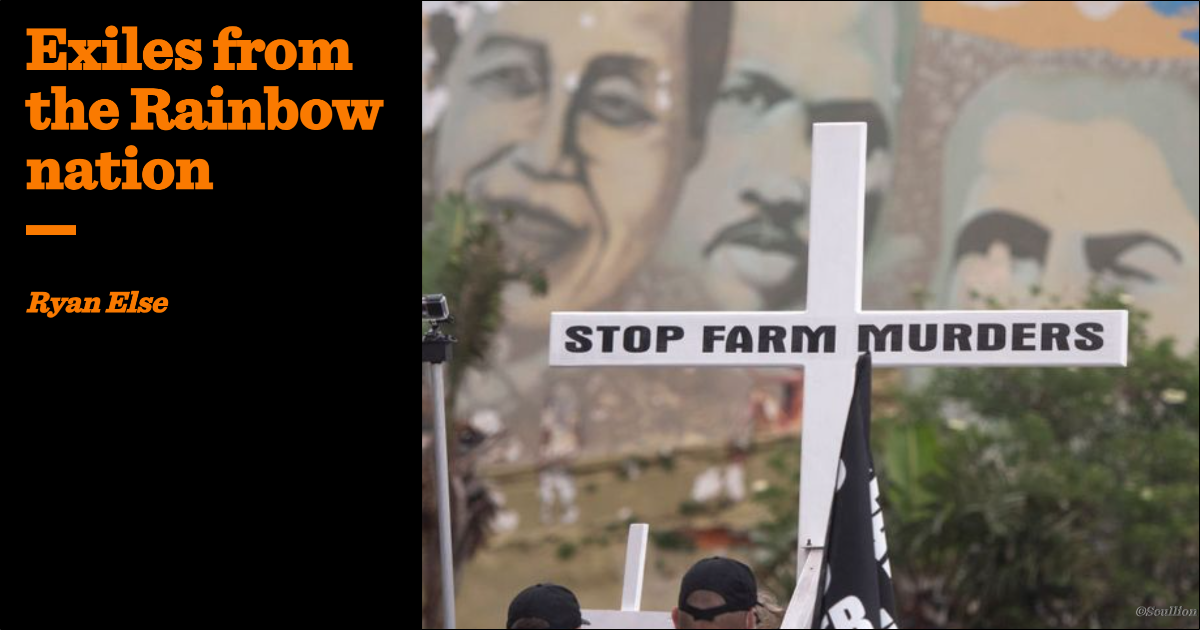
This program is moving forward, and thousands and thousands of South Africans are packing up their lives and fleeing as legitimate refugees — not for a fun holiday, but because they fear for their lives, their family, and their future. While the refugee program and public statements from the United States are far from perfect, at least there is finally engagement about minority rights in South Africa and scrutiny placed on the African National Congress’s racial policies. Without engagement in the reality of modern South Africa, the unique severity of farm murders, the institutional racial discrimination against minorities and the acknowledgement of the severity of radical political elements, both contemporary and historical, the conversation won’t move beyond a surface level understanding of the topic.