My new report for Policy Exchange polled the views of more than 1,000 British Muslims on a host of issues.
Its troubling conclusions, I believe, should be the moment we begin as a country to recognise the divisions that are slowly but inexorably growing within our society – and to do something about them.
As you’d expect, the vast majority of British people deplore the Iranian regime, which has killed thousands of its own citizens in cold blood in recent weeks and launched vicious attacks both on UK soil and against our military interests around the world.
No wonder that just 8 per cent of the wider British public have a favourable view towards Iran.
However, among Muslims in Britain, 39 per cent have a favourable view towards Iran: well over a third of that population.
How has such a worrying state of affairs come to pass?
The core, of course, is the Israel-Palestine conflict, which has galvanised a huge proportion of Britain’s 4 million Muslims in recent years and which, I fear, has at times been hijacked by bad-faith actors intent on driving a wedge through our society.
Radical preachers, online influencers and other commentators have often encouraged British Muslims to see themselves as Muslims first, British second – and to align themselves with their Muslim brothers and sisters in Palestine, locked in conflict with the Jewish state.
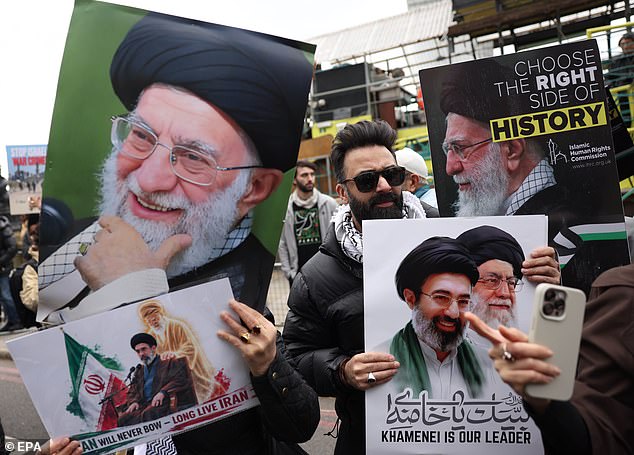
Just eight per cent of the wider British public have a favourable view towards Iran. However, among Muslims in Britain, 39 per cent have a favourable view
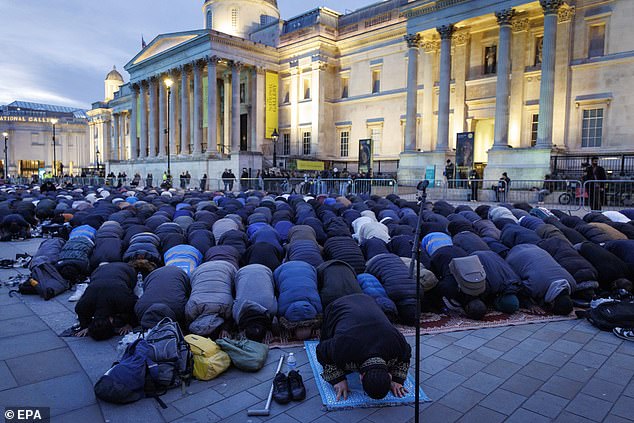
Islam has real influence in modern Britain, as was shown by last Sunday’s iftar ceremony in Trafalgar Square, celebrating the breaking of the religious fast during Ramadan
Iran, of course, has taken the fight to Israel – both directly and also through its no-less-committed proxies: Hamas in Gaza, Hezbollah in Lebanon and the Yemeni Houthis.
It matters not, it seems, that Iran is a type of Shi’ite theocracy, while perhaps 85 per cent of British Muslims are Sunnis. In the wider Muslim world, these two schools are often at each other’s throats: yet such divisions are frequently put to one side in Britain when it comes to Israel.
The truth is that, as our report clearly shows, there are profound and growing differences between how Muslims and non-Muslims in Britain view the world.
We are now reaping the sad results of multiculturalism, writes Dr Rakib Ehsan
Muslims here, for example, tend to be dramatically more in favour of China and Russia – both states highly hostile towards British interests – compared with the rest of the population.
While a paltry 8 per cent of Britons have a favourable view of Russia, this rises to 29 per cent for British Muslims.
For China, the figures are 15 per cent and 38 per cent respectively. This is the case, even though both countries have a track record of major human rights violations against their own Muslim citizens.
This does not bode well for our national unity in an increasingly dangerous world.
Of course, many British Muslims, including younger ones, are perfectly well-integrated in society. And yet, I find it deeply concerning that younger Muslims here are more likely to identify as ‘Muslim first and foremost’ compared with their elders. That, I suspect, is because their parents and grandparents were often born and raised in dysfunctional Muslim-majority countries and have experienced their difficulties first-hand. They are far more likely to be grateful to have been welcomed in Britain.
Younger British Muslims, in contrast, have known nothing else.
Islam has real influence in modern Britain, as was shown by last Sunday’s iftar ceremony in Trafalgar Square, celebrating the breaking of the religious fast during Ramadan. This event was hailed by London mayor Sir Sadiq Khan as the ‘biggest in the Western world’.
But as my report proves, one corollary of such increasingly devout public religiosity is that we must work harder to integrate minorities.
For decades, successive governments – Labour and Tory alike – were wedded to the doctrine of ‘multiculturalism’: prioritising every culture except the indigenous one.
This was a profound mistake. Stressing people’s differences rather than their commonalities is a surefire route to division. We are now, as my report confirms, reaping the sad results.
Dr Rakib Ehsan is a Senior Fellow at Policy Exchange