Every night, Iranian university student Alireza falls asleep staring at his mobile phone, desperate for news about how the joint U.S.-Israeli military onslaught is impacting his country and upending his life.
And almost every night, the computer science major has nightmares about the risks and uncertainties of a war that has pounded Iran with more than 15,000 airstrikes in 18 days, with no end in sight.
“I had imagined that the war might get this bad, but, honestly, I don’t see a bright future from it,” says Alireza, who wears glasses and has short black hair, and asks that his real name not be used. After leaving his university in Tehran amid air bombardments with just a backpack, he sought sanctuary in his hometown in western Iran, which also has been targeted.
Why We Wrote This
Israel’s killing of Ali Larijani, a pivotal Iranian leader, served only to escalate the crisis atmosphere that Iranians are feeling: How to cope and envision a future, while facing crushing U.S.-Israeli attacks and a rigid regime that sees protesters as “just like the enemy.”
Like many Iranians, Alireza says he feels trapped between the dark shadow of the sudden, massive U.S.-Israeli military campaign – which aims to topple the Islamic Republic and destroy its military and security capabilities – and the grim reality of the regime itself. In January, government forces crushed nationwide protests by reportedly killing more than 7,000 Iranians, and possibly far more, and recently issued fresh shoot-to-kill orders to prevent any new unrest.
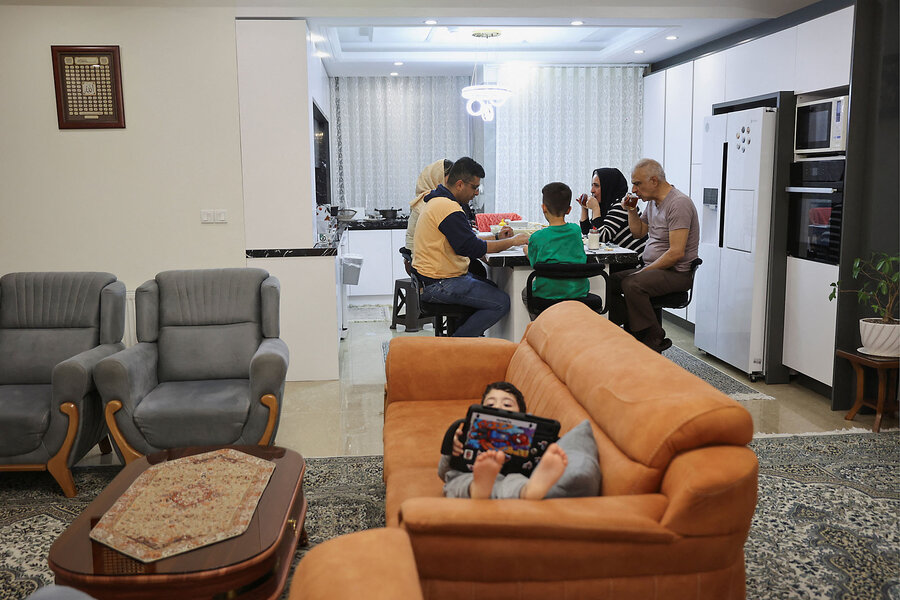
As Iranians prepare to mark the Persian new year, known as Nowruz, on Friday, a period that is normally rich with celebration, renewal, and family visits is being stained this year by a war far more destructive than anything Iranians imagined.

Ali Larijani via X/Reuters
Ali Larijani killed
The crisis atmosphere escalated on Tuesday as Israel announced that its strikes had killed both Ali Larijani, the powerful head of Iran’s Supreme National Security Council, and Brig. Gen. Gholamreza Soleimani, commander of the ideological Basij militia, whose uniformed and plainclothes forces were instrumental in the January crackdown.
The apparent bid to deepen Iran’s leadership vacuum also removed, in Mr. Larijani, one of the few top figures who could still balance hard-line and less-hard-line voices within the Islamic Revolutionary Guard Corps (IRGC), and among surviving senior politicians.
Mr. Larijani’s death was also seen as a blow to diplomatic chances of de-escalation, as it removes Iran’s last interlocutor with Gulf Arab states, which have been targeted repeatedly by Iranian retaliatory strikes.
Caught in the middle are Iranians such as Alireza, who by a significant majority oppose their repressive regime but are both terrified and alarmed by the scale of devastation wrought by the war.
“The idea that you can divide a city into ‘military areas’ and ‘residential areas’ is pure nonsense,” he says.
Alireza recalls being arrested before the war with his girlfriend while they were driving, because her hair was not sufficiently covered. The pair were taken to Yousef Abad police station, where his parents were summoned, and security forces “humiliated me in front of them for a long time.”
“Now that [police] building has been completely destroyed. But the café where I used to go at night to drink tea was right next to it, and that’s destroyed, too,” says Alireza. “The kebab place where my girlfriend and I had dinner three days before the war has also been destroyed. So, I don’t know if I should be happy or sad.”

Majid Asgaripour/WANA/Reuters
He describes numerous examples of other civilian sites, restaurants, and residences, wrecked because of their proximity to regime targets.
Among them was an entire building that collapsed 200 yards away from where Alireza was last June, when Israel launched a surprise attack and triggered a 12-day war. A nuclear scientist, the apparent target, lived in that building, but Alireza saw dead civilian men, women, and children pulled from the rubble.
“Heavy loss of life”
“The heavy loss of life is alarming,” said Vincent Cassard, head of the International Committee of the Red Cross delegation in Tehran, in a statement on Tuesday. “Families are gathering for funerals instead of [Nowruz] festivities.”
President Donald Trump says the United States has eviscerated Iran’s military capacity, brought its retaliatory missile launches down by 90%, and lowered drone strikes by 95%. And the Pentagon and the Israel Defense Forces are indicating no letup: “We still have thousands of targets in Iran, and we are identifying new ones every day,” IDF spokesman Effie Defrin said on Monday.
Iranian officials put the death toll at more than 1,400, without differentiating between security forces and civilians. Among them are 168 students and staff killed at a girls’ school in the southern city of Minab on Feb. 28.
“How long are military infrastructure, transportation systems, roads, and oil depots going to keep getting hit? How can a country be rebuilt if it has no airports, no roads, no functioning police?” Alireza asks.
“In what scenario is the government actually supposed to change?” he adds.
Security forces loyal to the Islamic Republic are working overtime to prevent renewed street protests or uprisings by armed ethnic minorities such as Kurds or Balochs.

Majid Asgaripour/WANA/Reuters
“The country is controlled by IRGC and intelligence service forces; they have always been in the shadows, and they are using all the power, all the brain they have, to play with us, play with the U.S.,” an Iranian woman told the BBC in a voice message over the weekend.
“The only force and power is in the hands of IRGC and Basij. There are a lot of people without official clothing … having guns,” said the woman, a resident of Tehran. “So, everything is going very dangerous here. We prefer to die from the bombs, instead of die by IRGC. And we know that the end might be very harmful, but we are in the most pressure you can imagine.”
Iran’s warning to protesters
Indeed, Brig. Gen. Ahmad-Reza Radan, Iran’s police commander, warned last week that anyone who “follows the enemy’s request [to rise up], we will no longer treat them as protesters. They will be treated just like the enemy. Our forces are in a state of full alert, with fingers on the trigger.”
President Trump and Israel’s prime minister, Benjamin Netanyahu, have both called on Iranians to topple the regime. Armed Israeli drones began firing upon security force checkpoints in Tehran last week.
But Mr. Trump said on Monday he understood why Iranians had not yet risen up.
“The biggest problem that I see is that they put out a warning. … Any protester that goes out onto the street will be immediately shot and killed,” said Mr. Trump, noting that only security forces have weapons. “[Iranians] can be brave, but they’re not stupid.”
Israel, for its part, assesses that Iranian protesters would “get slaughtered” if they took to the streets, according to a State Department cable described by The Washington Post on Tuesday. Senior Israeli officials reportedly told U.S. diplomats that Iran’s regime is “not cracking” and is willing to “fight to the end.”
In addition, amid reports that the CIA had been training and arming Iranian Kurdish militia groups based in Iraq, the IRGC on Tuesday declared a “state of war” along the Iran-Iraqi Kurdistan border, banned movement, and issued shoot-to-kill orders.

Majid Asgaripour/WANA/Reuters
With little sign of renewed street protests, one sociologist in Tehran – who is critical of the regime, and of the war – told the Financial Times that there is instead a growing “sense of nationalism emerging from the war,” a rally-around-the-flag effect, not unlike that witnessed after last June’s war.
“The fear of Iran’s destruction is increasingly uniting people as they fear the consequences of such a large-scale conflict,” said the sociologist, who asked not to be named.
Concerns for the future
On a personal level, that means Iranians like student Alireza are daily weighing the cost of the conflict to their future.
“The hardest moment is when you look at things you once saved money for and bought with so much excitement, and, suddenly, they mean nothing, just because you can’t carry them in your backpack,” he says.
“Clothes you love, that camera you were so happy to buy … your childhood photos – the silly collections you made, trying to give your life some meaning by gathering little things,” he says, wistfully.
“All of it suddenly feels worthless. You look at them, curse the people who caused this war, and then you leave them behind,” says Alireza.
“I’d like to quote a line from Hafez, the Iranian poet, because it describes exactly how I feel right now,” he says: “From every direction where I went, naught increased to me save terror; beware of this desert, and of this endless path.”
An Iranian researcher contributed to this report.