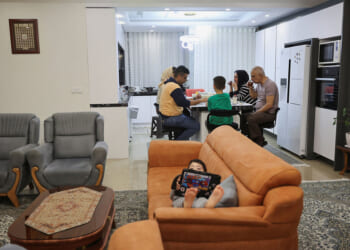
When the alarms sound at night, Shani Vitkin rolls the crib of her 3-month-old son into the safe room where her two other children, ages 6 and 8, sleep in their home in Rehovot, 40 kilometers (about 25 miles) south of Tel Aviv. The family dog tags along.
Since the start of the war with Iran, her husband has been on reserve duty as an air force medic, and she is at home alone with her three children. She battles exhaustion as she juggles nursing the infant with helping the older kids get online for school and do their homework.
“I need to cook and clean all day, entertain them, and make sure they don’t kill each other,” Ms. Vitkin says. “And they are already going crazy. And over and above all of that, we must run to the safe room.”
Why We Wrote This
After nearly 2 1/2 years of intermittent war, with sirens, dashes to shelters, and sleepless nights – “this madness that is our new normal” – Israelis acknowledge war fatigue’s toll even as they want arch foe Iran to be defeated.
Caring for the baby makes things harder, she says. “I wake up at night to feed the baby and then again when there are alarms, and they are never at the same time,” she says. “It is loops of nights without sleep. My tiredness makes me short-tempered; the children make me nervous.”
Israel’s war with Iran is unfolding not only on the battlefield but also in the routines of ordinary Israelis navigating daily life under missile alerts. After nearly 2 1/2 years of intermittent conflict with Iranian-backed groups, including Hamas and Hezbollah, the latest escalation has intensified a sense of exhaustion, even as public support for the campaign remains strong.
Emotionally depleted
Israelis are facing this latest challenge already “exhausted,” and depleted of emotional resources, says Mooli Lahad, a psychologist and founder of the Community Stress Prevention Center in Kiryat Shmona. “They have already recruited all their energy over 2 1/2 years, and it is usually physiologically and psychologically impossible” to sustain.
This prolonged “attrition” can lead to poor concentration, agitation, anger, and marital tensions, he explains. Nighttime missile barrages leave little chance for recovery.

Jonathan Elkins/Special to The Christian Science Monitor
“It is worse now because we are already so exhausted from two years of war,” says Ms. Vitkin. “We thought it is over. And now this. It is a terrible reality in which to raise your children.”
For more than two weeks, Israel and the United States have been carrying out hundreds of airstrikes in Iran, killing government leaders, and destroying military and infrastructure targets across the country. Israeli officials have long considered the Iranian regime, and especially its nuclear program, to pose an existential threat to the Jewish state. Unbowed, Iran is fighting back, joined by its Lebanese ally Hezbollah, in defiant attacks that have been setting the region aflame and are threatening to disrupt the global economy.
Over the weekend, Israelis stayed close to their homes as barrages of missiles from Iran and Hezbollah continued to pierce the skies.
57,000 alarms
As of Monday morning, more than 57,000 alarms had sounded in Israel since the start of the war, data compiled by the news site Ynet shows. According to the Institute for National Security Studies (INSS), 206 salvos have been fired from Iran, which included 265 missiles and more than 500 UAVs. In addition, Hezbollah has fired more than 325 salvos from Lebanon.
When Hezbollah fires rockets, there is “zero time” to reach shelter, says Yaakov Selavan, deputy mayor of the Golan Regional Council.
“You duck and you cover your head,” he said in a briefing with journalists. His four daughters now routinely sleep in the family’s bomb shelter, and he and his wife join them when alarms sound. One daughter has grown so frightened that even the slam of a door can send her to the shelter. She also refuses to leave the home.
The alarms catch Israelis at all times, wherever they are: in the shower, at the doctor’s office, driving, sleeping. People then scramble for safety, grabbing children and dogs, or patiently guiding elderly parents.

Jonathan Elkins/Special to The Christian Science Monitor
Those without a safe room at home or a shelter in their building need to head to neighborhood communal ones. In Tel Aviv, some residents have begun sleeping in underground light-rail stations, bringing mattresses or yoga mats, food, and water. At some stations, families have set up tents, coffee stations, and improvised workspaces.
One resident, Mazi Sevilya, moved to sleep in an underground station in Tel Aviv when the war started. She has a shelter in her building, she says, but feels “safer here.” She has brought a light mattress, a blanket, and a thermos, and goes home to shower and for food.
“It doesn’t have to be this way”
Yonatan Gur, another Tel Aviv resident, was sitting on the floor in the station, waiting for the signal to exit safely. He was in a store when the siren sounded. “I am tired,” he says. “This has been our reality for a long time, but it still feels surreal. This madness that is our new normal has not yet sunk in.”
His wife and three children have temporarily relocated to his in-laws’ in the south.
“I am a history teacher,” he says. “I know that what is happening to us is not fate. We are living with the decisions people make. We could have done much more to prevent wars. It looks like we don’t hate wars enough. Maybe we are too resilient. This is our life here, but it doesn’t have to be this way.”
According to an Israel Democracy Institute poll, 93% of Jewish Israelis support the war in Iran, with most thinking it should continue until the regime is overthrown.
Yet, as days go by, it has become apparent that the war’s objectives are fuzzy. And not knowing where the war is going and how or when it will end adds stress, says Dr. Lahad.

Jonathan Elkins/Special to The Christian Science Monitor
As they patiently hunker down in their bomb shelters, Israelis are also confronting another realization: the “total victory” promised by Prime Minister Benjamin Netanyahu since the wars with Hamas, Hezbollah, and Iran began appears distant.
They told us it was all over, says Ms. Vitkin. “This discourages me, because I know now that it will never end. We will be drawn into it again and again. This is the first war of my baby, and I wish I can say it will be his last, but it won’t.”
Belief lowers stress
Israelis are tired of continually seeing images of bombings and assassinations, said Idit Shafran Gittleman, a senior researcher at the INSS, on the Channel 12 news outlet. What they want to know is “how much this brings us closer to the end of the civilian challenge, how much does it bring us closer to … really being the last round and that’s it.”
Believing in a cause can help lower stress and build resilience, says Dana Lassri, an associate professor at the School of Social Work of the Hebrew University of Jerusalem.
If Israelis view the war as justified and as a last-ditch effort to secure a better future for their children, she says, they will be more willing to put their needs aside and focus on the challenge ahead.
Mr. Selavan, the Golan deputy mayor, echoes that sentiment.
“We’re strong, we’re resilient, and we’re giving the government and the [Israel Defense Forces] what it needs to finish the Hezbollah threat once and forever,” he says. “If it means I’ll need to be one more month in the bomb shelter, I’ll do it, but let’s get the job done.”