For parents up and down the country news that two young people have died and 11 others – mostly aged between 18 and 21 – are seriously ill after contracting deadly meningitis will have sent them into a tailspin of worry.
One of those who died was a student at the University of Kent, and the other has been identified as a Year 13 student at Queen Elizabeth Grammar School in Faversham.
Experts say that this is the worst outbreak to hit the UK for at least a decade – ‘we haven’t seen anything on this scale for many years’, says Andrew Preston, a professor of microbial pathogenicity at the University of Bath.
‘In fact, I can’t remember the last time so many people have been struck down at the same time. In the past, we would see clusters of cases and they tended to be sporadic, but this outbreak is very focused and affecting a lot of people.’
One theory is that it could be down to a new strain emerging: other factors may include an alarming drop in take-up rates of meningitis vaccines offered to teens.
As thousands of students in Canterbury seek precautionary antibiotics, we spoke to the UK’s leading experts to provide everything you need to know about how to keep your children safe.

Juliette Kenny, 18, died on Saturday surrounded by her family after falling victim to the deadly bug which has swept through several towns in Kent
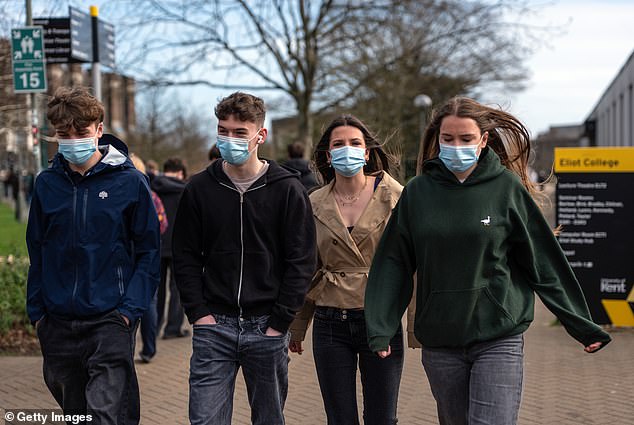
Students wearing face masks walk through the University of Kent campus in Canterbury on Monday
What is meningitis?
Meningitis is an infection by a bacteria, virus or (in rare cases) fungi affecting the meninges, the protective tissue that surrounds the brain and the central nervous system that runs down inside the spinal cord, says Professor Preston.
‘It is extremely dangerous,’ he adds – once these tissues become inflamed, this puts pressure on the brain (causing the characteristic blinding headache), while the inflamed spinal cord causes a stiff neck.
Bacterial meningitis is the most lethal form – it can be caused by a number of types of bacteria, including the Meningococcal groups A, C, W and Y and B (one of this group is now known to be responsible for the current outbreak).
Viral meningitis, which is usually milder, tends to get better on its own within seven days, explains Dr Michael Head, a senior research fellow in global health at the University of Southampton.
Why are first-year students so vulnerable?
Meningitis is spread by fine droplets sneezed into the air – or exchanged during kissing.
While up to 20 per cent of the general population carry the Meningococcal bacteria responsible, at the back of their throats, this rises to one in four young adults aged between 15 to 19. What makes students vulnerable is that they typically party together and have more social interaction than the other younger age groups.
‘We think that getting meningitis is completely accidental, caused by a breach in the nasal lining or something else that happens to allow the bacteria access into the bloodstream,’ says Professor Preston.
How is it different from fresher’s flu?
Early symptoms of bacterial meningitis can easily be mistaken for a common cold,’fresher’s flu’ or even a hangover, Professor Preston told Good Health.
‘The scary thing about the initial stages is that the symptoms can be very non-specific. You can feel like you are coming down with a cold and yet be very ill indeed with infection in the brain in a matter of hours.’
Indeed while a common cold or flu will develop gradually, causing coughing and sneezing, fever and muscle ache that emerge over a few days, bacterial meningitis takes hold quickly.
‘Once the bacteria is in the blood, it replicates very rapidly,’ says Professor Preston.
‘From that point, it can rapidly pass through the blood-brain barrier, infecting the meninges – which causes headache, photophobia [aversion to light] and neck stiffness within hours.’
With a hangover, the symptoms should improve through the day.
When should I seek medical help for my child?
Students are advised to watch for worrying symptoms in their friends, even if someone has been vaccinated.
‘Just because someone has had the meningitis jab, doesn’t mean they won’t get meningitis – because the vaccines offer some protection against certain causes of meningitis, but not all,’ says Rob Galloway, an emergency medicine consultant at University Hospitals Sussex in Brighton and Good Health columnist.
Early intervention is crucial, he says – don’t wait for the red rash that doesn’t fade when pressed with a glass (which is a sign that the infection has moved from the brain into the body).
‘Typically, people will present with a fever and confusion, as well as muscle and joint pain and even coughs and sneezes.
‘Later on, they may develop spots or a rash which shows that sepsis is under way,’ he explains.
In one study, published in The Lancet in 2006, a rash did not occur until between 12 to 22 hours after symptoms first occurred.
Other signs that the body is being overrun tend to occur around eight hours after the child becomes unwell – as well as headaches, photophobia and neck stiffness these include leg pains, cold hands and feet, pale and mottled skin and vomiting, though they may not have all of these.
These are all signs to seek medical help, says Professor Galloway. ‘There really is no time to wait. If you have been in close proximity to others who have been diagnosed, and have symptoms that resemble a cold, go to a GP, dial 111 or head to A&E immediately.’
He adds that context is important. ‘If you have the sniffles at another university where there isn’t an outbreak, it probably isn’t meningitis – although you should still be vigilant.
‘If you have a temperature and aches and pains with a fever – and you attend the University of Kent [affected by this latest outbreak] – you should seek health advice immediately and organise to take an antibiotic as a preventative.’
Is there a risk in shared student accommodation?
‘The infection is spread via saliva and droplets, so it can be transmitted via shared utensils, cutlery, cups and even toothbrushes,’ says Professor Galloway. ‘Try to use your own utensils and keep surfaces clean and tidy, though the risk is low.’
Sharing cigarettes is also not advised.
Should my child wear a mask at university?
Because the bacteria is spread through the air in droplets, wearing a mask can reduce the likelihood of spreading the infection, says Professor Galloway, adding that wearing a mask may be a sensible choice for students at the University of Kent in crowded areas, but is not necessarily appropriate for all students everywhere.
How can I protect my child against it?
Vaccination is hugely important, says Dr Head. The ACWY vaccine offers protection against four types of bacteria that can cause meningitis: meningococcal groups A, C, W and Y.
It’s offered to teenagers aged 14 years old, and to people up to the age of 25 who’ve never had a vaccine containing meningitis C.
Professor Preston says uptake of the ACWY vaccine among adolescents is around 73 per cent, ‘so there are a lot of unvaccinated students which may reduce herd immunity’.
Meningitis B is the most common cause of bacterial meningitis in the UK, but while there is a vaccine the NHS only offers it to babies and those with specific underlying medical conditions.
Otherwise it is only available at private clinics and pharmacies including Boots and Superdrug. The course requires two doses which are usually taken one month apart and cost up to £200.
Should I pay for my teen/university aged child to have the MenB vaccine?
Professor Galloway says this is a good idea – he is planning to arrange it for his own children before they go to college ‘as a precaution’.