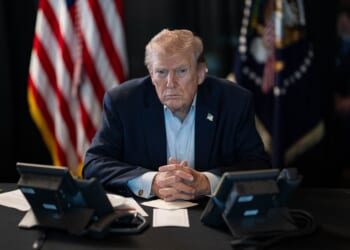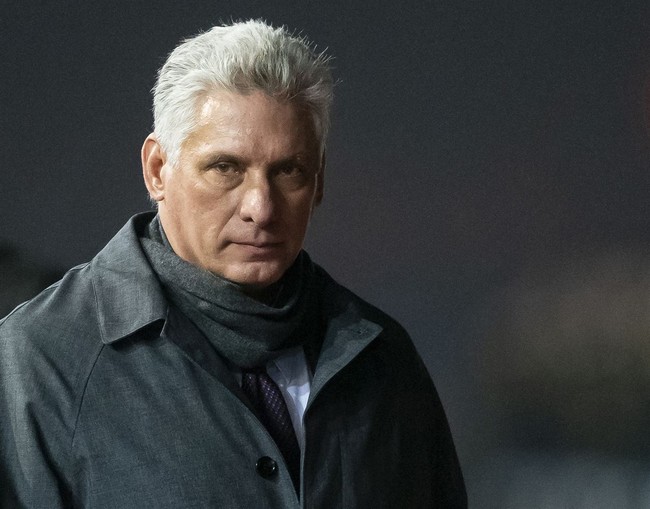
The NY Times is reporting this afternoon that President Trump is demanding Cuba’s current president, Miguel Díaz-Canel, be removed from power in any deal with the country. This may be the first time people inside the administration have said so directly, but it has been obvious for weeks that this is what they had in mind.
The other part of this, which also isn’t really news, is that Trump is willing to leave some version of the regime in place so long as that regime is America friendly moving forward.
As U.S. and Cuban officials negotiate over the future of the Communist-ruled and economically besieged Caribbean island, the Trump administration is seeking to push President Miguel Díaz-Canel from power, according to four people familiar with the talks.
The move would topple a key figurehead but leave in place the repressive Communist government that has ruled Cuba for more than 65 years. The Americans have signaled to Cuban negotiators that the president must go, but are leaving the next steps up to the Cubans, the people said.
The United States so far is not pushing for any action against Castro family members, who remain the country’s top power brokers, two of the people said. That is consistent with the general desire of Mr. Trump and his aides to force regime compliance rather than regime change in their foreign policy.
Again, this isn’t really news. Two weeks ago the Miami Herald reported that President Miguel Díaz-Canel’s days in office appeared to be numbered.
Cuban leader Miguel Díaz-Canel’s time as the face of the island’s communist leadership might be coming to an end, as the Trump administration has signaled a replacement may be needed as part of ongoing negotiations to push for economic and political changes on the island, the Miami Herald has learned.
Cuba’s handpicked president, Díaz-Canel, 65, has been sidelined in ongoing conversations between Secretary of State Marco Rubio advisers and Raúl Castro’s grandson and other people in Cuba. And the Trump administration sees him as “as an obstacle” to the changes it would like to see happen on the island, a source with knowledge of the matter, who asked for anonymity to discuss the sensitive topic, told the Herald. The source said that such a view has been communicated to the Cubans in the ongoing back-channel talks.
And as has also been reported, the US has been talking to various members of the Castro family about having someone else take over who would adopt a different approach to the United States.
Last week, the Herald reported on a meeting between Rubio’s advisers and Raúl Guillermo Rodriguez Castro, Raúl Castro’s grandson, bodyguard and closest aide. The meeting took placed last Wednesday in Saint Kitts on the sidelines of the annual conference of CARICOM Caribbean leaders. Rodriguez Castro is also involved in running GAESA, the military conglomerate that controls about 40% of the island’s economy and key assets like the country’s gas stations, the Port of Mariel and tourist hotels. Several sources told the Herald the U.S. discussed the possibility of gradually easing U.S. sanctions on Cuba in exchange for reforms on the island.
Previously these reports seemed to be reading between the lines a bit. Not it sounds like administration sources are being a bit more explicit about what they intend to do. For Trump, he can claim this as another win, similar to what he did in Venezuela. Officially the same government is still in power, but unofficially they probably won’t be friendly with Russia and China anymore.
The downside in the case of Cuba is that there are hundreds of thousands of Cuban’s living in the US, including several members of congress, who will not be happy with half measures.
The move, though intended to show the Cuban exile community and other Americans that the Trump administration seeks political as well as economic change, would likely disappoint many conservative Cuban exiles in the United States, who want to see wholesale political transformation in Cuba. Cuban American lawmakers in Congress and politicians in Florida could also demand more action from Mr. Trump.
U.S. negotiators also want Cuba to agree to remove from power some older officials who remain committed to the ideas of Fidel Castro, the father of the communist revolution, the person said. And the Americans are pushing for the release of political prisoners, a longstanding policy goal of the United States.
From the perspective of U.S. officials, the talks are focused on having Cuba gradually open its economy to American businesspeople and companies — laying the groundwork for a client state — while getting a few symbolic political wins for Mr. Trump to announce.
Cubans, at least most of the ones living here, hate communism. So any deal that leaves the communist government in place, even one where the hardliners have been removed, will not be something all of them will accept.
Back in February, four members of Congress sent Trump a letter asking him to prosecute Raul Castro in a US court. Trump has refused to take that approach in Cuba even though that’s basically what he did in Venezuela with Nikolas Maduro. It seems that Trump’s plan for Cuba involves a transition that Raul Castro could essentially be on board with, hence talking to his grandson. Though the story suggests the grandson would not be the new president.
Mr. Rodríguez Castro, known as Raulito, would nonetheless have power behind the scenes, with another figure who does not bear the Castro last name officially holding office, the person said.
There’s something appealing about having the surviving Castro brother and his grandson preside over the downfall of the communist revolution Fidel led. But again, not all Cuban ex-pats will be okay with a gradualist approach to ending communism. Many would probably rather see Raul Castro in a US prison for his remaining years.
Finally, President Trump made some new comments about Cuba today, saying he expected to “take it” pretty soon.
President Trump raised the possibility of the United States “taking” Cuba on Monday, telling reporters at the White House, “I do believe I will be having the honor of taking Cuba.”
“Taking Cuba. I mean, whether I free it, take it. I think I can do anything I want with it,” he said. “They’re a very weakened nation right now.”
Cuba’s current government is making an announcement tonight about plans to allow more foreign investment in the country. However, it sound like the Trump administration is waiting to see what they say before taking its next step.
A person close to the negotiations said that the Trump administration was waiting to see whether the changes announced on Monday would be truly structural and meaningful — not simply cosmetic — before deciding whether to issue licenses that would allow such investments. The person asked not to be identified because he was not authorized to speak publicly about sensitive diplomatic matters.
Again, what may sound good to some may not sound good to Cubans living in America. Rep. Carlos Gimienez had this to say about Cuba’s expected announcement.
🚨#SOSCuba No habrá NINGUNA inversión de USA en #Cuba al menos que hayan cambios políticos CONTUNDENTES en la isla.
El régimen necesita de nosotros, nosotros no necesitamos de ellos.
Da pena que la prensa complaciente le haga eco a las ‘bolas’ que el régimen echa a rodar.🇨🇺🇺🇸
— Rep. Carlos A. Gimenez (@RepCarlos) March 13, 2026
#SOSCuba There will be NO investment from the USA in #Cuba unless there are DECISIVE political changes on the island. The regime needs us, we don’t need them. It’s a shame that the compliant press echoes the ‘lies‘ that the regime spreads.
They hate communism and they’re right to do so. Selling them half a loaf which leaves a Castro in power behind the scenes could be a tough sell.
Editor’s Note: Do you enjoy Hot Air’s conservative reporting that takes on the radical left and woke media? Support our work so that we can continue to bring you the truth.
Join Hot Air VIP and use promo code FIGHT to receive 60% off your membership.