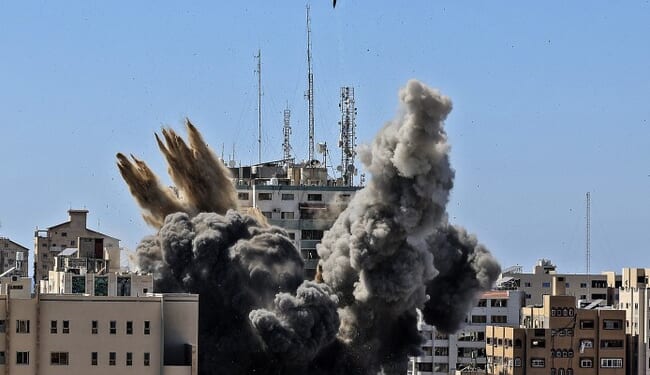
The IDF has finally begun a new ground incursion into Lebanon, in response to Hezbollah’s coordinate missile attacks with Iran. Tehran and its proxy has engaged in a campaign to exhaust Israel’s anti-ballistic missile defenses. The big question at the moment is whether this is …
A: The beginning of a full-blown invasion and occupation of the sub-Litani region
B: The beginning of a full-blown war with Beirut as a strategic goal
C: A limited incursion to force Hezbollah out of missile range while Israel focuses on Tehran
D: A threat of A or B as a means to force Lebanon to deal with Hezbollah as it has repeatedly promised
E: A warning to Hamas to comply with the cease-fire in Gaza
F: A thumb in France’s eye
G: A do-over of a bad November 2024 cease-fire brokered by the Biden Regency
H: A combination of most of the above
At the moment, the overall intent has not yet been made plain. The Israeli government announced the launch of ground operations in Lebanon, but the Israeli media has been uncharacteristically quiet about it. The Times of Israel hasn’t reported much about it, beyond the declaration of it being a “targeted” ground operation:
The Israel Defense Forces said Monday it had begun a “targeted ground operation against key targets” in southern Lebanon, pushing more forces deeper into the area as part of an expanded buffer zone, after the Hezbollah terror group began attacking Israel earlier this month amid the US-Israeli war with Iran.
Defense Minister Israel Katz said the operation would continue until Hezbollah no longer poses a threat to the residents of northern Israel, and compared the operation to the war against Hamas in Gaza.
The 91st “Galilee” Regional Division began a raid late Saturday in the eastern sector of southern Lebanon, during which troops encountered and killed several Hezbollah operatives, according to the military.
The IDF said the operation was aimed at expanding “the forward defense area.”
That makes this sound like option C, with perhaps a nod to option D. However, two days ago, the Israelis warned that they would respond to Hezbollah’s attacks with a much more robust offensive if Lebanon didn’t fulfill its commitments to disarm the Iranian proxy in the 2024 ceasefire, not to mention the treaty signed in 2006 that ended the last Israeli invasion:
Israel is planning a large-scale invasion of southern Lebanon in order to dismantle Hezbollah’s assets south of the Litani River, Axios reported on Friday, citing Israeli and US officials.
According to the report, Israeli officials are planning an operation in which the military would seize the entire area south of the Litani River and dismantle Hezbollah’s military infrastructure, which would be the largest one performed in Lebanon since the 2006 war.
“We are going to do what we did in Gaza,” a senior Israeli official told Axios. According to the report, the offensive was planned after Hezbollah’s attack against Israel, where more than 200 rockets were fired against the country in coordination with Iran’s Islamic Revolutionary Guard Corps (IRGC).
That sounds like either option A or B. If that’s the plan, though, few are reporting on it. Neither the Jerusalem Post nor the Times of Israel has followed this incursion with the kind of kinetic energy that a major offensive would normally produce. However, we do have more interesting coverage from the New York Times that suggests option B may be the plan … although readers need to dig into the story quite a way to realize it:
As Israel widens its ground assault in southern Lebanon, the town of Khiam has emerged as a focal point of the escalating offensive.
The town is situated on strategic high ground a few miles north of the border with Israel and has been coveted over decades of conflicts. It has been the site of some of the fiercest clashes between Iran-backed Hezbollah militants and Israeli ground forces as they made incursions into southern Lebanon over the past two weeks.
Israeli troops have not appeared to be able to seize complete control of Khiam and have faced resistance by Hezbollah fighters, residents say. Israel’s ability to do so will be an indicator of the strength of Hezbollah fighters and of how far Israeli forces can push into southern Lebanon.
This leaves the impression that the IDF has stalled out. Only in the final paragraphs do readers discover that the IDF may be close to capturing this key Hezbollah stronghold:
Only days into the current bought [sic] of fighting, which erupted this month after Hezbollah fired at Israel to avenge the death of Iran’s supreme leader, Ayatollah Ali Khamenei, Israeli forces neared the town of Khiam at a breakneck pace. Residents say the Israeli forces clashed with Hezbollah fighters and have not yet seized complete control of the town.
The Israeli military did not immediately respond to a request for comment.
To residents, the fighting in the town is a sign of the scale of the war to come.
“I think this war will be much bigger than the last,” Mohammad Hassan, 28, a resident of Khiam who fled to the capital, Beirut, days after the outbreak of war earlier this month.
Rather than move on a broad front – or perhaps without such a move being reported – it appears that the IDF has first chosen a strategic position to anchor a wider invasion. That makes some sense, but it’s still not clear whether that is actually strategic in a larger-war sense or just a good position from which Israel can target Hezbollah missile launchers more effectively.
All of these have the effect of option D, in which Lebanon has to face the failures of its previous promises to disarm Hezbollah and secure the sub-Litani region. The Aoun government in Beirut has thrown up its hands and claimed that it cannot effectively disarm Lebanon on its own, which certainly seems to be true whether that’s a function of a lack of will, a lack of strength, or a combination of the two. Some in competing parties have had enough, demanding that Aoun cut a deal with Israel, and one lawmaker wants Aoun to go further than that to deal with Iran:
NEW 🔴
Lebanese Forces official Ibrahim El Sakr calls on the Lebanese Army to surround the Iranian embassy and detain the ambassador, and urges President Aoun to visit the Israeli Knesset and offer a peace for land deal.
–@MEMRIReports pic.twitter.com/JO153XETnf
— Open Source Intel (@Osint613) March 15, 2026
That would violate diplomatic accords, but it gets the point across. At the very least, the Lebanese government should declare all Iranian diplomats persona non grata while Hezbollah uses Lebanon’s territory to conduct war against Israel. They can eject the entire group and cut off any coordination taking place through the embassy between Iran and its most important proxy. Aoun should negotiate a partnership with Netanyahu to squeeze Hezbollah from the north and the south, with newly aligned Syria on hand to cut off Hezbollah’s escape routes.
It may take a few days to see what Israel has in mind with its latest attempt to end the threat from Hezbollah in Lebanon. It may take longer than that to see whether the Lebanese government ever plans to honor their previous commitments, even when Hezbollah is in its most weakened state in over 40 years.
Editor’s Note: Thanks to President Trump and his administration’s bold leadership, we are respected on the world stage, and our enemies are being put on notice.
Help us continue to report on the administration’s peace through strength foreign policy and its successes. Join Hot Air VIP and use promo code FIGHT to get 60% off your membership!