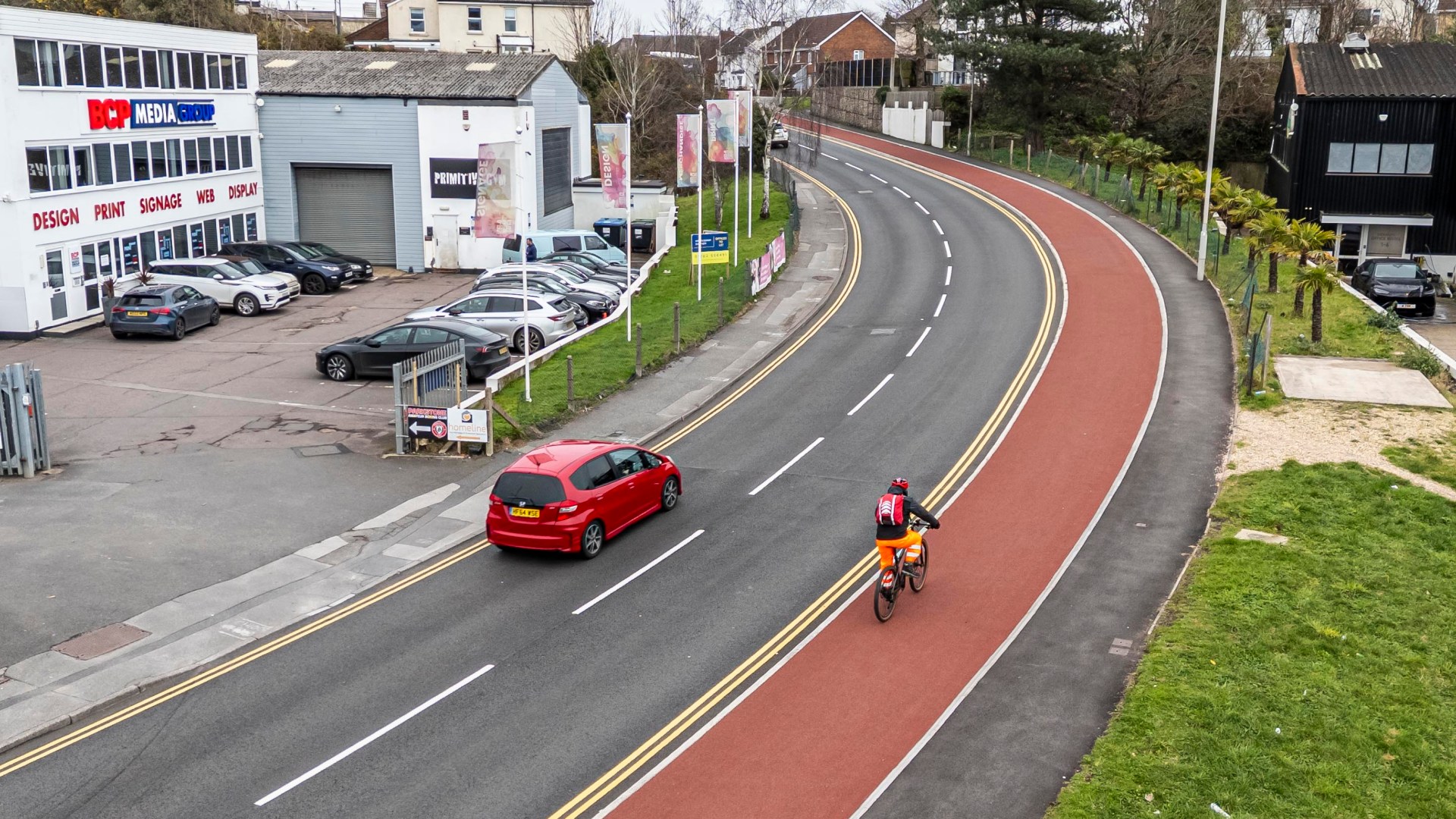
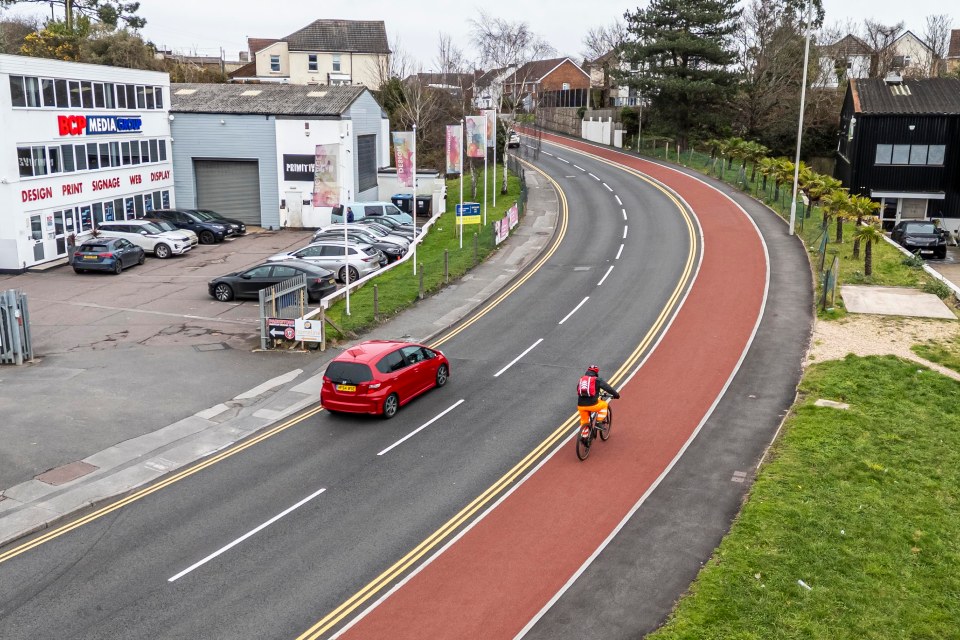
A MASSIVE cycle lane costing £17million has been branded a “monumental waste of public money”.
The 11ft strip of tarmac is wider than the carriageway it runs next to, giving cyclists more room than motorists.
The work on Ringwood Road in Poole is part of a £120m project to lay almost 50 miles on new cycles lanes in south east Dorset.
But complaints have rolled in after people claim the two-mile cycle lane is barely being used and has made driving dangerous.
Pavement corners at junctions have been extended which means cars emerging from side roads have to turn almost at right angles and often swing out into the opposite carriageway.
The narrower carriageway means there is hardly any room for motorbikes to overtake and filter in while lorry drivers have to fold their wing mirrors in to avoid the risk of clipping oncoming traffic.


There is also less room for emergency vehicles to squeeze through.
There are also safety concerns over the quality of materials used for the cycle lane after a 13-year-old girl suffered serious cuts to her face when the wheel of her scooter caught on loose chippings and she fell off.
Residents have also questioned the impact the works have had on the local environment.
One woman said the area has become an “Asphalt Desert” with trees and grass verges ripped out to make way for widened pavements and the brightly-coloured cycle lane.
Bus laybys have been done away with, which results in traffic backing up behind buses when they stop in the road, causing more congestion and emissions.
The ‘Transforming Travel’ project in residential areas of Bournemouth, Poole, Ferndown and Wimborne, is aimed at encouraging more people to cycle and scoot to places.
But critics claim it is part of BCP Council’s “war on motorists”, with officials pledging to reduce local car journeys by 50 per cent.
They say the millions of pounds of public money would have been better spent on improving the condition of the roads and filling in potholes.
Steve Moody is chairman of the campaign group BCP & Dorset Motorists which has over 5,600 members.
He said: “There is definitely a war on motorists and people are really fed up with it.
“This is all part of the council wanting to reduce car journeys by 50 per cent, that is their stated aim. To do that you are going to have to make anti-car measures.
“What they haven’t taken into account is that people need their cars for work and for business and things like shopping and taking their kids to places like school. Can you do you weekly shop on a bike?
“The whole Ringwood Road project is an absolute fiasco and a monumental waste of public money and resource.”
BCP Council has declared a “climate emergency” and pledged to be carbon neutral by 2040. A major part of that is sustainable travel and getting people out of cars.
Steve said: “The council has closed its ears to anything other than their own agenda.
“Their approach is ‘if you build it, they will come.’
“But all the anecdotal evidence suggests that cyclists are rarely seen using the new cycle path.
“A major issue is the main road has become really narrow to make way for the extra wide cycle path and it is dangerous.
“They have extended pavement corners so much it is really difficult for cars to pull out and often they encroach into oncoming traffic because they aren’t able to turn as they should.
“If you have two HGVs in opposite lanes we have heard drivers have to pull their wing mirrors in to pass.
“The bus laybys have been removed which means the bus stops are on the road which creates more congestion because everything has to stop and wait with engines ticking over.
“These narrow roads increase congestion. They aren’t going to reduce emissions by increasing congestion but this is lost of them.
“The ideology of certain members overtakes what is beneficial to the vast majority of the residents they are meant to serve.”
Andy Hadley, BCP Council’s cabinet member for climate mitigation, environment and energy, disagreed with the claims and said they were merely following the government’s national target of 50 per cent of trips taken by people to be by either walking, wheeling or cycling by 2030.
He said: “The claim of a ‘war with motorists’ is quite untrue.
“The 50 per cent target for trips to be undertaken by Active Travel by 2030 is a national ambition from the Department of Transport, which we have adopted.
“This target is driven by commitments for improving air quality, health, reducing congestion, improving neighbourhood cohesion and reducing crashes on the highway.
“It is not possible to create significant new space, so we have to seek more efficient ways to enable people to get around. This does mean re-allocating space to prioritise public transport and keep people safe.”