This article is taken from the March 2026 issue of The Critic. To get the full magazine why not subscribe? Get five issues for just £25.
One of the contradictions that overshadows contemporary art’s place in the world is that the artist can be either a mystic seer whose ideas emerge from beyond reality — or, conversely, a rational observer of the material world, with the artwork a lucid intervention in it.
These understandings are a priori mutually exclusive. In practice, their division plays out on disciplinary lines. Abstract painters, for example, are far more readily forgiven for the idiosyncrasy of their images than video artists whose productions tend to be viewed as if they were documentary.
There are, however, artists who reject the division between the otherworldly and reality. Suzanne Treister, whose expansive practice since the 1980s has explored technological development, the occult, scientific discovery and conspiracy theory, treads the boundary between premonition and discovery.
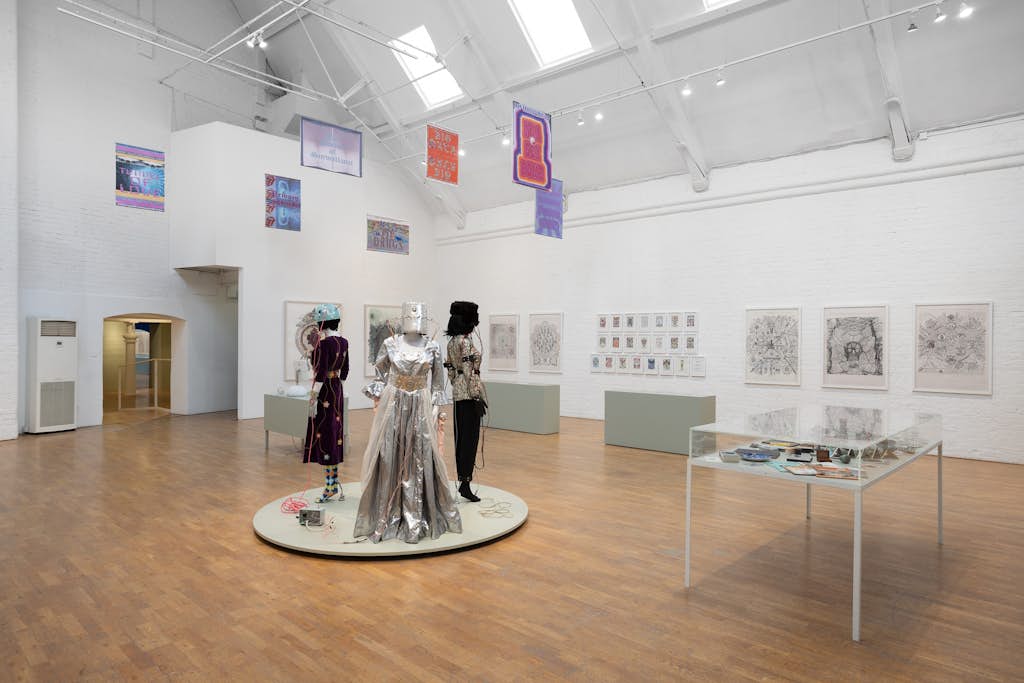
A richly layered retrospective of her work at Modern Art Oxford reveals the friction in the artist’s motivations, testing the mind’s ability to hold contradictory ideas in focus.
Treister started out as a quintessentially postmodern history painter whose subjects included the goddess Venus and space travel, often fantastically brought together on canvas. By the 1990s, she was interested in computer and gaming technologies whose widespread domestic adoption marked the beginning of the algorithmic infiltration of human consciousness.
The prescience of Treister’s now-canonical works is easy to miss because her concerns persist in critiques of technology. Fictional Videogame Stills (1991–92), created in early graphics software on an Amiga home computer, offer seductive, quizzical and terrifying prognoses in equal measure.
One adventure vista poses “have you been sentenced to a fate worse than death?” as a gameplay question; another promises a “virtual paradise”. Another still pronounces that “all exits are closed”.
This enclosure is the first which Treister confronted in her practice: intervening by purely aesthetic means in a system bound to reason meets critical limitations. The graphic allure of even her dystopian computer images, or of the 1993–94 series of ornately decorated floppy disks SOFTWARE, restricted their potential for disruption of the systems which created them.
Was their production, therefore, an opportunity missed? It is poignant that even today, whilst video games are far more popular than the visual arts or film, criticism is a marginal pursuit in the field.
Treister’s workaround was to couch her exploration in fiction. In the early 2000s, she channelled her practice through the alter-ego Rosalind Brodsky, who, apart from fronting a synth-pop band, became the lead researcher of the “Institute of Militronics and Advanced Time Interventionality”.
The work of this body included diagrammatic explorations of the golem — this 2002 project’s stated production of date of 2026 uncannily prefigured our current discussions of AI — as well as explored harder to reconcile links between alchemy, black holes and Tchaikovsky’s Swan Lake.
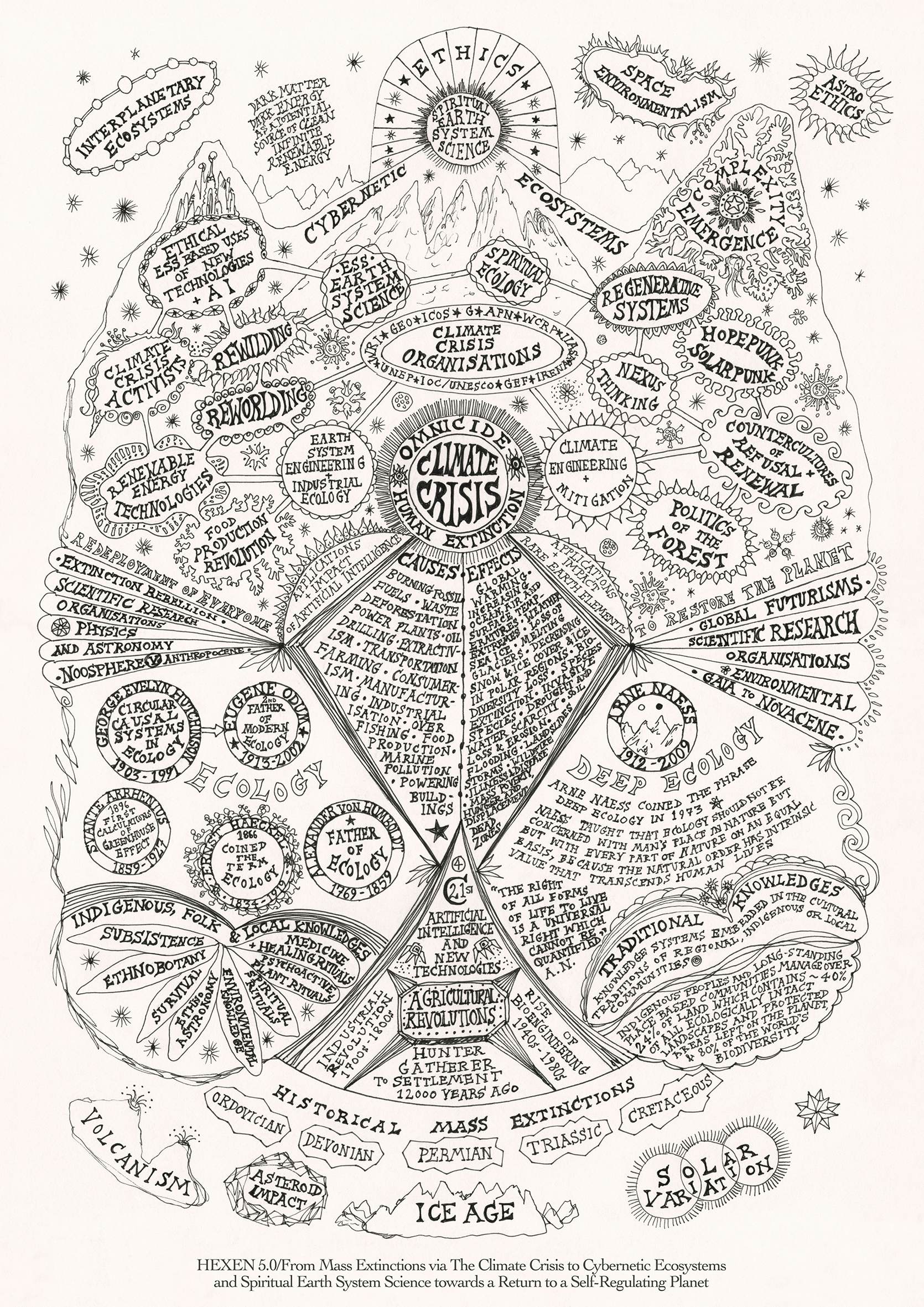
Should Treister’s mind maps, such as those in which she fantastically plotted connections between military control technologies and the occult in her HEXEN series of drawings, posters and … tarot cards, be understood as conspiratorial assertions of fact, as metaphors or abstractions, or as intentionally deceptive projections?
There is nothing surprising, at first, in the form’s implication that everything is somehow connected. For example, Treister’s extrapolation from the early computer networking technology ARPANET to the early 2000s combat simulation training paradigm DARWARS finds backing on Wikipedia. The connections she draws between the CIA’s covert MKUltra programme and countercultural figures such as Allen Ginsberg, on the other hand, require a leap of the imagination.
In 2004, Treister began painting entities as diverse as books, toys and nuclear power plants following a NATO classification system. In the video and drawing installation HFT The Gardener, a decade later, she faux-scientifically studied the stock market’s performance as a function of the psychotropic substances consumed by traders.
All the while, Treister has maintained a meticulous archive of her work online, cataloguing the outcomes of her aesthetic explorations as though they were bona fide research. This means that her images make claims on rationality at will whilst proposing that the true connections between the phenomena they portray hinge on undisclosed esoteric or artistic methods.
In recent years, Treister has collaborated with scientists, taking up residencies in institutions such as CERN. Her project Scientific Dreaming (2022) invited particle physicists to write short science fiction, even further, albeit falsely, investing Treister’s documentary work with scientific authority.
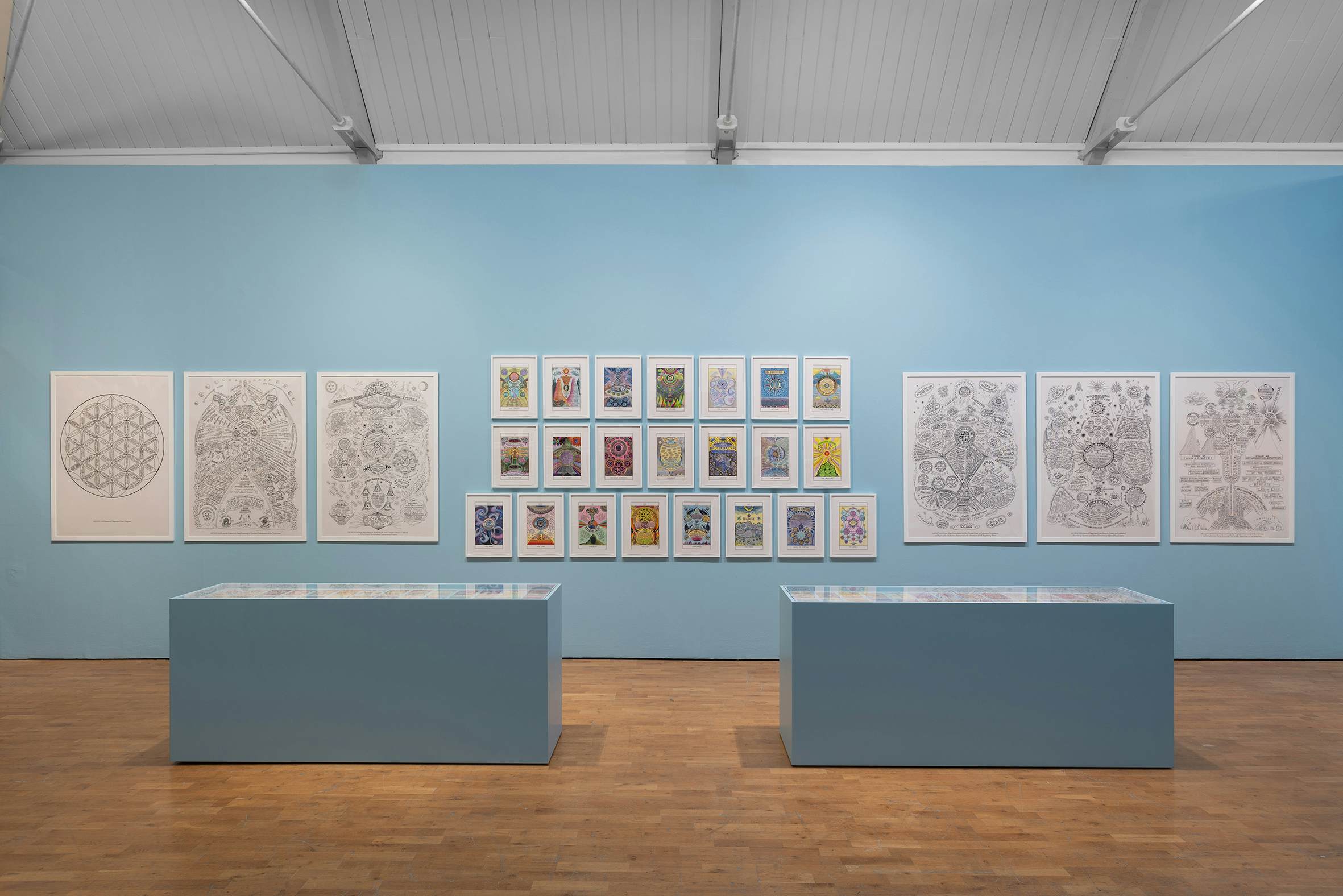
Yet in this work’s shadow, Treister seems to once again find the exits foreclosed. Her most recent project, Institute of Mystical Earth System Science (2024–25), is a proposal for a series of holistic, pan-disciplinary entities charged with saving the world from the side-effects of human knowledge production. This scheme includes visualisations that can only be described as AI slop.
Treister conceptualises “the museum of visionary data stars” and another one for “augmented telepathy”, as if she were unable to break the constraints of her discipline once again. It is a moot point whether the enclosure is aesthetic or scientific.
Prophetic Dreaming is at Modern Art Oxford until 3 May 2026