DARK tourism is booming. Travelling to sites linked to death – the likes of Auschwitz, Ground Zero and Fukushima – are seeing increasing numbers of visitors.
Peter Hohenhaus – a world authority on the industry, who has visited over 900 “dark” destinations – pointed to a problem that threatens to tarnish it – and that is the “wrong kind” of pilgrims, those who treat tragedy less as history and more as a shrine – the Neo-Nazis and far-right sympathisers.
“I have difficulty with Nazi sites, for example, Eagle’s Nest [built in 1938 as a Nazi party conference and social venue] in Germany,” he says.
“I went on an organised tour once. Interestingly, they only exist in English and are mostly taken up by Brits and Americans. I was the only non-native English speaker.
“I had a very uncomfortable feeling as there is always the risk of glorifying Nazism.”
The Sun met with the author of “Atlas of Dark Destinations” in the heart of Vienna, underneath the terrace where Adolf Hitler addressed Austrians on March 15, 1938.
Read more about dark tourism
This is where our tour of the darkest hotspots in Austria‘s capital begins – the exact spot where the dictator announced the annexation of the country to the Third Reich.
“I would always fit this site in a dark tourism tour of Vienna,” he points to the historic – yet restricted terrace – of the Hofburg Palace.
“This is where Hitler announced the Anschluss to an enthusiastic crowd of 150,000-200,000 people, and it is now called Heroes’ Square.
“It was completely ignored after the war. For decades Austrians were quite happily considering themselves the first victims of the Holocaust.
“How much they partook? Most of the really evil Nazi perpetrators were Austrians. But the country was very late facing up to that.
“They are doing it now. There is a museum inside about modern Austrian history that includes this [chapter].”
Peter, a German expat, explains that Austria still does not know what to do with the terrace – an obvious symbol of Nazi rule – and admits that there is “a lot of tension” over it.
The question of its fate resurfaced back in 2021.
Visitors were invited to cast their vote on whether it should be reopened – but there were fears that Neo-Nazis would flock to it to perform Hitler’s salute.
Peter shares this belief. He is also concerned that Vienna – a dark tourism hotspot – could be attracting more Neo-Nazis and far-right sympathisers because of the high number of World War Two sites.
The city still carries these burdenous shadows of the 20th century Hitler rule – streets where crowds cheered in 1938, the buildings that witnessed the collapse of Europe into war.
On his website, “Dark Tourism”, Peter rates Vienna as nine on his so-called darkometer, stressing that it is “one of the world’s most rewarding cities to visit” for such type of tourism.
The Central Cemetery, known as Zentralfriedhof, the Flaktowers in Augarten and Heroes’ Square are some of the highlights listed.
Peter explains that Vienna has a “legendary” relationship with the morbid and death as we enter the cemetery in the outskirts.
This is Europe’s second largest cemetery after Ohlsdorf in Hamburg, and is the last resting place for more than three million dead – almost twice as many as the living residents of Vienna.
The most “atmospheric” part, as our tour guide puts it, is the crumbling Jewish section in the western-most area.
So many Jewish families were wiped out in the Holocaust that there was no one left to take care of the graves after the end of World War Two.
Many of the headstones are now left shattered, toppled and ridden with bullets. In 2012, further antisemitic vandalism was reported.
Cemeteries are one of Peter’s favourite subcategory of dark tourism, so much so that his wife “walked down” the aisle on their wedding day in a coffin.
That same coffin was later transformed into a party prop as each of their guests wanted to try out laying in it. This is how much “darkness” is embedded into our tour guide’s daily life.
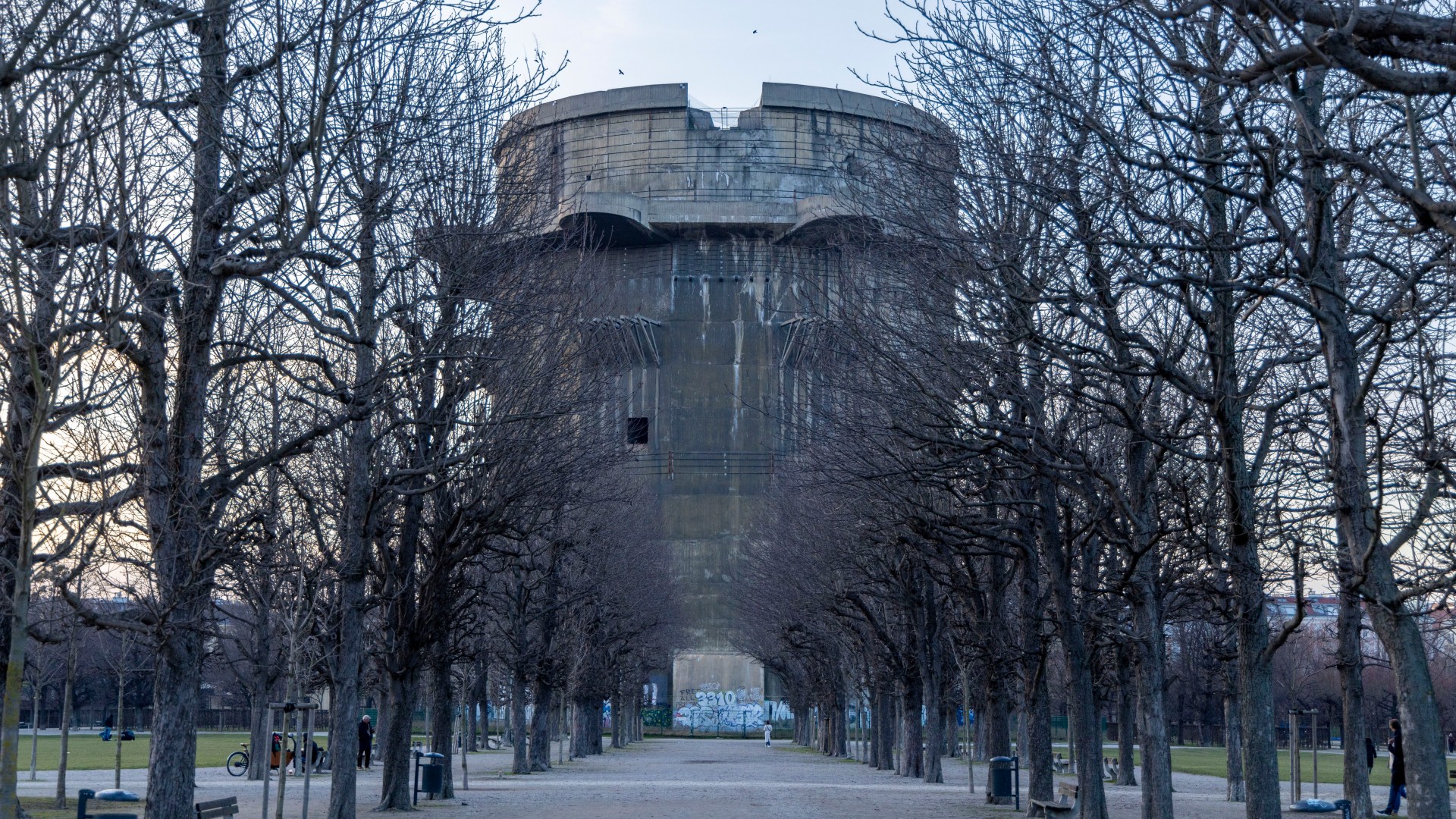
Another top dark site in Vienna that not many tourists – not even locals – know about, are the Flaktowers in Augarten.
At almost 180ft, they were erected using forced slave labour, largely overseen by the Nazis.
The colossal tower-like bunkers were originally built for anti-aircraft gun batteries and as public air-raid shelters.
They are now Vienna’s largest World War Two relics, abandoned to crumble on their own.
“Could they be repurposed as an art space, or again as air-raid shelters in case of an emergency?” The Sun asks Peter, but he instantly shakes his head.
He says: “The towers are now perhaps the largest graveyard for pigeons.
“A few years ago, the government contemplated blowing them up. When staff went to inspect it, they had to wear respirators.
“Inside, there are at least two metres of bird poo and the rotting skeletons of dead pigeons. If there is a hell for pigeons, it is the Flaktowers.”
Peter sees these sites as places to reflect on some of the darkest chapters of history.
He spent most of his life travelling across the world – ticking off one dark tourist site after another – without even realising it.
It was only in 2006 that he came across the term, after his first trip to Chernobyl in Ukraine.
“After reading about it, I realised I am a dark tourist,” Peter says about his life’s passion.
“I had already been to several of these places. I went to Chernobyl in 2006 and the year before that I went to North Korea. I had also been to various concentration camps and memorials.”
Warnings about dark tourism
SOME elements of dark tourism have been criticised, particularly around the behaviour of tourists while at sites like Nazi death camps.
Tourists have been lampooned for taking self-described “Auschwitz selfies” and grinning in front of prisoner uniforms.
There are a number of ethical risks – like disrespectful behaviour and the commodification of suffering, even voyeurism when visiting areas in the immediate aftermath of a disaster.
Other spots, including war-torn areas, can be dangerous for tourists, adding an element of controversy to a planned trip.
Sites like the Chernobyl Exclusion Zone, Fukushima, or abandoned industrial areas can have hidden hazards, such as high radiation levels, structural instability, or unsafe terrain.
Since launching his website in 2007, he has been collating all the sites he visits. But he “seriously underestimated” the scale of the project.
“I thought that I will write 100 pages and then it is done,” he laughs.
“I stopped counting after 1,500 pages and that was several years ago. I do not actually know how many pages it is now – it must be easily 15,000 or 20,000.”
Fervently passionate about his work, Peter admitted that many people “misunderstand” what it is all about.
In tourism, he says, the term is mostly “shunned,” explaining: “People think it is about the tourist being ‘dark’ or ‘morally deviant’, which is nonsense.
“We go to these places because we want to confront the dark reality. Try and understand it.
“There is a something called place authenticity – being at the place where something significant in history happened. It is different to just reading about it at home.
“That’s sort of added value. And that’s an important part of that process.”
For Peter, defending dark tourism also means criticising it, and he still has some strict “dos” and don’ts” during his adventures.
Selfies at concentration camps is where he draws the line.
He says: “I find the whole selfie practice inappropriate. It is not all about you. Putting yourself into the foreground is disrespectful. That’s why I’m totally against it.
“Times are changing and for example, the official guidelines at Auschwitz state that selfies are okay, even invite them along if they are not too disrespectful.”