There’s always a day that divides your life into the before and the after.
On February 24, 2022, there were six of us in a Mitsubishi, packed with things we had grabbed in haste — four adults and two little girls, ages three and nine, who took turns sitting on my lap in the backseat.
They did not cry or complain, sensing our mood. We drove West. Tanks and military convoys were left behind us. The oncoming lane was completely deserted. Not a single car was moving toward us.
It was an eerie sight: empty sky, gray tarmac, thousands of vehicles ahead — and not one heading east, where the war was unfolding.
When night fell, the taillights ahead formed a shimmering red river stretching toward the black horizon.
That was when I understood the scale of the catastrophe. It was not a dawn shattered by explosions. Not the feverish swarm of news buzzing like wasps. It was this silent procession of cars moving through the darkness — a journey into the unknown.
Yesterday there was peace. Today there was war, and nothing could be done about it. That is how it happens. One day you look up at the sky to see if it might rain. The next day you look up to see whether a missile is overhead.
It could be a village house outside Kharkiv, a residential neighborhood in Israel, a luxury hotel in Dubai, or Kuwait International Airport — anywhere within reach. The missile does not ask where you are, or why you are there.
On the first day of Operation Epic Fury — the American and Israeli assault on Iran — our Ukrainian friend appeared at our door in tears. Her husband was trapped on an oil rig off the Saudi coast. As captain, he could not abandon ship without abandoning his duty. His Australian replacement had turned back when the skies shut down. The man was stranded — surrounded by water, surrounded by war.
Four years earlier he had fled Ukraine and found work at sea — far from the war, or so he thought. Now drones flew overhead, and he could not escape the destiny he had tried to outrun.
He was not alone. Hundreds of thousands of travelers were stranded across the region — in hotels, at closed airports, on cruise ships. They had come for vacation and found themselves in the middle of a war. Like him, they had assumed that distance was the same as safety.
They were unprepared. What about us?
From my mother’s stories about the coming of World War II to the Soviet Union, one stayed with me. She and her sister once accidentally locked themselves in the toilet of a train carriage and were trapped there during a German bombing raid. It was her first summer holiday. They spent the winter far from home, without warm clothes.
Did I ever imagine that, eighty years later, I, too, would become a refugee?
The strange thing about what increasingly resembles a Third World War is that most of the world still believes it is living in peacetime.
This war does not resemble the wars of the twentieth century. There are still armies fighting on battlefields, but the conflict increasingly appears in fragments: frozen bank accounts, burning pipelines, cities plunged into darkness, fighter jets and drones provocatively flying into foreign territory.
Last autumn, Russian drones and military aircraft repeatedly violated the airspace of European Union countries. Alerts were issued. Investigations were launched. Then the news cycle moved on.
That was the first bell.
There will be a second. And most people will wait for the third — which will not be a bell at all but the war itself.
More and more people wake up each morning inside a day that may turn out to be their last. I am one of them. So are the people I love.
Perhaps that is why I wake several times a night and reach for my phone to read the news.
One night I read that ten northern European countries have begun preparing joint evacuation plans, drawing on the experience of the war in Ukraine. My first thought was: good. My second: too late?
Aggression is always an action. Defence is always a reaction. And reactions, by nature, come after.
Twelve years ago, when Russia seized Crimea and launched a hybrid war in Donbas, my intuition told me it was time to pack my things and run. There were too many armed men on the streets. The cannonade kept me awake at night, and television had become a round-the-clock version of Orwell’s Two Minutes Hate against Ukraine. Yet I stayed put. There is always tomorrow, right?
Early one morning in Donetsk, I was walking past the school where my children had once studied when I noticed a military truck standing in the schoolyard. Its metal frame was raised at an angle. Even from a distance, I recognized it: a Grad rocket launcher, a machine designed to spray rockets in the general direction of the enemy. Around it stood several men in camouflage with machine guns.
One of them waved me over and asked what I was doing there. I said I was just passing by.
“Why here?” he demanded. “Are you spying?”
The suggestion was so absurd that I let out a nervous laugh. The men did not like it. They exchanged glances and stepped closer, blocking my way. One of them — wearing a striped undershirt beneath an unbuttoned camo jacket — asked what I found so funny. Confused, I could only shrug.
“Why don’t we just shoot him?” one of them said to the others. “I don’t like him.”
“Me neither,” the man in the striped undershirt replied and pointed his machine gun at my stomach.
At that moment I understood something very clearly: I could die right there, in the schoolyard where my children had once played, about three hundred steps from my home.
Then one of them said, “Wait. I know this guy. He lives nearby.”
The man in the striped undershirt turned back to me.
“Then why the hell are you standing here like a fool? Get out of my sight.”
I began to walk away slowly, expecting to feel a bullet in my back. One step. Two steps. Twenty. It was a very long walk, taking only a few seconds.
Back then in Donetsk, people were killed often and for almost any reason: a careless word, a sideways glance, a neighbor’s denunciation. You either supported the regime or became one of its victims. I wanted to be neither.
The next day my wife and I left. It was the very last train from Donetsk to Kyiv. The border closed behind us. The trap slammed shut.
We arrived in Kyiv and saw crowds of carefree people in cafés and on the streets. They behaved as if nothing special was happening in the east. It did not trouble them. At first it seemed strange — at least while I would wake to the roar of an airplane, mistaking it for a bomber. But that passed, and the past stopped predicting the future.
We had almost eight years before Russia’s full-scale invasion — 2,778 days, to be exact. Throughout all this time, we remained the people from “The Sound of Silence” — “talking without speaking, hearing without listening.” For months, while Russia was amassing troops along our borders, we refused to see it, trying to go on with our normal, peaceful lives.
On the evening of February 23, millions of Ukrainians went to bed believing that tomorrow would look much like yesterday. Children listened to fairy tales in bed. Loved ones exchanged goodnights and kisses. Alarm clocks were set for the morning.
Before dawn, the missiles came, destroying structures and lives — along with what psychologists call normalcy bias.
One of those who did not take the threat seriously was a refugee named Irina, whom I once met in Poland. It was shortly after Ukrainian troops liberated the small town of Bucha near Kyiv and discovered hundreds of corpses of men, women, and children caught in the Russian army’s meat grinder.
Irina and her daughter had been there and survived, unlike many others. But they could easily have shared the same fate.
Irina had arrived in Bucha with her young daughter, Valya, and settled on the sixth floor of a multi-story building just a week before the war began. When the Russians arrived, they missed the chance to leave the city. Everything happened very quickly. Suddenly, it was too late to run.
One day, standing by the window, Irina saw a column of tanks and armored vehicles surrounded by soldiers. The Russians had come. From time to time the tanks swerved to crush the cars parked along the street. As the column slowly passed, the soldiers suddenly began spraying bullets in all directions, firing at any movement in a window or on the street.
Irina and Valya hid in the bathroom and stayed there until morning. For hours they sat in complete darkness, wrapped in blankets. Gas, electricity, and running water were cut off. Irina could not charge her phone or call for help. And who could have saved them?
The single mother and her daughter had to survive on their own. There was some water in the boiler tank and a little food in the refrigerator, along with flour, potatoes, and eggs. Some neighbors tried to cook outside over wood fires, but Irina did not dare follow their example after seeing dozens of corpses lying in the street — people shot by Russian soldiers. No one could risk their life trying to collect the bodies.
Irina forbade Valya to go near the window, trying to shield her from the shock. The refrigerator soon stood empty. When the eggs were gone, Irina fed her daughter raw dough with raisins and buckwheat soaked in water. Twice she left the building in search of food, and each time it was a gamble. The Russians shot whoever they wished. They also robbed apartments and raped women. After committing a crime, they often killed their victims and then eliminated witnesses, methodically checking neighboring buildings.
Irina told me she still could not believe her luck in being alive in Poland and had no intention of returning to Ukraine for the rest of her life.
“Where there’s war, there’s no place for ordinary people,” she said. “You need to be as far away from it as possible.”
Not everyone has succeeded. Not everyone will.
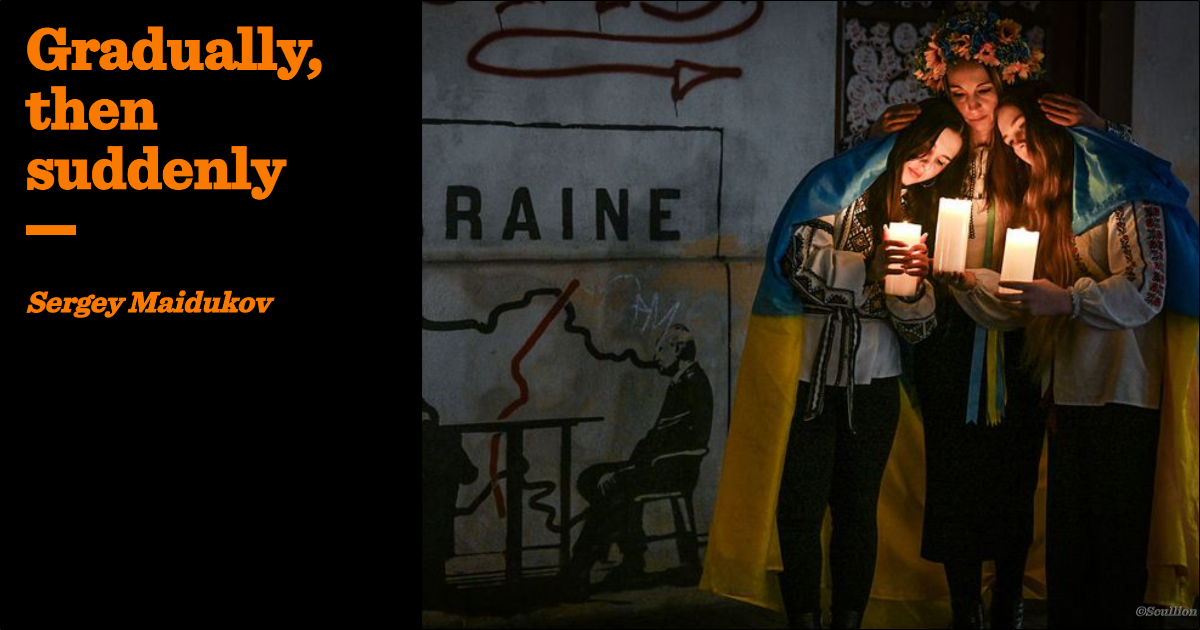
Tragedy almost never announces itself in advance. “Gradually, then suddenly,” as Hemingway put it in “Fiesta”. This applies to anything: bankruptcy, illness, war.
Every morning we wake up alive. That day is the only one we actually hav
Any morning we wake up can turn out to be a prologue to the last ordinary day before something changes everything — until you find yourself, like Dorothy, looking around and whispering: “Toto, I have a feeling we’re not in Kansas anymore.”
Our world isn’t so much like Oz with its wonders. Yet we often seem to wear green glasses while the Wizard behind the curtain assures us that all is under control.
Illusions can be cast aside or shattered. There is always a last day before.
Every morning we wake up alive. That day is the only one we actually have.