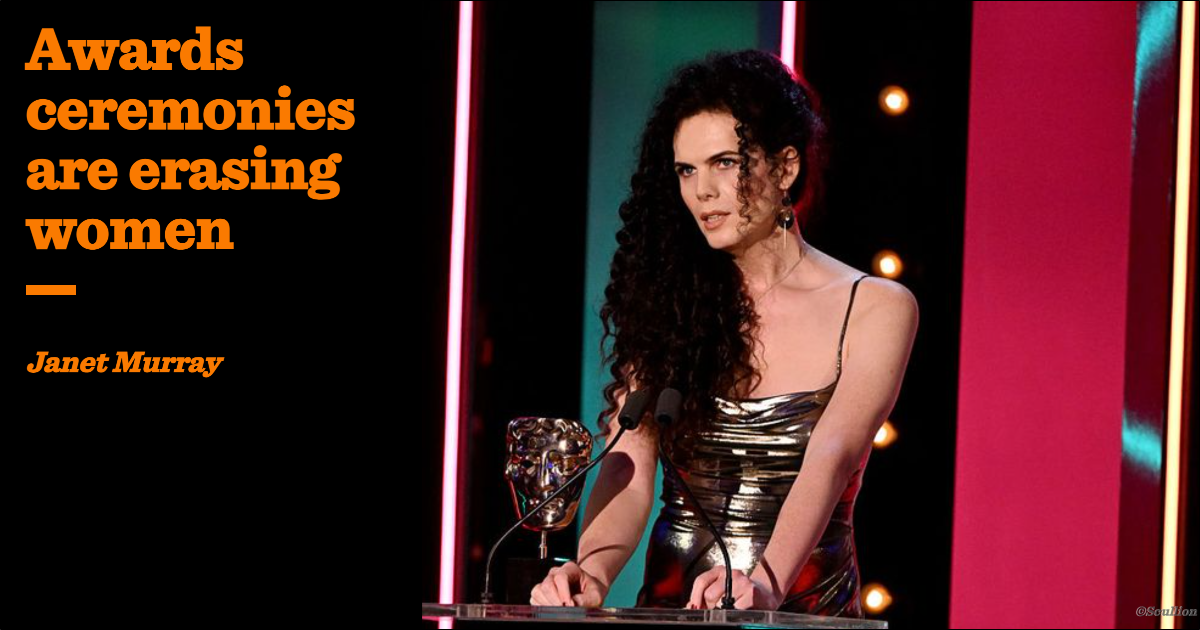
A man who once played the piano with his penis on TV has been nominated for a prestigious television award. If you think that sounds like a low point for the creative arts, that’s not even the worst part. Because this man claims he is a transgender woman, and has been nominated in the Female Comedy Performance category of the Royal Television Society Awards.
Which means an actual woman has lost not only the chance to win, but even the kudos that comes with being shortlisted for a major prize.
I should point out that Jordan Gray has not been nominated for the penis-piano stunt itself. That happened on Channel 4’s Friday Night Live in 2022, during which Gray stripped live on air and proceeded to play the piano with “her” penis — a moment Channel 4’s chief executive at the time, Alex Mahon, called “a beautiful moment of trans expression”.
Seeing someone like this shortlisted in a female comedy category is a slap in the face to women
No, the nomination is for an ITV sitcom from last year called Transaction, which is about — you guessed it — Gray’s experience of being trans. I haven’t seen the show, so I can’t judge its merits. But the artist in question has, quite literally, centred male anatomy in his act while claiming to be a woman. Seeing someone like this shortlisted in a female comedy category is a slap in the face to women. Women who are already tired of men muscling in on their awards.
In 2024, transgender model Alex Consani — a biological male — won Vogue magazine’s Model of the Year at the British Fashion Awards. A biological male was also nominated for an Emmy Award: trans actress Nava Mau from Baby Reindeer. Last year Glamour UK chose nine men as its 2025 “Women of the Year”.
And they’re not just being given women’s awards and creative opportunities — they’re helping themselves to the income that goes with them too.
It’s daylight robbery.
In January, social-media influencer Dylan Mulvaney, a biological male who was previously named Attitude magazine’s “Woman of the Year”, was cast in the Broadway production of Six, a show that has long marketed itself as a female-centred retelling of women’s history, told through a modern pop-concert format.
“YAY BROADWAY,” Mulvaney wrote on Instagram, confirming the news of his Broadway debut. “So happy my bway debut is playing a fellow polarising woman in this perfect musical next month.” Except he isn’t actually a woman.
There was public backlash over Mulvaney appearing in Six, and when he fronted an advertising campaign for Tampax – and partnered with Bud Light on a “365 Days of Womanhood” promotion. But why should Mulvaney care when he’s laughing all the way to the bank from the proceeds of his “womanface”?
Progressives argue that allowing men to be nominated in women’s awards categories is all about inclusion, while conveniently forgetting that sex-based categories were originally created for a reason: to ensure female performers and artists were recognised. Particularly in industries where it’s harder for women to reach the top.
Some organisers have tried to avoid controversy — by abolishing sex categories altogether. But that doesn’t make things any fairer for women. When the BRIT Awards removed male and female categories in 2022, not a single woman was nominated for Artist of the Year.
This is hardly surprising. Making something “gender-neutral” doesn’t magically make it fair – in the same way providing “gender-neutral” toilets doesn’t necessarily provide the safety, comfort and dignity women deserve. (I was reminded of this recently when I found myself washing my hands next to a creepy-looking man loudly coughing phlegm into the sink.)
I hate to say it, but women are part of the problem — some women anyway. Take filmmaker Georgie Wileman’s recent BAFTA acceptance speech for a documentary about endometriosis — a disease affecting the female reproductive system. In the two-minute clip circulating online, the word “women” is never mentioned.
Her co-director praised her bravery in dealing with a serious gynaecological condition and making a film about it. But apparently she wasn’t prepared to use the word “women” — preferring instead to refer to “people with endometriosis”.
Part of me doesn’t blame her. I lost my own business and livelihood for saying publicly that I didn’t like the phrase “pregnant people”. Speaking the truth about biological reality still comes at a cost — even close to twelve months after the Supreme Court ruling which clarified the meaning of the word “woman” in equality law and which many women hoped would put a stop to this kind of nonsense once and for all.
That this awards announcement comes hot on the heels of International Women’s Day makes it sting even harder. It seemed men had to take centre stage there too. International Women’s Day events for men who “identify” as women, and a Cosmopolitan feature marking twelve months since the Supreme Court ruling on how men who say they are women were impacted by the ruling. Co-written by a woman. Working under a female editor.
Apparently, this is what progress looks like — a biological male exposing male genitals on live television, and then accepting a nomination for a women’s award. Whatever it is, it is not progress for women.