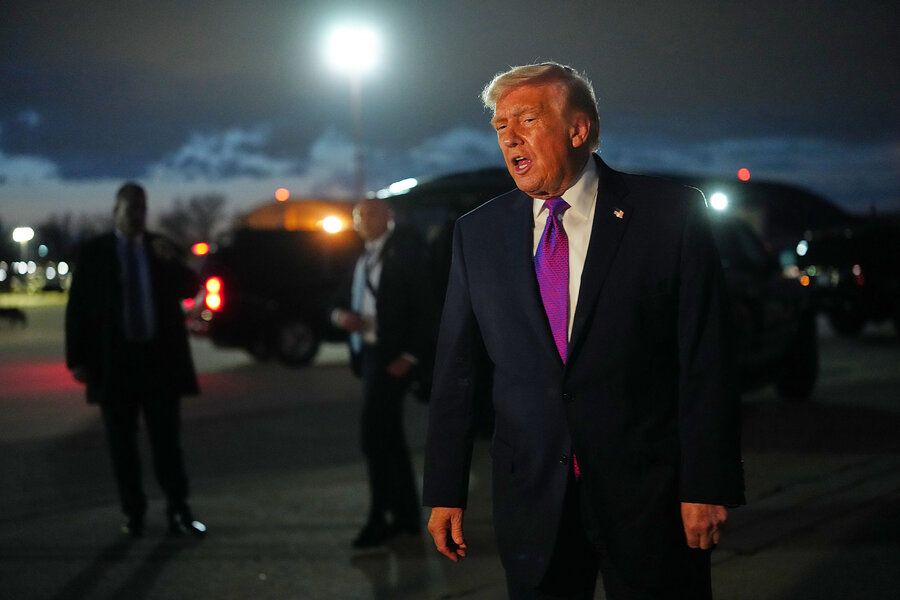
President Donald Trump has long described his decisionmaking style as relying on gut and instinct rather than lengthy deliberation with aides and experts.
Almost a year ago, after first imposing and then pausing massive global tariffs, President Trump told reporters his decisions going forward would be made “instinctively, more than anything else.”
By all appearances, the same modus operandi seems to have played out in one of the most momentous decisions a president can make: whether to go to war. When asked by a reporter last week if Israel had forced the United States’ hand against Iran, as Secretary of State Marco Rubio had implied, Mr. Trump offered a different explanation.
Why We Wrote This
President Donald Trump’s supporters say his decision to attack Iran reflects his leadership style of swift, unilateral action. Others see it as impetuous. As the president hints at an endgame, huge questions – over the Strait of Hormuz, the Iranian nuclear program, and the country’s leadership – remain.
“We were having negotiations with these lunatics, and it was my opinion that they were going to attack first,” Mr. Trump said during an Oval Office appearance with the chancellor of Germany. “So if anything, I might’ve forced Israel’s hand.”
Mr. Trump’s Iran campaign has upset some prominent MAGA commentators who took seriously his promises of “no more foreign wars” and the motto “America First.” Many have also accused the president of failing to “sell” or even fully explain the war’s goals to the American people. The administration has put forward various objectives over the past two weeks, from eliminating Iran’s nuclear threat to changing the regime to destroying Iran’s navy and missile capabilities.
Yet longtime observers and those who know Mr. Trump say his decision to attack Iran was entirely in line with a leadership style that has always opted for swift, unilateral action over governing-by-committee caution. “America First,” they say, has never been synonymous with isolationism, but sometimes means pushing aside failing institutions to address threats head-on.
“He’s willing to take risk, and he’s basically elevating a willingness to take risk over process,” Nadia Schadlow, a deputy national security adviser during Mr. Trump’s first term, recently told New York Times podcaster Ezra Klein. “If the risk is higher of inaction rather than action – and clearly the White House thought that – that’s why they chose to go forward.”

To others, Mr. Trump’s approach appears not so much decisive as impetuous. “It’s never complicated with Trump,” says author Chris Whipple, who gained insight into the president’s world over the course of 11 interviews last year with White House chief of staff Susie Wiles. “He cares about two things, strength and winning. So it’s war by whim.”
The same could be said of Mr. Trump’s risky military incursion into Venezuela in January to arrest its president, Nicolás Maduro, and bring him back to the U.S. to face federal charges, including narco-terrorism. The bold move was an operational success, but the verdict is still out on the future of Venezuelan governance, where acting President Delcy Rodriguez, who was Mr. Maduro’s No. 2, remains in charge.
During his second term, Mr. Trump has grown increasingly aggressive in using military force, notes Katherine Thompson, a senior fellow in defense and foreign policy studies at the Cato Institute and a former Trump Pentagon official. Last year saw seven weeks of attacks by the U.S. and allies on Iranian-backed Houthis in Yemen, plus June’s air strikes on Iranian nuclear sites. This year has already seen the U.S. incursion into Venezuela and now war against Iran, with no end in sight.

At the start of his second term, “there was a much clearer sense of vision,” Ms. Thompson says, with the administration prioritizing the Western Hemisphere and the Indo-Pacific and letting allies know they had to contribute to their own security. Even with the attacks on Yemen and Iran’s nuclear facilities, “it was very clear these were narrowly scoped objectives – short-burst campaigns.” Now, she says, Mr. Trump is falling prey to a “white whale” issue that has bedeviled a succession of American presidents – Iran and the wider Middle East. “It’s a legacy item,” she suggests.
All of which prompts another question: Does Mr. Trump have an endgame for Iran?
During last spring’s trade war, when tariff levels were fluctuating by the day and the stock market was plunging, critics coined the term “TACO” – shorthand for “Trump Always Chickens Out.” Today, some are asking, “Will Trump TACO on Iran?”
Recently, the president has hinted at wanting to wrap things up sooner rather than later. At a rally in Kentucky on Wednesday Mr. Trump told the crowd: “We’ve won.”
“You never like to say too early you won. We won,” he said. “In the first hour it was over.” In the very next breath, the president then added: “We don’t want to leave early do we? We gotta finish the job.”

What constitutes “finishing the job” remains unclear. Huge questions – and much of the world economy – hinge on the Strait of Hormuz, where oil shipments are currently being blocked by Iran. What remains of the Iranian nuclear program, including stores of enriched uranium, is another critical detail.
At one point, Mr. Trump said he should play a role in determining Iran’s next leader, with the U.S.-Israeli air campaign having wiped out much of the nation’s senior leadership, including Ayatollah Ali Khamenei. Iran says the late ayatollah has been replaced by his harder-line son, who issued his first public statement on Thursday, vowing revenge against America.
“I was disappointed [by the choice in leader], because we think it’s going to lead to just more of the same problem,” Mr. Trump told reporters at a press conference Monday at his resort in Doral, Florida.
For Mr. Whipple, three months after his Vanity Fair scoop on the inner workings of the Trump White House, one comment from the usually press-shy Ms. Wiles still stands out: that the president has “an alcoholic’s personality.” Ms. Wiles didn’t mean it literally (Mr. Trump is, in fact, a teetotaler) but offered it as an insight into the president’s own sense of invincibility, his belief “that there’s nothing he can’t do.”
In Term 2, that observation seems to be bearing out, Mr. Whipple says. Mr. Trump “believes he can do anything without consequences.” And it appears, for now at least, that no one in his midst will try to stop him. “Every White House is a bubble,” he says, “but with Trump, it’s exponentially more so.”