It’s becoming clear that Donald Trump gravely miscalculated his assault on Iran. Less than two weeks after American forces killed Ayatollah Khamenei, and with hundreds of Iranian casualties and 140 US troops injured, a treacherous problem has arisen.
Two days after Operation Epic Fury was launched on February 28, Iran declared the Strait of Hormuz closed. Now that 25-mile-wide strip of water between the south coast of Iran and the United Arab Emirates – through which 20 per cent of the world’s oil and gas exports travel – has become a chokehold.
At least three tankers have now been hit by ‘unknown projectiles’, according to maritime authorities in the Strait of Hormuz. At least one person has been killed. This vital corridor could therefore be closed indefinitely by Iran’s drones and marine mines.
As a result, oil prices are surging, hitting over $100 a barrel this week – a $27 increase from the day before Trump attacked Iran. And that’s just the beginning.
Iran’s new leader, Ayatollah Mojtaba Khamenei, yesterday vowed to keep the strait closed to all shipping – a chilling threat to the global economy.
He also declared that unless the US and Israel pay ‘compensation’ for the aggressive bombardments from the past two weeks that have devastated Tehran and other Iranian cities, reprisal attacks on Western assets around the world will be ordered.
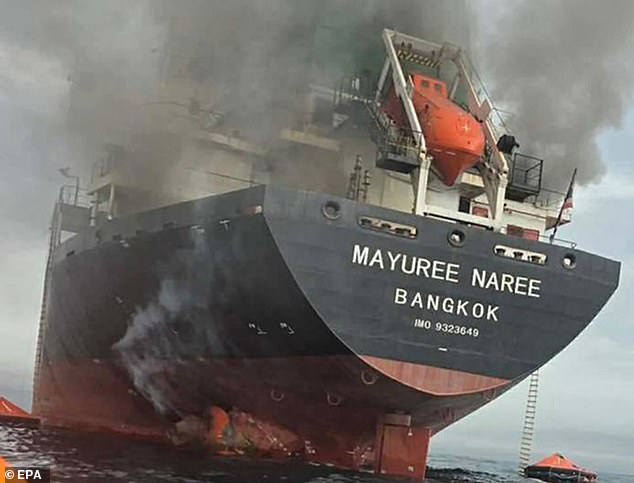
At least three tankers have now been hit by ‘unknown projectiles’, including a Thai-flagged cargo ship which was hit with Iranian missiles on March 11
As if to make good on this promise, on Wednesday night British troops at a joint US and UK military base in Iraq were attacked by two Iranian drones.
With customary chutzpah, Trump declared that the US had ‘already won’ the war. But how can it be, if Iran maintains its blockade of Hormuz?
The crisis is set to cause economic chaos on a scale far worse than the two oil price shocks in 1973 and 1979 that sparked devastating recessions in the West.
Trump has been backed into a corner. The only way to defeat Iran is to seize control of the strait. But the US navy cannot do this by itself or with air support alone. The only way to secure Hormuz is to deploy boots on the ground – the last thing the President or the American people want.
Trump must know that any ground invasion would be a huge operation. He’s most likely to target islands off the shores of Iran, such as Kharg, Iran’s primary oil export terminal, 21 miles off the mainland, or Qeshm, which runs parallel to the shipping channel.
An assault on either key island would require 20,000 troops at a minimum. And it’s likely that Trump would also demand support from British Armed Forces, whose Royal Marines and SAS are the best in the world at this kind of fighting.
Closer to home, the surging oil price, rising insurance costs and the disruption to shipping will wreak havoc on the domestic US economy. Midwestern farmers are dependent on Gulf exports: oil for their machinery and natural gas for fertiliser production.
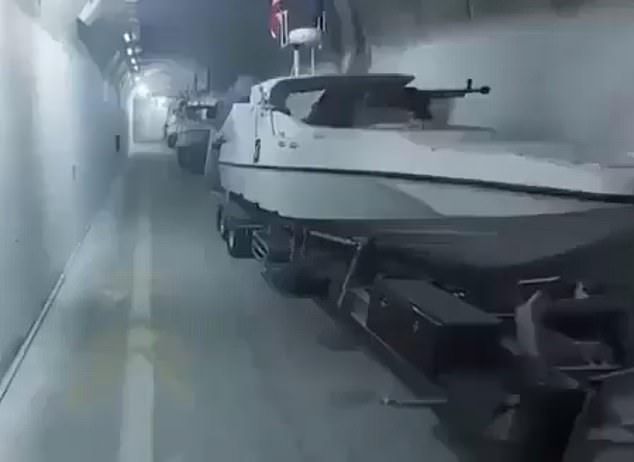
Iran has published footage of underground tunnels stocked with naval drones, anti-ship missiles and sea mines
The second and third-order effects of the current war on the automotive, manufacturing, health and countless other sectors are also likely to mean carnage. The attack on Iran has already been met with opposition in the US – with 48 per cent of Americans strongly disapproving of it – and the mid-term elections are in November. Trump’s Republican Party must win if he is not to be a lame-duck president for the rest of his tenure.
Trump’s failure to plan for Iran blocking the strait is frankly bizarre. In 1988, the US navy fought a naval battle against Tehran in the strait itself, after the USS Samuel B. Roberts was nearly sunk by an Iranian mine in the Persian Gulf.
Operation Praying Mantis saw nearly half the Iranian fleet obliterated in a single day.
Trump has predicted a similar decisive victory over Iran’s surface fleet.
But – just as he appears to have assumed that by killing Iran’s figurehead the war would automatically be won – he has overlooked the fact that Iran hasn’t spent the past 40 years waiting to repeat that bitter experience. They have concentrated on equipping and training for a battle that will be much less one-sided than Praying Mantis.
We already know that the Houthi militia in Yemen – a scrappy but dedicated Iranian proxy – is capable of striking Red Sea shipping, blocking the route to the Suez Canal. The Houthis are probably waiting for the signal to join the war.
Last night, Trump’s Treasury Secretary said that the US navy is prepared to escort tankers through the strait. But that will not release Trump from his impossible bind. Keep the Strait of Hormuz and the Red Sea open, and risk major military losses for the US.
Or tolerate oil surging to $200 per barrel: not a price Americans or the world can pay for long.
If Epic Fury lasts much longer, history will remember it as Trump’s Epic Fail.
Mark Almond is director of the Crisis Research Institute in Oxford.