A former teacher at a £62,000-a-year boys’ school has avoided suspension for touching two pupils inappropriately – after blaming his ‘Italian heritage’.
James Coltella, 42, taught English and acted as Oxbridge coordinator at Tonbridge School in Kent from 2020 to 2022.
He touched two students, referred to as Pupils A and B, inappropriately on their legs, knees and shoulders, and attempted to hug one several times.
The ex-teacher characterised himself as a ‘tactile’ person and blamed his missteps on his ‘Italian heritage as a possible explanation’.
Mr Coltella would also hold public speaking ‘training’ sessions for seven boys, including Pupils A and B, which saw him instruct students to recite song lyrics to each other.
He most often used a song by American artist Charlie Puth called ‘Marvin Gaye’, which has lines referring to having a ‘king size to ourselves’ and ‘it’s Karma Sutra show and tell’.
But a Teaching Regulation Agency (TRA) professional conduct panel ruled not to ban him from teaching, after nine of 25 total allegations were found proven.
Mr Coltella has now tried to reinvent himself in the United States, as a freelance writer and ‘strategic communications’ expert, after studying a public administration masters at the prestigious Harvard Kennedy School.

James Coltella (pictured), 42, touched two students, referred to as Pupils A and B, inappropriately on their legs, knees and shoulders, and attempted to hug one several times
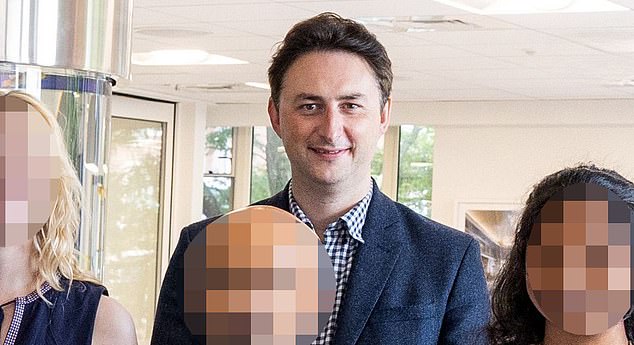
The ex-teacher (pictured) characterised himself as a ‘tactile’ person and blamed his missteps on his ‘Italian heritage as a possible explanation’

He taught English and acted as Oxbridge coordinator at Tonbridge School (pictured, file photo) in Kent from 2020 to 2022
The ex-teacher’s LinkedIn profile makes much of his 15 years in teaching but does not mention institutions by name, instead simply referring to ‘Kent Schools’.
It veils his previous roles, which include a nine-year stint at The Skinners’ School in Tunbridge Wells, from 2011 to 2020.
Mr Coltella served at the prestigious boys’ grammar school, variously, as an English teacher, head of English and eventually assistant head of sixth form, which saw him join the school’s senior leadership team.
He also used to work at the all-boys Maidstone Grammar School, as an English and languages teacher, from 2006 to 2010, where he helped run a unit of Royal Air Force cadets.
This came after a year at the Marymount International School in Rome, in 2002, an English masters at King’s College London, and an Italian and French degree at the University of Exeter.
Mr Coltella is now based in Beaverton, Oregon, in the United States, where he works as a freelance writer on politics and international affairs.
He is also a Bloomberg Harvard City Hall Fellow 2025-27, a scheme which gives Harvard graduates placements supporting city halls across the States.
The ex-teacher has previously worked in executive communications and media relations at the Harvard Center for International Development.
Documents from the hearing in January said Pupil A, at Tonbridge School, had regular one-to-one meetings with Mr Coltella in the latter half of 2021.
They were used mostly to discuss his personal statement for university and for teaching Italian, which the teacher had studied at university.
The panel noted he ‘always chose a chair or seat that very close to [the student]’ in these sessions.
It also pointed to remarks by the student, who said in witness statements Mr Coltella was ‘always touching my shoulder and knee’.
The student explained: ‘Touching my knee would also happen when he would laugh and I also recall that the teacher would touch my knee like my grandmother would as he would have his hand on me and would rub his thumb to comfort me, like someone would do if you were crying.’
Pupil A also said the teacher had asked for a hug several times, which he always agreed to – but it left him feeling ‘horrible with himself’.
He said the private sessions tended to last an hour – but the panel noted Pupil A eventually ‘sought to avoid Mr Coltella’.
The student cut down on the number of meetings, and ‘sought to shorten the sessions by providing an excuse so that they would last 15 minutes’.
During Tonbridge School’s investigation, Mr Coltella said, when asked if he had touched Pupil A, he shook his hand and patted him on the back ‘to say well done’.
He said he had only hugged the student ‘in terms of patting Pupil A on the shoulder, never an emotional hug’.
The teacher said he was sure ‘his actions were not construed in a sinister way’ – but acknowledged perhaps there was a line that he may have naively blurred’.
He ‘did not deny’ touching the student in private sessions, saying he ‘gave pats in a platonic way and hugs in an encouraging way, not anything sinister’.
Pupil B, also at Tonbridge School, similarly said Mr Coltella would ‘touch and brush my leg’ in both group and one-to-one sessions.
He said ‘it was too much for a teacher’, with the panel noting the student said ‘it did not feel sexual’ – but ‘he thought it was odd’.
Leg touching was done while sitting physically close or while laughing ‘if I said something funny, like him hitting your leg when saying a joke’, Pupil B said.
Another student at Tonbridge School, referred to as Pupil C, said he often waited outside the classroom when Pupils A and B were in these one-to-one meetings.
Pupil C said he did this to ensure ‘they were not kept longer than they had to be’ with Mr Coltella.
In fact, Pupil A explicitly asked both Pupils B and C to wait outside the room during private sessions, ‘almost for his safety and security’.
Mr Coltella later said he did not recall touching Pupil B – but if he were to have done so, it ‘would probably have been something like brushing him on the knee’.
Both Pupils A and B referred to reciting the Charlie Puth lyrics in public speaking group training sessions, which were used most often, alongside other songs.
Pupil A explained the boys were instructed to say the words to each other, while making eye contact, in a ‘sincere and authentic way and not laugh’.
The panel explained: ‘If they were messing around, Mr Coltella would step in, be very close to them, “look us deep and directly in our eyes and say the lyrics with real sincerity”.’
The teacher confirmed used the Charlie Puth song along with others to help pupils talk to each other in a ‘soft, not coercive, but kind and loving manner’.
He said he had used the lyrics for five years and ‘it seemed to connect with the boys’, the panel noted, and ‘the song were ones that he believed worked well’.
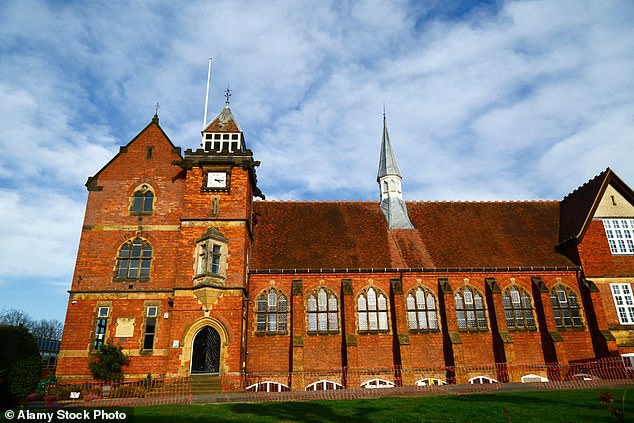
Mr Coltella’s previous roles also include a nine-year stint at The Skinners’ School (pictured, file photo) in Tunbridge Wells, from 2011 to 2020
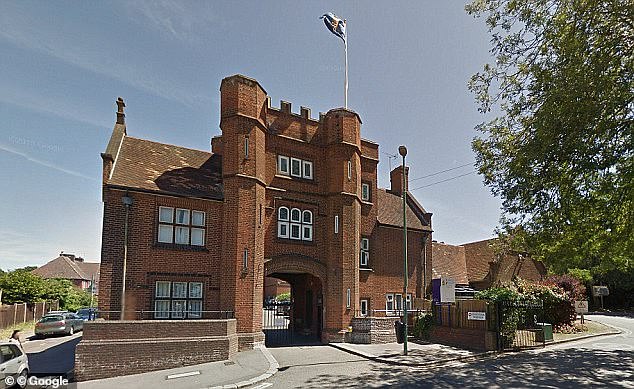
He also used to work at the all-boys Maidstone Grammar School (pictured, file photo), as an English and languages teacher, from 2006 to 2010, where he helped run a unit of Royal Air Force cadets
But in representations to the TRA in June 2024, he said: ‘It is now evident that the lyrics of the song chosen was unwise, but my intention was about helping them connect with emotion in public speaking so that they could better persuade individuals when at global competitions.’
Allegations against Mr Coltella first emerged in February 2020, a parent of a student, referred to as Pupil E, at The Skinners’ School made a complaint to staff.
This saw the teacher given a ‘management guidance letter’, setting out the school’s expectations as to future conduct for someone in his position.
Mr Coltella moved to Tonbridge School that September – but in January 2021, Pupil E complained to The Skinners’ School again.
They also registered concerns with the Local Authority Designated Officer (LADO) at the council, who is in charge of handling complaints about adults who work with children.
Tonbridge School, which was made aware of these grievances, then received a separate complaint from Pupil A in November 2021.
Staff undertook a month-long investigation before referring Mr Coltella to the TRA in January 2022.
Allegations made by Pupil E were found by the panel to not be proven.
Documents for the hearing noted: ‘The panel considered that Mr Coltella’s actions were serious given the negative impact on Pupil A and Pupil B.
‘In his dogged determination to achieve academic success for them, his methodologies were open to misinterpretation and he failed to safeguard their welfare.’
The panel therefore found Mr Coltella’s behaviour mounted to serious misconduct, falling significantly short of the standards expected of his profession.
It also found him guilty of unacceptable professional conduct, which could bring the profession into disrepute.
But the panel noted aside from his management advice letter, Mr Coltella was ‘otherwise of previously good history’.
‘There was evidence that he had demonstrated exceptionally high standards in teaching and that he had contributed significantly to the education sector,’ it said.
‘He had an unblemished career as a teacher for approximately 14 years.’
The panel also pointed to praise for his character from staff, student and parents, in witness statements and in emails and other communications from over the years.
It was ‘concerned’ that in representations to the TRA, Mr Coltella ‘largely’ referred to the impact of proceedings on his own career, life and mental health.
He said, ‘Waking up every day to the reality of my situation has taken a huge toll on me,’ and said the impact on himself and his family had been ‘immeasurable’.
His acknowledgement of his impact on others was ‘less evident’, the panel said – though he did refer to his ‘remorse for any emotional harm I may have unintentionally caused’.
But the panel noted he called his dismissal a ‘terrible wakeup call’ and said he had done a ‘lot of work on myself over the last 4 years’.
‘I can genuinely say that I am a different person. From therapy to study, I have worked hard to re-launch my career and myself,’ he said.
Mr Coltella said he recognises ‘how I need to change and behave, fully empathising and appreciating different perspectives – indeed the work I have undertaken on myself has helped me to better understanding [sic] varying perspectives as well as completing training on preventing and responding to sexual harassment and other sexual misconduct’.
He added: ‘My Italian heritage and upbringing fostered a demonstrative manner; however, the need to think about how your actions are received by others has now been acutely understood.
‘I now fully realise that policies are clearly put in place to protect all parties and had I followed procedure then I would not have placed myself in a vulnerable position.’
He concluded: ‘I have learned many lessons from this terrible situation and only ever wanted the best for others.
‘As my character references attest, there was never any malicious intent and I am deeply sorry for any emotional harm I may have caused.
‘It is clear to me where I have erred and what I must do in order to never repeat mistakes of the past.’
The panel cited all this evidence in its recommendation not to bar Mr Coltella from teaching – which was upheld by the secretary of state.
A spokesperson for Tonbridge School said: ‘We are grateful to the Teaching Regulation Agency for its careful consideration of this matter and acknowledge their decision that whilst Mr Coltella’s actions did not merit a prohibition order, they found his conduct may bring the profession into disrepute.
‘As a School, we investigated concerns promptly and thoroughly when they arose, resulting in Mr Coltella’s departure from Tonbridge, and proactively referred the matter to the TRA in line with our strict safeguarding procedures.
‘Pupil welfare and safeguarding are at the heart of what we do and will continue to be treated with the utmost importance.’
A spokesperson for The Skinners’ School said: ‘James Coltella worked at Skinners’ School from 2011 to 2020.
‘The Teaching Regulation Agency’s consideration of the case has clearly been professional and thorough, and we accept their conclusion that some of Mr Coltella’s actions amounted to unacceptable professional conduct that may bring the profession into disrepute.
‘We also note and accept the judgement that collectively they did not merit a prohibition order.
‘We investigated concerns that affected our school with care when they were brought to our attention.
‘We take our responsibilities for safeguarding pupils very seriously indeed. Safeguarding is paramount to our work.’
Mr Coltella, Maidstone Grammar School, Marymount International School in Rome, Harvard Kennedy School, the Bloomberg Harvard City Hall Fellowship scheme and the Harvard Center for International Development have been contacted for comment.