This article is taken from the March 2026 issue of The Critic. To get the full magazine why not subscribe? Get five issues for just £25.
In 2012 the Guardian ran a feature in which prominent names in Scottish literature such as Val McDermid, Irvine Welsh and Janice Galloway were asked to give their views on independence ahead of the 2014 referendum. Almost to a man, or woman, they came down on the “yes” side or equivocated. There was only one staunch defender of the union, Allan Massie.
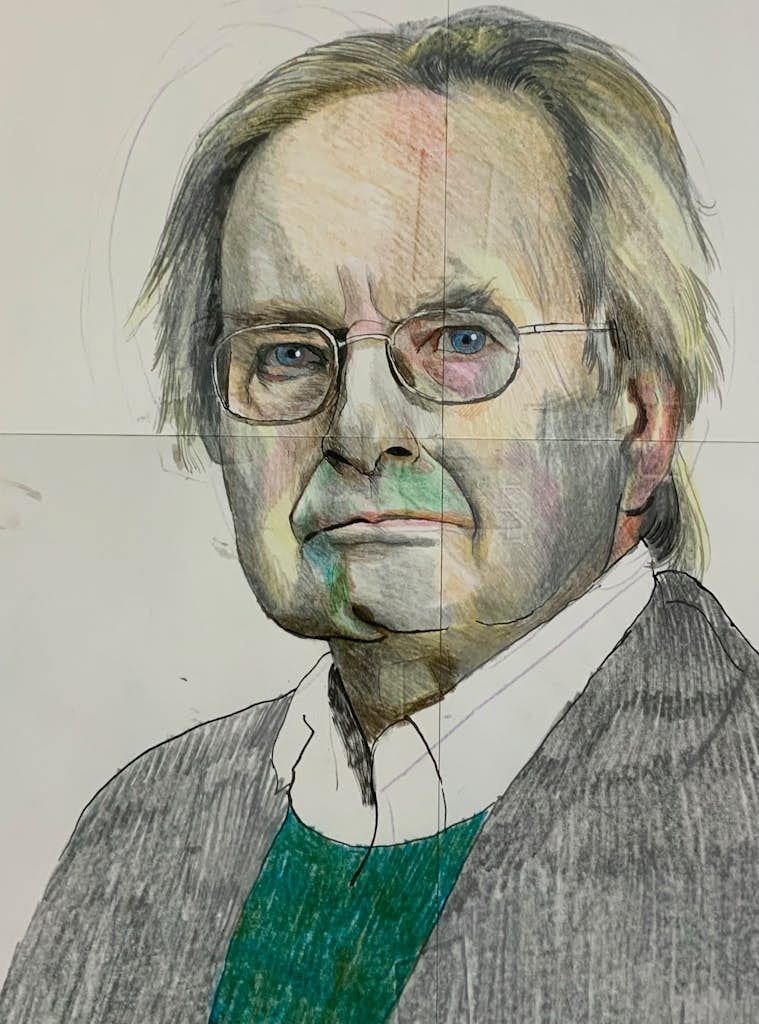
Massie had a position in Scottish culture that has no equivalent in England. He was like Charles Moore, Philip Hensher, Julian Barnes and Simon Barnes all rolled into one — though much better than that sounds. Last month he announced that he was putting down his pen as lead fiction reviewer for the Scotsman newspaper after 50 years and more than 3,000 reviews. Then just before going to press I learnt from his daughter Claudia that he had died from cancer.
It had been an amazing innings considering he also contributed to the Sunday Times, Spectator, the Daily Telegraph and others on politics, sport and culture. And all this while he wrote novels that, at their best, are up there with the finest post-war British fiction. It’s a work rate that makes most authors look like dilettantes.
I first came across Massie in 2003 when I was a callow publicist at Hodder & Stoughton working on the last of his Roman novels, Caligula. I blithely contacted Scottish newspapers to see if they wanted to interview Massie, and received wry chuckles from the grizzled hacks of Edinburgh and Glasgow. It wasn’t that they didn’t know him; it was that they knew him too well. What would be the point of a profile?
When he came to London to record something for Open Book on Radio 4, we went out to the Gay Hussar in Soho with his editor. This famous Labour institution, now a trendy wine bar, wasn’t the ideal fit for him politically, but it was a jolly evening even if the Hungarian food wasn’t terribly good. On our rounds of the bookshops the next day to sign hardbacks of Caligula, he bought me a copy of The Radetzky March by Joseph Roth and later sent me a copy of his 1989 novel A Question of Loyalties with a note saying that it was probably his best work.
I must have read it five or six times now. It’s one of those rare novels that makes the reader think of something — in this case, collaboration in wartime France — in an entirely new way. Like much of Massie’s fiction, it uses texts within texts such as diaries and letters as the narrator Étienne de Balafré tries to discover the truth about the father he never knew — Lucien, a conservative intellectual and deluded idealist who thought he could serve France better in Pétain’s government than by joining De Gaulle.
Whilst many resisters in the novel are principled, Massie shows that villainy and brutality were not confined to the Vichy side. De Balafré’s tragedy is that he is too rigid to change sides as so many others did.
For me it’s one of the great Second World War novels and sits alongside Evelyn Waugh’s Sword of Honour trilogy or Olivia Manning’s Fortunes of War series, yet it didn’t make the shortlist for the Booker Prize (won that year by Kazuo Ishiguro’s The Remains of the Day). His follow-up, The Sins of the Father (1991), did cause a brief furore when one of the Booker judges, Nicholas Mosley, resigned because it wasn’t on the shortlist.
Surprisingly for someone so prolific, Massie became a professional writer late in life. He was born in 1938 in Singapore, brought up in Aberdeen, and attended Glenalmond College and Trinity College, Cambridge, before becoming a teacher at the private school where he met his wife, Ally, who died in 2022.
In his late 30s, he was teaching English in Rome when he was asked to write an article. He never looked back.
His debut novel, Change and Decay in All Around I See (1978), was published by Euan Cameron at Bodley Head, who had written to Massie to thank him for a complimentary review of one of his authors’ books. The two became lifelong friends. It was through Cameron that Massie was taken on by the literary agent Giles Gordon, who had a keen eye for talent and thought journalists were “perfect author material”.
The debut was well received, but Massie found real success with his Roman novels, which took up the baton from Robert Graves. They were Augustus (1986), Tiberius (1991), Caesar (1993), Antony (1997) and, most daring of all, Caligula (2003), in which Massie attempted to humanise one of history’s great monsters.
His friend and former literary editor of the Glasgow Herald, Alan Taylor, wrote that Massie’s “favourite stomping ground is the no man’s land where bald “facts” leave chasmic holes in the historical narrative”. You can see this in the Roman novels, the Second World War trilogy and his early book about Italy’s decade of terrorism and kidnapping, the anni di piombo, in The Death of Men.
Massie found particular success in France when A Question of Loyalties was translated into French in the 1990s. This was a time when the country was only just beginning to come to terms with its complicated war record, exemplified by President Mitterrand, who served with Pétain before joining the Resistance, and plays a cameo role in the book. Massie was feted in France in a way he wasn’t back in Britain. In 2007 he was made a Chevalier de l’Ordre des Arts et des Lettres (he received a CBE in 2013).
He would return to this fertile territory in 2010 with his late-period Bordeaux Quartet, a crime series set in Vichy France which was inspired by Simenon. It is a travesty that they haven’t been adapted for TV. One can imagine actors of a certain age queuing up to play Superintendent Lannes, a detective to sit alongside Ian Rankin’s Rebus or William McIlvanney’s Laidlaw.
After quitting drinking, his only vice was Gitanes Bleu, which he eventually gave up in favour of a daily cigar
Another later work, Surviving (2009), was based on his friendship with Dylan Thomas’s widow Caitlin, who he met when he attended Alcoholics Anonymous in Italy in the 1970s. The two remained friends until her death in 1994. After stopping drinking, Massie channelled his energies into his writing rather than roistering. His only vice was smoking Gitanes Bleu, which he eventually gave up in favour of a daily cigar.
Perhaps sobriety explains the extraordinary work rate. In addition to his 25 novels in under 40 years, he wrote non-fiction, including a book about his hometown of Aberdeen, a popular history of the Roman emperors, and one of the best books about Anglo-Scots relations, The Thistle and the Rose (2005).
Massie sums up the Scottish mentality and attitude towards its often overbearing neighbour in one word, “nevertheless”. He writes: “Certainly, the English irritate the Scots, often acutely. There are more of them, and we resent this. They are inclined to equate the United Kingdom with England, and we resent that. They assume an air of superiority. And they remind us too often of their, occasional, sporting triumphs. All this is intolerable.” Nevertheless, he was a staunch unionist.
He was one of the last Scottish writers to have grown up during the twilight years of the British Empire.
Being Scots and British came naturally. He was keen on rugby union and cricket and wrote extensively on both. This puts him out of step with the modern Scottish literary world of Creative Scotland, the Edinburgh International Book Festival and slavish devotion to the SNP. It’s telling that he lived away from the Edinburgh and Glasgow establishment in Selkirk in the Borders. Fortunately, now that he is no longer with us, there’s still his journalist son Alex to take up the cause of unionism and good sense. His other children are writers too: Louis works for the AFP press agency, and Claudia was an art critic.
Whilst he was a major political figure in Scotland, south of the border, Massie was best known for his literary criticism. He wrote a long-running “Lives and Letters” column for the Spectator. Phenomenally well read, he was always happy to wade into literary arguments, such as when he took the late John Carey to task in the pages of the Daily Telegraph for dismissing the work of the poet George Barker.
However, Massie didn’t really fit in in London either. One could not imagine him ever having hung out at the Pillars of Hercules pub with the likes of Martin Amis. His work has more in common with non-British writers such as Joseph Roth and Giuseppe di Lampedusa than with any of his contemporaries.
In some ways, all the other output, the newspaper columns, and so on, detracts from his brilliance as a novelist. Like other well-known figures who write fiction (Thomas Keneally in Australia is a good comparison), the public persona overwhelms the novels. Perhaps if he had been less prolific and more of a Thomas Pynchon-like recluse, then he would have been more celebrated. His son Alex wrote: “He always denied that his journalism ever obstructed his literary alter ego but few people ever believed that could possibly be true, and in his final times he grudgingly conceded that all those other folk might have had a point.”
Nevertheless, he has left us some brilliant novels. Now that he is no longer with us, I hope a new generation will discover them. For Massie neophytes, A Question of Loyalties is the ideal place to start. I am envious that there are those who will get to discover Massie’s writing for the first time.