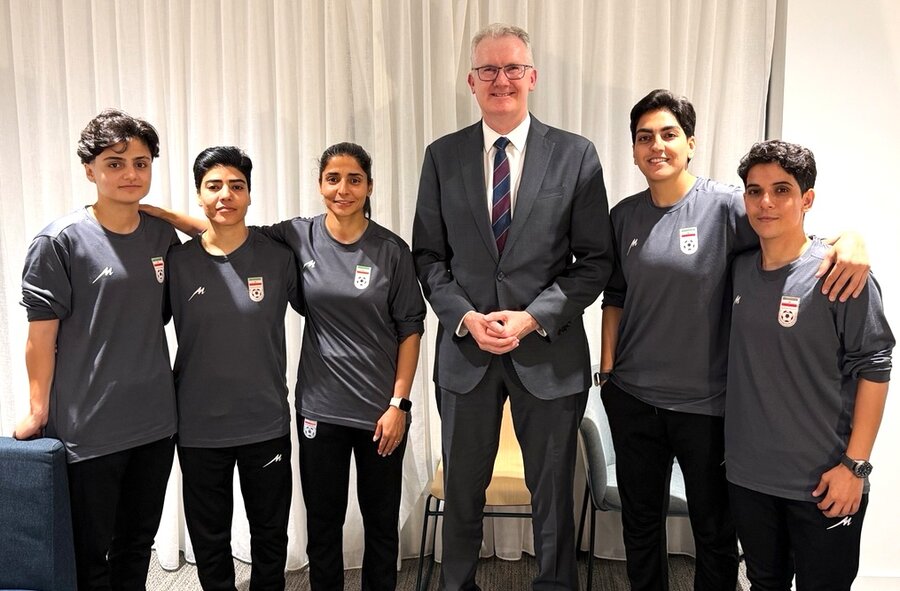
On Monday, while visiting Australia to compete in a tournament, five members of the Iranian women’s soccer team were struggling in a hotel room over whether to defect and escape suppression back home. Their struggle ended when Naghmeh Danai, an Iranian-Australian and a migration agent, told them, “You will have more respect [here].” The five could quickly gain official residency and build a new life – as athletes, women, and citizens in an egalitarian society.
“And they were thrilled,” Ms. Danai later said. The five accepted asylum – and freedom – in Australia.
This minor tale of Iranians seeking to be honored on their merits reflects a major theme during the many years of protests in Iran: An authoritarian theocracy purposely set up in 1979 to replace a dynastic monarchy has come to rely on nepotism and crony networks to keep itself in power, denying opportunities for many Iranians and leading to corrupt, ineffective governance.
Within the regime, kinship and marital ties matter more than competence. The gene pool drowns out the talent pool. One 2024 study found that 22% of government ministers were the sons of clerical personalities. Even the largely powerless president, Masoud Pezeshkian, called for meritocracy in government last year and an end to what he described as “narrow-mindedness in appointing officials.”
Nothing represents this official favoritism more than the elevation of Mojtaba Khamenei, the second son of the slain supreme leader, Ali Khamenei, as Iran’s new, all-powerful ruler. If the regime were to fracture and fall someday, it might be because of internal dissent against such dynastic rule and all the inequality this represents.
Long before he even took power, Mojtaba Khamenei, known as the “shadow prince” of the Islamic Republic, was the subject of protesters’ chants against hereditary rule. Despite that popular sentiment, the regime decided to keep control during the military campaign by Israel and the United States by picking the dictator’s son rather than seeking legitimacy with the people.
The choice might have defied the wishes of the father. The late Ali Khamenei once stated that one of the Islamic Revolution’s greatest achievements “was the destruction of a structure which was based on a cruel and unreasonable hereditary monarchy.” Today, public resentment of the aghazadeh (Persian for the favored children of the elite) still runs high. Last October, for example, candidates for teaching posts protested outside the Education Ministry over blatant nepotism in hiring.
A second revolution against deep-rooted nepotism seems far off. Yet that’s not the case in the hearts of everyday Iranians like the five women on Iran’s soccer team who defected. They chose a life in which individual abilities are allowed to flourish.