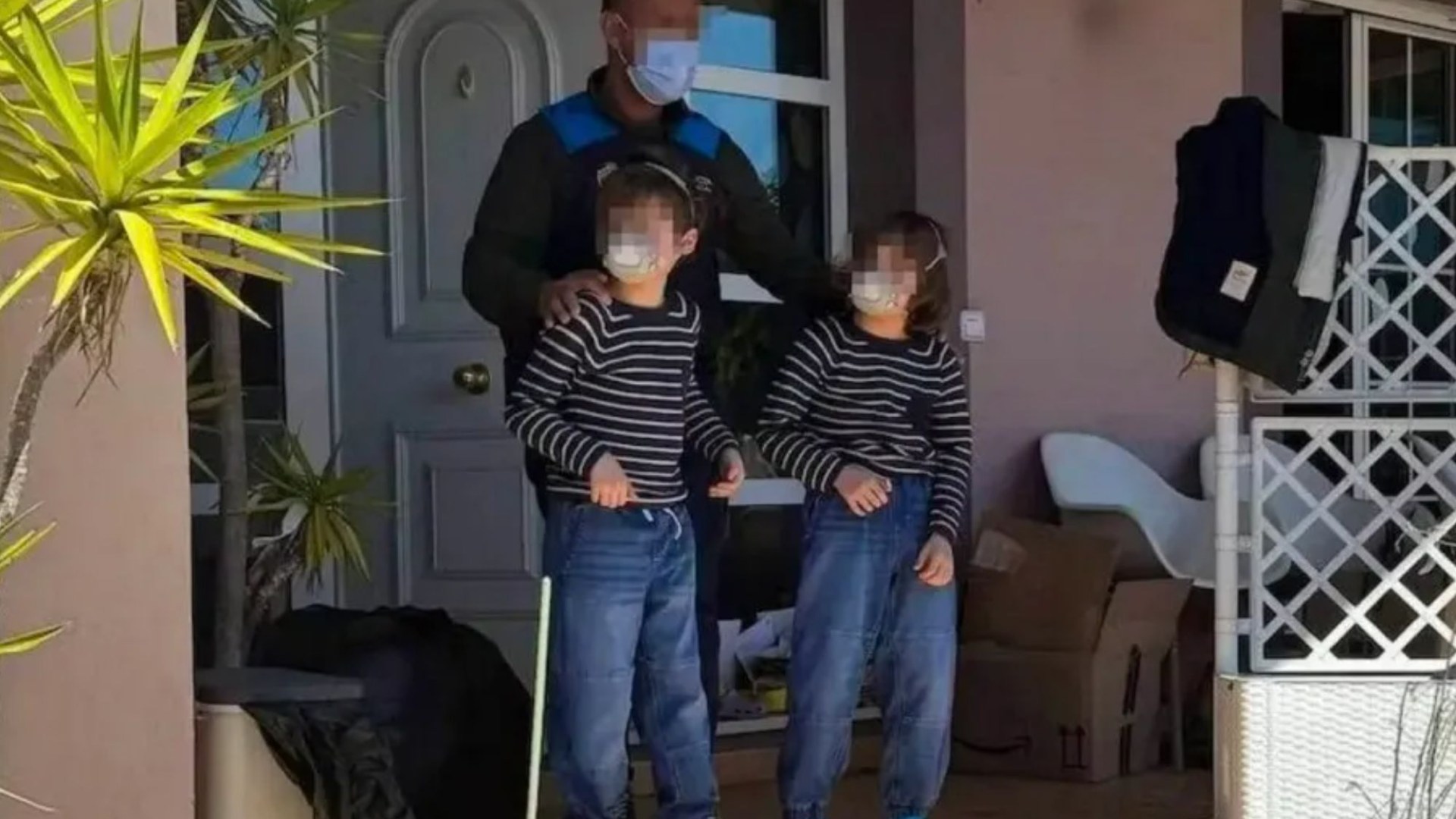
THE parents accused of trapping their three children inside a Spanish “House of Horrors” during a four-year Covid lockdown went on trial today.
German freelance tech recruiter Christian Steffen, 53, and his American-born wife Melissa Ann Steffen, 48, face more than 25 years in jail each if convicted.
The youngsters’ ordeal only came to light after their parents were arrested in April last year at a rented villa in an upmarket neighbourhood of Oviedo at the foot of Mount Naranco.
Inside, cops found two twins aged eight and their 10-year-old brother who had allegedly been kept shut away from the world for nearly four years.
The children were suffering from chronic hunched backs, bowed legs and “severe constipation” after being forced to wear nappies with limited toilet breaks.
They may well have been trapped for many more years if not for a wily neighbour, who kept a detective’s diary logging Christian’s suspicious activity.
She eventually handed over the notebook to police, who raided the home and freed the children.
The couple today appeared before judges at the Audiencia Provincial Court in the northern city of Oviedo for a trial expected to last two days.
But the dramatic hearing is being held behind closed doors after prosecutors asked for the press and public to be barred.
Judges agreed because of the seriousness of the allegations and the possible “unfavourable consequences” publicity could have for the pair’s three children.
Hamburg University philosophy graduate Steffen was the only registered occupant of the house he and his naturalised German wife began renting at the end of 2021.
The pair had moved to Spain after leaving Germany amid reports they emigrated when officials refused permission for them to school the children at home following the Covid crisis.
Both have been held in Asturias Prison since being remanded in custody shortly after their arrests, while their children remain in local authority care.
Prosecutors say the couple should be jailed for a total of 25 years and four months each if convicted.
They face a charge of “habitual psychological violence within the family environment”, which carries a possible sentence of two years and four months.
They are also accused of three counts of unlawful detention linked to family abandonment, one for each child, which could see them jailed for seven years and eight months for each offence.
Prosecutors said in their indictment ahead of the trial: “The accused, by mutual agreement, failed to fulfil their duty of care towards their children and deprived them of their educational, health, emotional and social needs.
“They locked the minors up inside their home and isolated them completely from the rest of the world, denying them contact with other people both physically and through other forms of communication.
“The children didn’t even know their relatives or any other people who weren’t their parents.
“They never went outside, not even to the garden of their home, for almost four years because of the unfounded fear the accused had, and they had instilled in their children, that they might be infected with something.
“The accused never enrolled their children in school in Spain and learned by themselves or with the help of their parents, with the result that the younger children, aged eight when they were found, didn’t know how to read or write.
“Furthermore, the children did not receive any health monitoring: the last time they saw a doctor was in 2019, and it was the defendants who were responsible for diagnosing and treating their problems when they arose.
“They had a large supply of medicines at home, purchased without the required medical prescription.
“Furthermore, the children also had problems with bladder and bowel control, caused by the prolonged and improper use of nappies.
“The home was in poor condition, with a significant lack of cleanliness and large amounts of rubbish and dirt accumulated in various rooms.
“In addition, the furniture was inadequate to meet the children’s needs: the twins slept in cots, the bars of which they had broken so they could get in and out freely.
“Their brother slept in a bed that was too small for his age.
“The children walked hunched over, with bowed legs, had difficulty going up and down stairs, and had irritated skin and onychomycosis.
“One of them had a slight stoop. When they went outside, once their situation had been discovered, the children were surprised by their surroundings.
“As a result of these events, the children suffer from social dystocia, which will delay their incorporation into social relationships appropriate for their age.”
Melissa’s lawyer Javier Munoz told waiting media outside the court this morning as the trial was about to get underway: “There is no House of Horrors.
“What we have here is a case of voluntary isolation, a family that has not abandoned its children, quite the contrary.
“It has devoted itself to its children in a way that might be considered extravagant or unorthodox, but certainly not criminal.”
Christian’s defence lawyer Elena Gonzalez also said she was confident her client would end up being acquitted, insisting he was “not a criminal” and saying police should never have been involved.
As well as lengthy prison sentences, prosecutors want the couple banned from approaching or contacting their children and ordered to pay £13,000 compensation to each of them.
A university professor called Silvia, who lived next door, has been lauded after she noticed something suspicious about the house.
Silvia began compiling what has been described as a “forensic detective’s” diary after spotting what she thought was a little girl playing in the garden about 65 feet from her window.
She began noting the times curtains moved or blinds opened on the villa’s second floor.
She also repeatedly saw a bespectacled man leaving the property wearing a face mask to collect supermarket deliveries and takeaway food at the gate.
Her suspicions deepened as the number of deliveries grew and she began hearing what she believed were children’s voices.
When police studied her dossier they discovered the orders included nappies, sparking a decision to enter the property.
A city hall source told Spanish daily El Mundo: “The neighbour went to Oviedo City Council’s Childhood and Family Service on April 14 with what was practically a handmade police report.
“The shopping list was the clue that set it all off.
“It was the list of a family, not a single person, and there was something that didn’t fit at all which was the striking amount of nappies.”
The source added: “Without that neighbour, the children would almost certainly have gone undetected in that house for many more years.
“Some close neighbours didn’t even know the house was being lived in.”
Police say when officers finally freed the children, one of them knelt down on the grass and “touched it with amazement.”
The youngsters were placed in the care of regional social services.