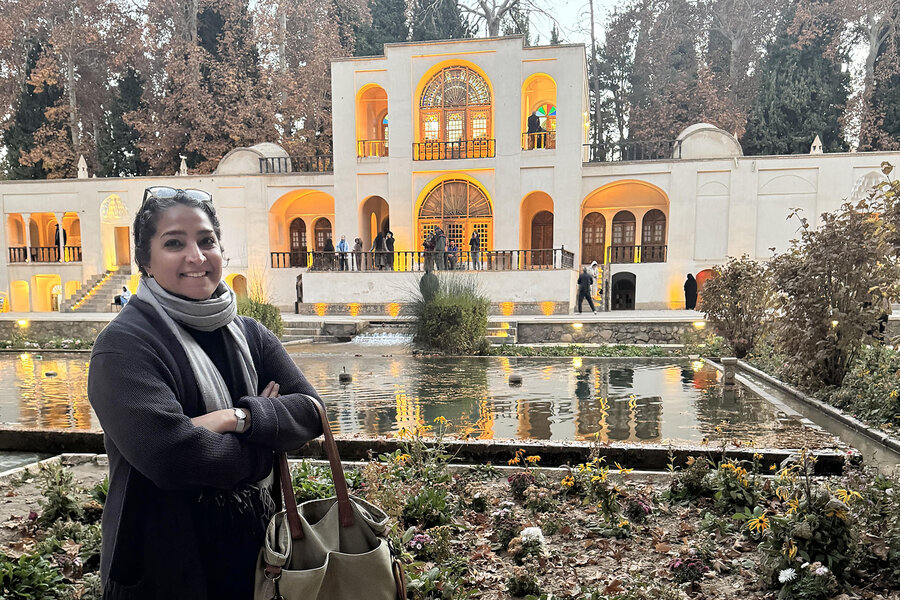
Like many members of the Iranian American diaspora, Kowsar Gowhari has followed the U.S.-Israeli military intervention in the land of her birth closely.
Since the attacks began Feb. 28, many of her relatives have fled the nation’s capital of Tehran for the relative safety of cities further south. Taken in by aunts, uncles, and cousins, they gather at evening time to break the fast of Ramadan, watch the latest war news, and argue about their country’s future.
“There are some who believe this government is done, finished,” says Ms. Gowhari, an attorney who lives and works in Rockville, Maryland. “My parents, what they really want is for Iran to stay independent and free of foreign intervention. They may be critical of the government, but they don’t want [President] Trump to destroy the place and to put in place a puppet government.”
Why We Wrote This
President Donald Trump has urged Iranians to “take over” the country once the bombing stops. But among Iranians who live abroad, the U.S.-Israel war is surfacing nuanced and differing visions on what kind of government it should have.
Here in the United States, Ms. Gowhari says, activists from various factions are attacking each other on social media, bullying shopkeepers and restaurant owners to promote their political agenda, and driving wedges in a community that she believes should be uniting instead.
Early Monday, Iran’s Assembly of Experts named Mojtaba Khamenei – the late Ayatollah Ali Khamenei’s son – as the country’s new supreme leader. A cleric, like his father, the new leader is described as “confrontational” and having close ties with the hard-line Islamic Revolutionary Guard Corps, with little inclination to negotiate with the U.S. or Israel.
The 10-day-old war in Iran – which has claimed about 1,300 lives thus far – has exposed deep divisions within the Iranian diaspora community. Crowds of Iranian Americans in Los Angeles danced in the streets to celebrate news of the death of former Iranian leader Ali Khamenei on March 1, while others voiced alarm over the military intervention of two foreign powers, the United States and Israel. These disagreements are expected to complicate any efforts to build consensus over Iran’s future government. But the diaspora appears to mostly agree on one thing: Iran has reached a tipping point.
“Iran has always been a melting pot with diverse views, and after the protests and the brutal crackdown, everyone is on the same page, left, right and center,” says Mohamad Machine-Chian, a researcher and author at the University of Pittsburgh, who grew up in Iran. “Forty years ago, people thought that the Islamic revolution was the way to go. Forty years later, they can see the disaster that has been created.”

While the Islamic Republic’s founder, Ayatollah Ruhollah Khomeini, was a charismatic leader capable of moving people with his oratory, his successor Khamenei built his power differently. “He created a loyalty market,” Mr. Machine-Chian says. “People would support him, but their cooperation always has a price.”
Iran’s oil wealth gave Khamenei powerful influence, but as U.S.-led sanctions took hold, Khamenei’s power base became tenuous at best. Mr. Machine-Chian says the assassinated leader’s son will inherit a much diminished power structure. “Without money, people may not stay loyal for long. Things can change very quickly.”
For the estimated 750,000 Iranian diaspora members living in the U.S., the war has brought both the prospect for change and the fear of personal loss. One of the more prominent groups supports the Crown Prince Reza Pahlavi, the son of the late shah who was toppled by Islamist and leftist protesters in 1979.
In recent remarks, Mr. Pahlavi welcomed the U.S.-Israeli military operation and called on Europe to provide its own support.
“The military operation is a humanitarian rescue mission and will save many lives,” he said. “Europe’s decision to proscribe the IRGC is welcome but it now needs to go further and support our transition plan to rebuild Iran.”
But no single political voice speaks for the Iranian diaspora, at least for the moment. Some Iranians seek a gentle reform of the present rule of Islamic clerics, while others seek an entirely secular government. Some have pushed for armed revolt against the Islamic regime, while others favor negotiation.
Jamal Abdi, president of the National Iranian American Council and a diaspora member, advocates for peaceful negotiation to help create incentives for the Islamic Republic to moderate its policies. “We’re very opposed to the war,” he says, adding, “The only way for Iran to have a government that represents the people is for the Iranian people to decide for themselves.”

Courtesy of Kevin Amirehsani
But he recognizes that with the brutal crackdown on street protests in 2025, the Khamenei regime made clear that it viewed the dissent as an existential threat. Estimates vary on how many protesters were arrested and executed between December 2025 and January 2026, but they marked the deadliest period of repression in decades.
Kevin Amirehsani, an economist who works in the Colorado state government, is a second-generation Iranian American. He has followed the news intently and advocated for diplomatic engagement with Iran, rather than military pressure, which he says can only strengthen the resolve of the Iranian regime. Since the war began, he says, his parents are checking in on aunts, uncles, and cousins in Tehran and north of the capital.
Like Ms. Gowhari, Mr. Amirehsani says the regime’s crackdown on dissent and the subsequent war have polarized debate within the Iranian American community. As a member of Mr. Abdi’s NIAC, he has helped redouble their efforts to push the U.S. government to seek nonviolent solutions, while others are drawn to the banner of monarchists.
“The general vitriol online and in person is going up rapidly,” he says. But as the Israeli and U.S. bombing campaigns have spread from Tehran to dozens of other cities across Iran, he has seen many Iranian Americans who were vocal supporters of military intervention going silent online. “After constant bombing on the streets, and after the attack on that girls school [on Feb. 28], it has started to hit home.”
For Ms. Gowhari, the war puts her in a difficult position as an American of Iranian descent. On one side, she desperately wants the country of her birth to be free of oppression. But she cannot support a war that will likely kill many civilians, including possibly family members. The bombing of the Shajareh Tayyebeh girls’ school in the southern city of Minab, with young girls accounting for most of about 165 reported deaths, is an ominous sign of the heavy price that civilians pay during wartime, she says.
“The Iranian diaspora was worried about the U.S.’s record when it comes to intervention in Iran, but there are people who still advocated for military intervention,” Ms. Gowhari says. “But now, with bombs striking civilians and hitting school children, people are seeing the cost of that advocacy.”