President Donald Trump has injected plenty of uncertainty into the world economy with his trade policies and tariffs, interventions in Venezuela, and withdrawal from major global institutions. But his war on Iran might prove to be his biggest jolt yet to financial markets.
As the war entered its second week, with no end in sight, and Iran standing firm against the U.S. and Israeli bombing campaign, oil prices soared, and stock indexes fell in much of the world.
Then came some rebound as stock investors focused on hopes that Mr. Trump would find an off-ramp from war before damage to the global economy became too severe.
Why We Wrote This
Oil prices retreated below $100 a barrel on Monday, on investor hopes that the conflict in Iran will end relatively soon. But energy costs remain elevated, and volatile markets are a sign of uncertainty for the global economy.
Over the weekend, benchmark Brent crude prices soared from $92 a barrel to more than $119 before settling back below $90 by Monday’s end. That’s the highest level in four years. The VIX, a measure of market volatility from the Chicago Board Options Exchange, reached its highest point since last April, when Mr. Trump implemented his broad-based “Liberation Day” tariffs. And stock indexes fell around the world, including Japan’s Nikkei (down more than 5%) and Germany’s DAX (down nearly 1%).
American stock indexes plunged at their morning opening but recovered by the end of the trading day as governments weighed options to ease oil-price pressures, and as comments from the president struck a more positive tone. The U.S. “could do a lot” about the stall in oil tankers passing through the Strait of Hormuz, he told CBS News in an interview, without sharing details. “We’re very far ahead of schedule” on the U.S.-Israeli offensive campaign against Iran, he added.

Meeting in Geneva on Monday, some of the world’s most economically powerful democracies, known as the Group of Seven, considered jointly releasing oil from their strategic oil reserves. They ultimately put off the move, as Mr. Trump is reportedly considering a range of options to ease gasoline prices, which have soared from a national average of $3 a gallon to $3.48 over the past week. This could include drawing down strategic reserves or limiting exports of U.S. crude.
Whether the war will wind down speedily remains uncertain.
“Sometimes, you get these conflicts where you’ve got one power that has overwhelming technological and military advantage and you expect the job to be done quickly. And it isn’t,” says Campbell Harvey, a finance professor at Duke University and author of the 2021 book “Strategic Risk Management.” Then “people think that the U.S. might get into a longer term conflict, even if boots are not on the ground. This greatly increases the risk.”
That’s especially true of wars over energy. Oil and gas play a key role in powering economic growth globally. When supplies are constricted or cut off for more than a few days, the risks to growth around the world rise.
Ed Yardeni, a market strategist, has raised the odds of a U.S. stock market meltdown this year from 20% to 35%.
Iran’s moves over the weekend and the responses from the United States and Israel have heightened tensions.
On Sunday, Iran replaced its supreme leader, Ayatollah Ali Khamenei, who was killed in joint U.S.-Israeli airstrikes, with his son Mojtaba Khamenei. Mr. Trump, by contrast, had been pushing for a say in the choice of leadership.
“I’m not going through this to end up with another Khamenei,” he told Time magazine on Wednesday. “We have to make sure it’s somebody that’s reasonable to the United States.”
Secretary of Defense Pete Hegseth echoed the president’s hard line in an interview with CBS’ “60 Minutes“ on Sunday, during which he predicted more U.S. casualties in the war. “It stiffens our spine and our resolve to say this is a fight we will finish,” he said.
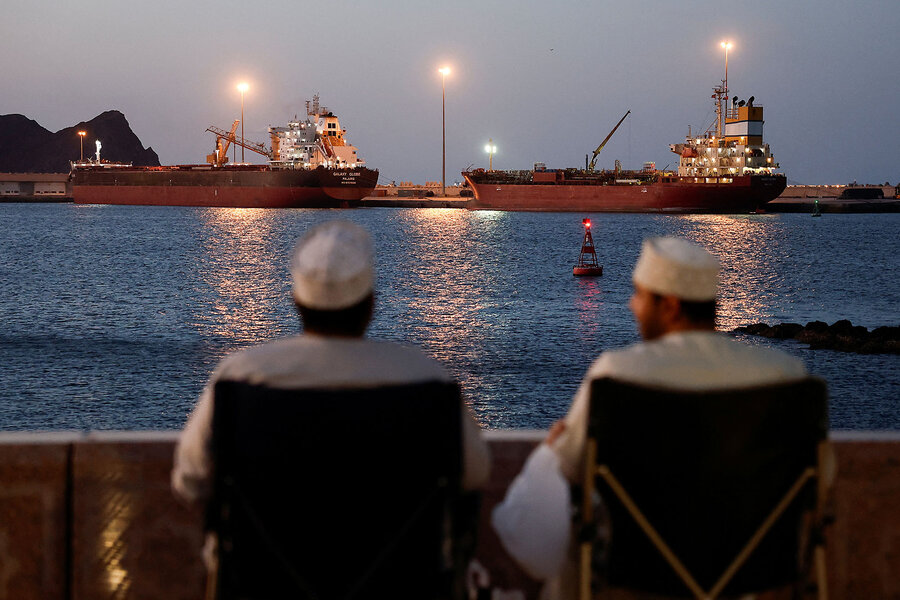
Besides closing the Strait of Hormuz, which normally handles one-fifth of the world’s oil shipments, Iran has begun targeting the infrastructure of its Mideast neighbors. Those include attacks on an oil facility in the United Arab Emirates, a thwarted drone attack on a huge Saudi oil field, and a strike on Bahrain, which was followed by a fire at its only oil refinery.
Such attacks will prolong the drag on the economy from high energy prices, economists point out, since it will take much longer to repair facilities than it would to reopen the Strait of Hormuz.
The U.S. has said it will not attack Iran’s oil infrastructure. But over the weekend, Israel hit three oil depots and a refinery in the vicinity of Tehran.
If these strikes continue, they could send oil prices spiraling even higher. High oil prices, in turn, could send the U.S. and other major economies into recession if they remain elevated long enough.
On Monday, though, market sentiment tilted toward hope by the end of trading.
“We expect the U.S. to declare victory fairly quickly and the Administration will likely focus on re-opening the Strait,” David Kelly, chief global strategist at J.P. Morgan Asset Management, emailed in an analysis on Monday. “Futures markets apparently expect them to succeed, with the June [West Texas intermediate] contract on Friday trading at $82.56 [per barrel] and the December 2026 contract trading at $69.07.”
The Standard & Poor’s 500 stock index closed up 0.8% for the day.