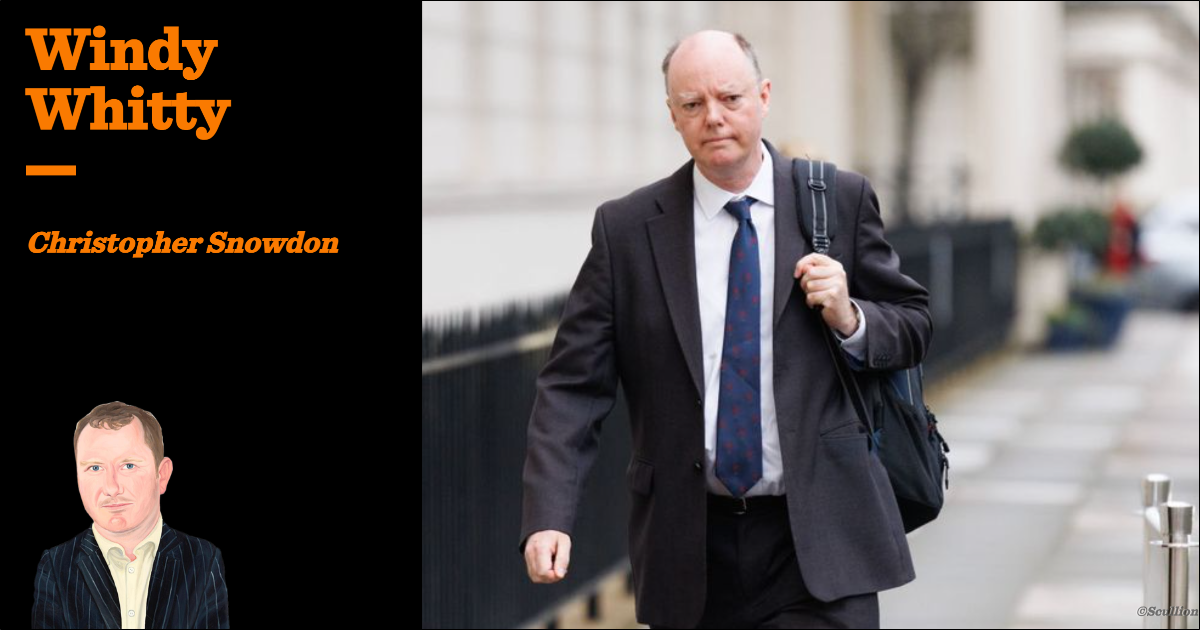

Speaking at the Medical Journalists’ Association annual lecture last week, the Chief Medical Officer Professor Sir Chris Whitty took at pop at “fat jabs” such as Mounjaro and Ozempic. Thrashing away at a strawman of his own construction, he asked: “Does anyone in this group believe that the correct answer is to allow obesity to rise because of pretty aggressive marketing of obesogenic foods to children and then stick them on GLP-1 agonists at the age of 18?”
“Just relying on the drugs seems to me the wrong answer,” he said. To which we might ask, who is just relying on the drugs? Not the public, most of whom manage to avoid “living with obesity” by controlling their appetite and doing a spot of exercise, and certainly not the politicians, who have saddled Britain with the most extensive set of anti-obesity policies anywhere in the world.
While complaining about the “aggressive marketing of obesogenic foods to children”, Whitty neglected to mention that adverts for HFSS food (high in fat, sugar and salt) have been banned during children’s programmes on television for twenty years and are now banned during all programmes before 9pm and on the internet around the clock. Nor did he mention the sugar tax, introduced eight years ago, or the traffic light labels on food products, or the food reformulation scheme, or the mandatory calorie labelling, ban on volume price discounts and ban on supermarkets putting HFSS products at the entrance, exit or end-of-aisle.
Successive governments have capitulated to the “public health” lobby at every turn, but this can never be admitted by the likes of Whitty because it would raise the question of whether any of these policies have worked. Record levels of obesity would suggest that they have not. GLP-1 drugs, by contrast, have demonstrated their effectiveness in both clinical trials and real world conditions. If evidence-based policy was more than a slogan, Whitty would be asking why we are wasting our time messing around with advertising when we have a proven remedy for obesity. Instead, he is asking the opposite question:
Really, is our answer to say ‘give up on public health’, which we know will work, in children and then just rely on drugs to get us out of a hole? I do not think this is a socially acceptable answer.
“Which we know will work” is doing a lot of heavy lifting here. It is telling that he used the future tense, presumably because saying that they have worked — anywhere — would be too blatant a lie. But if they haven’t worked anywhere, why should we believe that success is just around the corner?
Those who remember Sir Chris from the pandemic, when he was plain old Professor Whitty, may be surprised at his sudden rejection of pharmaceutical interventions. Back in 2021, he never said “Is our answer to give up on lockdowns, which we know will work, and then just rely on vaccines to get us out of a hole?” Admittedly, he tried to bounce us into a fourth lockdown at Christmas by pretending not to know that the Omicron variant was relatively mild, but the general message was that pharmaceuticals were the pragmatic substitute for unsustainable behavioural change. The vaccine roll-out was not us “giving up on public health”. It was public health.
I have argued before that institutional resistance to GLP-1s is an example of Not Invented Here syndrome. The “public health” plan was to treat obesity like smoking and portray Big Food as the new Big Tobacco. This was doomed to failure because obesity is not at all like smoking and most anti-smoking policies don’t make any difference anyway. Fat jabs do make a difference but they were not in the script, and the “public health” establishment is not going to rip up their playbook just because they’ve finally found something that works. Chris Whitty, who is the embodiment of the orthodoxy, relies on the conceit that there is a “public health” approach to obesity that will achieve what the drugs do without the expense and side effects, if only the government would allow it to be tried.
When asked what the “public health” approach means in practice, its proponents can only point to things that have already been tried (such as food advertising bans) or which are so vague and impractical as to be meaningless (such as “changing the obesogenic environment”). But Whitty claims that there is at least one country that shows that his approach works: France.
It’s perfectly possible to turn this around. Other countries have managed it and I think we should be aiming to look at the countries which have and I would start with France, because it’s just across the Channel, and it’s very clear that they have succeeded.
Whitty told the conference that obesity rates in France are “pretty well the same now as they were in 1990”. None of the medical journalists in the room bothered to check this claim and it is not true. The obesity rate doubled in France between 1997 and 2020, from 8.5 per cent to 17 per cent. But that is still significantly lower than in England where the rate was 28 per cent in 2020, so perhaps there are lessons to learn.
So what has France done to keep obesity down? In 2013, it introduced a stealth tax on sugary drinks at the trivially low rate of €0.07 per litre which was raised last year to a level similar to that of the UK. It has a ban on food and drink vending machines in schools. And that’s about it. There are no restrictions on food advertising on any platform. There is no mandatory calorie labelling, no ban on BOGOFs and no edicts telling shopkeepers where they can place their products. Compared to Britain, France practices laissez-faire. Other countries with relatively low obesity rates, such as Italy and Spain, do even less.
The reasons why much of Europe has less obesity than Britain are hotly contested. Maybe it is because they take cooking more seriously than we do. Maybe it is because they snack less. Maybe it is because they smoke more. Maybe they just have a bit more self-respect. Whatever the reasons, they have nothing to do with government policy, let alone “public health” policy. By appealing to the French way of life, Whitty is essentially saying that if he were in charge he would simply turn Britain into a different country. As a practical proposition, this seems about as feasible as the desire of American leftists to turn their country into Denmark. Insofar as there is a solution to obesity, advising the British public to eat less, do more exercise and if that doesn’t work, try Mounjaro, seems more realistic that telling them to be French